I studied diplomacy and law, but currently I am following my deepest passion which is being a writer. I have experience as a dancer in flamenco, belly dance, and ballet, and it is my pleasure to write about dancing!
Flamenco is among the most well-known dances worldwide, with its passion, rhythm, and vibrancy. That’s why today, we want to introduce you to some of the best and most famous flamenco dancers of history. Each contributing by embodying this art form, capturing its essence and spirit in their own ways.
Joaquín Cortés
Joaquín Pedraja Reyes, better known as Joaquín Cortés, born in Córdoba in 1969 into a gypsy family, is a dancer, choreographer, director and producer. He has been listed among the best ten dancers of the 20th century by numerous international rankings.
He was admitted as a member of the National Ballet of Spain at 14 years old. With this company, he travelled to many cities around the world and by the age of 16 he was promoted to the category of soloist. He performed as a principal dancer until he was 19.
In 1988, he decided to leave the Spanish National Ballet and began to be invited to numerous galas, events, theatres, and shows in places like Paris, New York, Russia, Italy, and Tokyo. Being acclaimed by the critics and the public, he made his own company: Joaquín Cortés Ballet Flamenco and, in 1992, he created his first work “Cibayí”.
His style: spectacular, dramatic, and avant-garde but with details and flashes of a pure beauty.
Shōji Kojima
Shōji Kojima is a world-renowned Japanese flamenco dancer who was born in Tokushima, Japan, in 1939. His art and his roots have brought him to the top of the international flamenco world.
This flamenco master with Japanese roots is a graduate of Musashino Academia Musicae, where he studied vocal music, piano, classical ballet, modern dance and got to know the world of flamenco. In 1966 he moved to Spain via the Trans Siberian Railway, determined not to return to Japan until he became the best flamenco dancer.
Once settled in Madrid, he began learning flamenco. In 1967, he was elected a member of the Spanish National Ballet Company and toured the Soviet Union on the Spanish-Soviet cultural mission. Just the following year he was recognized by the cantaor Rafael Farina and debuted as the first dancer of a full-length show of the cantaor’s company.
Farruquito
Juan Manuel Fernández Montoya, known worldwide as Farruquito, is the son of flamenco singer Juan Fernández Flores “El Moreno”, and flamenco dancer Rosario Montoya Manzano, “La Farruca”.
Farruquito is heir to a unique school founded by his grandfather, so he was born and raised in the purest Flamenco art. His debut on the international scene was at the early age of 5, on Broadway with the show Flamenco Puro.
At 11 years old, he first appeared on television in the video “Camarón Nuestro” and then appeared in the next year’s movie by Carlos Saura’s “Flamenco,” alongside with his grandfather-El Farruco. In 1992, he engaged in the Opening Ceremony of the Paralympics in Barcelona as a continuation of his artistic voyage. He also demonstrated his skills together with his grandfather at the Spanish Pavilion during the International Exhibition in Seville in a performance termed “Presente, pasado y futuro” (present, past and future).
The death of the patriarch in 1997 meant that Farruquito took over to perpetuate the lineage. Thus, when he was only 15 years old, he created his first show, Raíces Flamencas.
María Juncal
María Juncal is a leading flamenco dancer in Spain and around the world. She was born in 1981 in Palma de Gran Canaria.
She was born into a family of flamenco blood, the Borrull family, in Las Palmas de Gran Canaria. There she began her studies of Ballet and Classical Spanish Dance with the choreographer and prima ballerina of the Liceo de Barcelona; her great aunt Trini Borrull. She moved to Tenerife and worked with the Ballet de Cuba.
In Madrid, she studied with Flamenco masters El Güito, Ciro, Cristóbal Reyes, Merche Esmeralda, and La Tati and was part of El Güito’s company, touring Spain and France and finally moving to Manolete’s company. She is a soloist in the USA with the National Theatre of NY and performs in Boston, Chicago, Kansas, New York, and Minnesota, among others.
She starred in Musa Gitana, directed by Paco Peña in Europe and China, and worked as assistant director and soloist in the show España Baila Flamenco by Cristóbal Reyes.
Sara Baras
Sara Pereyra Baras, born in San Fernando, Cádiz, on April 1971, is known as Sara Baras; Spanish flamenco dancer and choreographer and director of her own dance company.
This great dancer began her artistic training in San Fernando in the school of Concha Baras, her mother and first flamenco teacher. It was precisely with the dance group directed by her mother and the work Los Niños de la tertulia with which she made her stage debut. It was a time when the artist from Cadiz shared the stage with greats such as Camarón de la Isla.
The company of Manuel Morao, and the television program Gente Joven in which she won the first prize at the age of 18 came later. But it was when she decided to complete her training in Madrid that Sara Baras began to perform regularly, surrounded by other outstanding dancers.
The National Dance Award 2003 and the Gold Medal of Andalusia 2004 are some of the many awards that figure in the career of this spectacular artist.
Antonio Canales
Born on December, 1961 in Seville, known as the birthplace of flamenco music, Antonio Gómez de los Reyes, better known as Antonio Canales, comes from a lineage of artists. He spent several years dedicated to dancing in the National Ballet before becoming a soloist. He left the National Ballet and went to Paris, where he became a member of Maguy Marín’s ballet. In addition, he served as a lead choreographer of the Versalia festival in the city of Italy during that time.
He is a world-renowned dancer who participated in about fifty creations as the main dancer and was present at various international galas. In the 80’s and 90’s, he won awards for his In 1992, Antonio took a pivotal step by establishing his own dance company. A debut in Bilbao featured mesmerizing choreography.
So there you are, some of our top picks on some of the best flamenco dancers, we hope you found them inspiring.
As a dancer, many times during class, my mind would start to wonder about the origins of that new bellydance step that the teacher was teaching. Where the flirtatious arm movements came from, the origins of instruments such as the veil and the saber, and why it is so mysterious and bewitching for viewers?
I have Arab heritage and given how Arab culture can sometimes be quite closed and traditionalist I have always found it amazing that belly dancing can be loaded with so much sensuality, More so than many other dances. Today I want to share with you, everything I found about it in my own research.
Enjoy this journey to ancient times!
The basis of Arabian Dance Movements
The center of the Arabian dance lies in the hip, which is adorned with movements of the head, shoulders, arms and, naturally, the belly.
The spectacular nature of this dance lies in the synchrony of the hips with the music and the emotion that the dancer conveys, while the variety of steps and the dramatic effects are what make it striking.
In oriental dance, the movements are sinuous and rhythmic, the legs never rise above the level of the hips.
To dance, our ear must become accustomed to the rhythms of Arabic music, which has very different from Western tempos, as it consist of series of irregular minor patterns that we dancers must learn to follow and even anticipate.
The Origins
The prehistoric origins of belly dance are a bit murky, but documented evidence takes us back to Egypt during the time period between 1200 and 1300 B.C., when this form was used by priestesses in the banks of Nile River
Fragment of Painting from Tomb of the Dancers. By Jon Bodsworth, Copyrighted free use, via Wikimedia Commons
Those were times in which life passed as an incessant becoming, in which eternity was bathed by the waters of the Nile. Surrounded by a fertile land, by multiple magical gods, by a civilization in which glory was expressed with magnificent pyramids that sought to touch the sky.
Egyptian women danced both to pay tribute to the gods, to accompany the funeral processions, to celebrate and honor the pharaohs and to entertain at feasts and banquets.
One of the key themes in the oldest form of Arabian dance is one of human fertility being thought to be directly related to the earth. Women were attributed magical powers.
For example, in Central Anatolia and the Mediterranean (Turkey), thousands of years ago women had ritual dances in honor of these magical powers. Men were excluded from these rites.
Also, there were many fertility dances in Ancient Rome and Greece were dancers performed movements based on the rotation of belly and hips, and many of said dances were made in honor to goddesses from Syria and Turkey.
In Cyprus, birthplace of Aphrodite, women performed ritual dances accompanied by songs and percussion through which they put themselves in a trance.
These same rites of honouring gods, seeking fertility, took place in Mesopotamia, Phoenicia, Egypt, Arabia and India. During the 4th century A.D., Christianity came to dominate the Middle East, establishing a patriarchal society based on a male God and prohibiting all such female dances.
The changes
The Copts, who are Christians from Egypt, preserved the continuity of this dance through clandestine performances, incorporating certain modifications to align it with their newly adopted religious practices.
Some time after, the slaves took the dance, the songs and the music out of the temples, although the performers have not been able to remove the stigma attached to their profession.
Later, at the beginning of the Middle Ages, Islam was established, which signified a new eradication of dance in the streets. Resurfacing in the 18th century within the context of slave communities, this dance underwent a revitalization.
Subsequently, the influx of Turkish people, primarily consisting of individuals with enslaved backgrounds, contributed to the enhancement of its technical intricacy.
These slaves, retained in the ancient medieval caliphates, represented their power, so the beauty and skills of the dancers (singing, poetry, recitation) were valued.
These dancers were called awalim, highly respected and influential among the caliphs; they performed in the houses of rich people accompanied by denay, oud, qanun and tabla, while they interacted with zagats and swords of some spectators. Their shows were even complemented with snake charmers and magicians sometimes.
There was also another type of dancers, the ghawazee or Egyptian gypsies, who danced in the open air for audiences of lower social class, accompanied by nay, oud and tabla. The ghawazee are characterized by their preservation of the aesthetic essence of the dance, as well as the spiritual aspect of it.
These dancers often shared stage with magicians, minstrels and fortune tellers (they themselves made coffee reading) and their belly dance costumes have a lot of bright colors, ornaments, cons, pendants and bracelets. Their origin is Phoenician.
Origins of moves
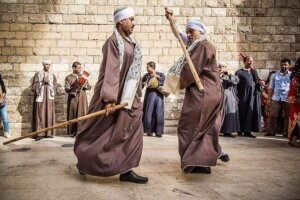
In its passage through different regions and epochs, the oriental dance was picking up steps and elements. For example, the cane used in oriental dance was taken from the tahtib dance, a kind of martial art of Egyptian men. The cane dance is known as raqs al asaya.
Tahtib. Adelbayoumi, CC BY-SA 4.0, via Wikimedia Commons
Egyptian Tahtib is said to be one of the oldest martial art in the world. Its full name is fann el Nazaha wal Tahtib, which means, “pursuit of righteousness through tahtib”. It consists of a combat between two or more opponents using a reed stick, tahtib, which measures between 1.30 and 6 meters long.
The tahtib dance is performed to the accompaniment of live music, to the Arabic rhythm of saidi, and includes jumps and gestures of blows, without contact with the body.
From the Persian dance, the delicate cadenced movements of the fingers and part of the coquetry with shoulders and arms were taken. In classical Persian dance, the dancer entered a state of higher consciousness in communion with the supreme being, to whom she dedicates the upward movements of her arms.
Likewise the shoulder shimmies when turning and the movements with the fingers apart are used in the Iranian dance known as bandary.
With respect to the saber, although it is believed that it was an element incorporated relatively recently to the dance, there are visual references of dancers with scimitars from the late nineteenth century, as this painting by the French orientalist painter Jean-Léon Gérôme entitled “Dance with saber in a cafe”:
Sabre Dance in a Cafe by Jean-Léon Gérôme, 1875. Source: PubHist.
The dance in which a tray with candles is balanced on the head was taken from the Moroccan dance known as raqs al seniyya, in which a tea tray is used.
This illustration by Charles Saalburg from the Chicago newspaper “The Inter Ocean” of 1893 shows different Midway Plaisance scenes from the Columbian Exposition held that year in Chicago. In the center appears a dancer balancing a tray with candles or a candelabra on her head, which could be raqs al shamadan but also raqs al seniyya.
Finally, the veil, one of the most magical elements, has been present in oriental dance since ancient times, as evidenced by this bronze statue from the Hellenistic period of a veiled dancer from the 2nd or 3rd century BC:
a veiled dancer, from Greece. 3rd–2nd century BCE. Source: MET Museum
I hope this article has served to bring some light about the many mysteries that belly dancing has to offer. Until next time!
Other articles about Bellydance and Arabian dance:
Christmas is around the corner, and if you are a Ballet enthusiast like me, you probably know that The Nutcracker recital has come to almost every city around the world.
If you need to become more familiar with it, then let us introduce you. The Nutcracker is an old but beautiful ballet performed each year and full of capturing stories about magic land. It was set on a Christmas Eve by Tchaikovsky, with legendary Marius Petipa and Lev Ivanov as the choreographers, and is an adaptation from E.T.A Hoffman’s story.
This classical ballet has many dance pieces from different cultures, like Spanish, Chinese, Russian, and Arabian. “The Arabian” dance in The Nutcracker is what this article will concentrate on today. It is an intriguing and elaborate scene inside this whole ballet and opens the audience up to different cultures, through the various the dance styles.
As someone experienced in both ballet and Arabian dance, today I hope to demystify this dance in the Nutcracker a little, as well as how all of these elements influence audiences and viewers.
A version of The Nutcracker dance by the City Ballet Academy. See an alternative interpretation here by the Boston Ballet. Both lack some of the elements originally true to the performances of years past.
The Westernization
The Nutcracker was first introduced in 1892 at the Maryinsky theatre in St Petersburg. Through the ages, this ballet experienced various choreographic transformations in response to the evolving audience’s taste. “Arabian” dance, a passage of the second act, is probably the most famous one.
The notion of orientalism in discussions regarding the dance is the Western view (specifically the British, French, and Americans) – a animated version of the Middle East:
“a place of romance, exotic beings, haunting memories and landscapes, remarkable experiences” (French Journalist 1975).
Its an image that originally held of the Middle East—a romanticized land inhabited by people who seem different to the typical Westerner in a seemingly eerie setting. Similar to the Orientalist dichotomies, this fictionalized Orient creates one homogeneous identity type characterized by its essence. “Arabian” dance comes as an interpretation of some exotic aspects of Middle Eastern culture but in the style of Western performance.
Editors note: It’s worth saying at this point that what is being described are ‘original views’ of a western society from around 130 years ago, at a time when the Nutcracker was first released and society was less global in its outlook. Today ballet companies are adjusting these particular Acts in the Nutcracker to reflect a more modern, inclusive audience.
Choreographic Variations
The Arabian dance has many variations, some of them have “Egyptians Marilyn Monroes” in pointé, some other focus on the “sultan and harem” scene, portraying a stereotype of lazy men and eager to please women. For example, the typical portrayal of the male forms the foundation of another comedic harem storyline of this ballet. This narrative was a recurring feature in the Louisville Ballet’s Nutcracker for many years.
It depicted a turbaned man adorned in harem pants and a sparkling vest, accompanied by a woman who, while potentially his wife, assumed the role of his servant. The man ostentatiously sipped coffee while the woman dutifully trailed him, replenishing his cup as necessary. She also engaged in acrobatic feats, such as supporting his cup on her extended foot as she lay on the floor or on her bare stomach during a backbend, effectively transforming herself into a makeshift table. We were trying to find a video of this somewhere but are struggling, if you come across one, please share with us.
Nonetheless, some other versions have a regal look, or an enigmatically cerebral air. The choreography of the Arabian dance has a “vocabulary” of difference, with movements that feature supine postures and angled limbs that have been part of the orientalization of ballet since the nineteenth-century Romanticism period, when the fantasies of fancy harems where the trend. Of course, much of what was originally featured is less inclusive for todays modern audiences and hence ballet companies moving their choreography on.
Interestingly, there is not a single form for what is called the Arabian dance. It has been reworked by different choreographers since it premiered and some of these do go against the normal conventions. Slow-moving and dreamy dances choreographed differently are typical for these sections. Balanchine decided to work it differently, with uncharacteristic briskness that challenges the norms of this specific dance piece.
The movements… are they really Arabian?
Photo by Vidal Balielo Jr. via Pexels
Even with the many differences, the traditional version usually comprises unique steps that have been persisted through various productions of The Nutcracker. These include distinctive “Egyptian” angled arms, resembling images painted on the old Egyptian vessels. Also, a deliberate slow walking style that has dipping or bobbing motions trace back to the bharata natyam, which roots to ritualistic ambiances.
The “prayer” gesture that involves palms being joined together on the chest or above the head seems more aligned with the dance forms from India other than those of Arabian origin. The lack of precision in the use of “Arabian” is evident within Clara’s dream world and, indeed, in the broader Western context.
Musical Accompaniment and Emotional Impact
Image via pexels by Valeria Boltneva
To craft the “sweet and enchanting” music requested by Petipa for the “Arabian” dance, Tchaikovsky initiated the composition by incorporating an aged Georgian lullaby, infusing it with a gentle yet persistent rhythmic motif. The outcome conveys an ambiance often described by musicologists, without apparent controversy, as “Eastern languor.”
However, the music’s background is quite intriguing. The lullabies of Georgian origin, which have been sung to cure sick children through history, give earthiness to the dance and create a magical mood. There is no doubt about the relationship between the music and the emotional effect of the dance, which has an additional depth to the overall experience.
This further reiterates that the Arabian Dance elicits emotions from audiences. In essence, for many, the dance represents the mystical world into which people are temporarily transported; hence the ability to mesmerize the audience. The link to healing traditions as well as the earthly aspects of the songs give another touch of interest for the audience interaction with the performance.
In short…
The Arabian dance in The Nutcracker is an intricate exploration of cultural performance and choreographic creativity within ballet. As an ever-changing art form, it goes beyond any set definition and contains different choreography that ranges from traditional representations to mysterious rituals. The evolving nature of this dance challenges conventional norms.
In essence, this dance piece serves as a poignant illustration of how artistic interpretations can shape and, at times, misrepresent cultural traditions. It compels one to think about the continuous Western practice of romanticism and Orientalizing the East, which is now requiring a more true to life representation of different cultural articulations in the realm of ballet. This of course all changes over time and so does ballet, to reflect new societal norms.
Arabian dance, just like the many other dance styles, is not only about the movements. It has a wide range of costumes and accessories like the sword, the veil and tambourines. They fill the stage with glitter, and are laced with sequins to make an impact in front of the public.
These costumes have been created to make each movement stand out. The best known Belly dance costume is very sensual, with a pronounced neckline, but not all of them are like that. We have in other articles looked at what is belly dance and famous belly dancers – In this article we’ll give you a wider taste of the heritage and splendour of the many dance costumes styles used in Arabian dance.
According to the rhythm that is performed, the bodice changes. Sometimes a transparent vest is placed on top of the bodice. The dancer’s abdomen is always uncovered so that her movements can be shown off. There are thousands of designs around the world, usually with sequins to shine in conjunction with the stage lights.
Belts
In addition to being used in rehearsal classes, they are also used in dance or performance costumes. These as well as the bodice are designed in Egyptian fabric and sequins or lace according to the taste of each dancer.
The hips move quickly and with force in each movement. That is why the belt must have clothes fastenings in the back, so that it does not come loose while dancing. You have to be very careful about that.
Skirts
The skirt is the element that gives the softness and style to the dance costume, as it has lace at the bottom. It can have a short or long opening at one or both sides, but most of the time the skirt must show a part of the leg, and not precisely to show sensuality. It must be like that so the dancer can move with ease around the stage with greater confidence.
Turkish and Egyptian Arabian dance costumes
The most popular producers of Arabian dancing costumes are Egypt and Turkey. However, each has things that make them unique.
Turkish costumes exude an ethereal quality, characterized by their airiness, shimmering textures, and remarkable flexibility. Their construction is often minimalist, incorporating wired frames beneath delicate fabrics for both belts and bodices. This unique design enables costume artisans to craft shaving shapes along the edges of these essential components.
The artistry doesn’t stops there; sculptural effects adorn the body of these costume through intricate beadwork and sequins. Three-dimensional marvels come to life as row of sequins are meticulously sewn with bead spacers, forming captivating floral, butterfly or star patterns.
The pursuit of subtle iridescence is realized through the delicate overlay of sequins. The ensemble is further elevated by the inclusion of delicate fringes, varying in length, bead colors and sizes.
When compared to their Egyptian counterparts, Turkish costumes offer not only aesthetic appeal but practicality as well. They are renowned for their comfort and ease, and they often come in complete sets, with charming sequinned accessories like headbands, hand pieces and necklets.
But they do have a drawback. While many Turkish costume makers have transitioned away from using delicate, easily breakable threads, those who engage in vigorous or frequent dancing may find themselves perpetually engaged in maintenance.
As for the spectators, in order to really appreciate the full impact of the Turkish costumes, the dancer has to be in close proximity to them. The subtle nuances of the crafted beadwork and overlays can be easily looked over in a vast room. Actually, they leave a very significant impression when shown on a table or hung in a wall, as thought they were works of art deserving of admiration.
On the other hand, the Egyptian belly dancing costumes are an embodiment of retro glam and glitter. They are a complete spectacle, with their glimmer which can be seen from afar. They have an innate way of captivating the audience, and they showcase and enhance a dancer’s movements with marvellous precision.
The design and making of these costumes can be equal to that of an Egyptian monument. They are made to last: the bodices and belts are crafted from heavily stiffened, heavyweight buckram, which is decorated with sequins, stones, fabric, beads and and sometimes adorned with fringe and beaded fringes.
Egyptian costumes endure the rigours of performances, and maintain their form independently. This robustness extends to gowns, skirts, veils and all other professional-level accessories hailing from Egypt.
Nonetheless, this opulence comes with a price: altering an Egyptian costume can be very challenging. They are weighty, have a limited flexibility and can cause discomfort and scratching too. Also, finding a well-fitting outfit can be a difficult task. The basic bra is only available in few styles and 3 sizes, so there’s little room for adjustments.
Raks al shamadan
This dance is also known as “candelabra”. It is normally danced at weddings, and during the procession, the dancers and musicians follow the dancer with the candelabra, as in guiding the groom and bride and lightening their way.
This is danced with either the traditional belly dance costume, or with a full dress with no neckline with long sleeves. Sometimes, the dancers might wear a veil underneath the candelabra.
Ghawazee
The Ghawazee costumes evolved pragmatically, influenced by regional styles and fashion trends. Contrary to misconceptions, they resembled everyday Ottoman women’s attire, with added hip scarves for dance.
The Maazin sisters, renowned for their performances, crafted elaborate, heavy skirts to establish their unique identity. These costumes weighed over thirty pounds, with styles shifting over time. Ghawazi performers in Luxor, Quene, and Esna wore 1.5″ heels or wedgies. They also creatively used vintage 1950s jewellery in their crowns, adding charm to their performances.
Beledi
Beledi means “my home town”. This dance has a distinct dress. It is long, close-fitting and of floor-length. The Beledi dress is accompanied by a scarf on the hip and another on the head. Its usually made of natural fibres (like cotton), giving a very folkloric look. It also uses glittery fabric and or sheer, which is used for cabaret belly dance performances.
Khaleegy Dress
These dresses are also known as “Saudi Thobe”, and in arabic its called Thobe al Nasha’ar. It is used for folkloric dances from the Persian Gulf. It is a wide, rectangular tunic and the fabrics are usually transparent, and have heavy embroidery on the wrist, neck and chest areas, as well as bright embellishments and ornaments. It is accompanied with earrings, necklaces and bracelets.
Gallabiya
This dress is the traditional garment of Egypt, and its used daily by both women and men. It’s a full-length dress, and it’s not always used for dancing. Belly dancers use the Gallabiya to cover themselves up before or after dancing, whether to maintaining some mystery, or to differentiate their performing time to their downtime.
Belly Dance accessories:
Finger Cymbals: In belly dancing the cymbals are played by the dancer accompanied by the darbouka. Also called zils, a word derived from the Turkish “zilya”, which means cymbals or zagat, in the Arabic language. These were sacred instruments around 1000 B.C. Used in Turkey and from Arabia to Morocco
The Sword: this element is used in the dance known as Raks al Sayf. The sword dance uses a slow rhythm, such as the masmudi, to execute delicate turns and movements with the sword balanced on different parts of the body such as the head, hips, bust, belly or limbs, although faster rhythms can also be incorporated if desired. The sword is a symbol of male power and therefore this dance expresses strength, imposition, precision, and struggle, so although the dancer dances with grace and sensuality, her expression must accompany the symbolism of power and defiance.
The Veil: In the West the veil has had a great reception, however the importance given to it depends a lot on the country, in Egypt for example it is uncommon to see dancing with veil, since in some places in the East its use is interpreted as a kind of striptease and therefore or do not use it or do it very briefly, shedding it quickly to not discomfort the public. In Lebanon, on the contrary, it is given a lot of importance and many turns and movements are made with it, exploiting to the maximum the possibilities it offers.
Other known dance accessories:
Silk veil fans
Isis wings
Candelabra
Tambourines
Asayas (“canes”)
So hopefully that’s given you a little taste of the breadth of Arabian dance costumes out there.
Wondering what the difference between the West Coast and East Coast swing styles might be? Then let us tell you all about swing.
Swing dance is an energetic and bustling genre that has a rich history, rooted in the vibrant music and dance culture from the roaring 20’s to the 40’s. Swing is known because of its dynamic movements and infectious rhythms, and encompasses a very diverse range of styles, each on with its unique flair and cultural influence.
Of course, both West Coast and East Cost fall under the category of Swing Dance. Nonetheless, this dance has a myriad of distinct styles (over 10), and there’s four of them that had direct influences on West and East swing. Let’s take a closer look at each:
Lindy Hop: This dance originated during the 30’s, and is known due to its high-energy nature. It features very “athletic” and acrobatic fast steps, and generally leaves all spectators in awe. You won’t be indifferent to it, and that’s for sure!
Shag: It came around during the 20s, and became widespread during the 30’s. It has a Jazzy spirit and is danced to up-tempo.
Balboa: This dance is performed in a closed position and originated during a time with very strict social codes and limited dancing spaces. It doesn’t feature turns and spins, and there’s a constant connection maintained between the dancers’ chests.
Lindy Charleston: This style bears a resemblance to the Charleston dance of the 20’s. It encompasses various positions, including the jockey, side-by-side, hand-to-hand and tandem. All adding depth and versatility to this classic dance style.
Photo by stevecoleimages on iStockphoto
So… what’s the difference?
To differentiate them, we need to know each one. Let’s start with East Coast Swing, which is also known as Jitterbug.
East Coast Swing:
As its name implies, this swing has its origin mainly in the east coast, and is distinguished by its association with jazz music and big bands. Its also related to the vibrant New York City scene of the 40’s.
This style emerged from the Lindy Hop, which was the popular and predominant dance style of that moment. East Coast was a response to the huge demand of dance studios for a more mainstream, approachable, and structured version of Lindy Hop (because, as you might imagine, not everyone was able to perform such an acrobatic dance at almost inhuman speeds), so East Coast Swing was designed for beginners.
Here, the fast melodies of rock and big bands dominate. This swing uses rock steps and has a nice energy, which makes it a good bet for beginners, and, in a certain way, it positions it as a standard dance. Here’s some nice examples…
West Coast Swing:
Now for West Coast (or Western) Swing, which originated in California. It’s important to note that this style is performed in a groove, and is considered a slower dance than the East swing.
Musically, west coast prefers slow rock, as well as blues rhythms. It can also favor country music at times. This swing can be seen as more sensual when compared to its counterpart and emerged when the Lindy Hop dance started to decline.
In social dances, it’s common to find people fusing elements of both styles, making a mixture of East Coast and West Coast dance. This video showcases some really fun examples.
The tempo
As a general “rule”, East coast Swing is danced to a fast tempo (between a BPM of 136 and 144), as follows its energetic nature and musical preference. In the contemporaneous American Rhythm of this swing, dancers also perform to the gleeful and vivacious pop music.
As for West Coast Swing, its enchanting aspects include that it is very versatile when it comes to choosing music. This dance style adapts itself gracefully to a myriad of music genres that go from the sensual hug of slow blues to the contemporaneous vibes form hip-hop, the melodious harmonies of pop, music from the 40’s and even the twang of country.
The tempo for this style varies greatly, but it oscillates in a BPM of 90-120 range. One of the hallmarks of West Coast Swing is its strong emphasis on dancing in sync with the music, a quality that plays a key role in winning West Coast Swing dance competitions.
Achieving this synchrony involves embodying the lyrics of the songs, skillfully combining dance moves with musical pauses, and harmonizing body movements with rhythmic beats.
A West Coast dancer must prove a ‘dance chameleon’, adapting their style to the musical context and passing easily from sensual and slow, to energetic rhythms.
The Basic Steps
In essence, East Coast Swing revolves around a dynamic interplay of rock steps and triple steps. What really defines East Coast Swing is its inherent sense of rhythm, characterized by a lively bounce, graceful ups and downs, and a captivating cadence.
Dancers infuse this style with an infectious burst of energy, accentuated by energetic shakes and kicks of the legs and feet, along with the mesmerizing swaying of the hips in a pendulum motion. Lifting the knees between steps is a testament to the exuberance of the dance and synchronizes perfectly with the vibrant energy of the accompanying music.
The foundation of West Coast Swing is its fundamental footwork, characterized by a rhythmic sequence of walk, walk, triple step, and triple step. It is important to note that within this sequence, the final triple step has a special designation as the “Anchor Step”.
What distinguishes West Coast Swing is its fluid and sophisticated style, marked by a deep emphasis on partner connection, a keen sense of musicality, and precision footwork.
Wrapping it up…
Both East Coast Swing and West Coast Swing have carved out a niche as enjoyable and sociable dances, often gracing the dance floors of weddings, parties, and lively bars. I enthusiastically encourage anyone to venture into the world of both dance styles – do you have a preference between the two and, if so, what attracts you to them? We’d love to hear from you.
Spanish Dances article by Tanya, a dancer who lives in Spain.
The warm, cheerful, and picturesque streets of Spain contain many wonders for anyone who wants to visit them. There is a very rich and diverse culture, and you can get to know so much of this by seeing these traditional Spanish dances – as we’ll introduce you to now.
List of top 10 Spanish dances:
If you have had the opportunity to walk through Seville, Madrid and Barcelona, you have surely seen the famous Tablaos that offer Flamenco shows. But there are so many other beautiful Spanish dances, as we’ll cover in this article, from the Gypsy communities of the south to the Celtic costumes of Galicia.
1. Sevillanas
Previously called “Seguidillas”, they are a dance (and a music style) that’s typical of Andalusia, mainly in Seville, Cadiz, and Huelva. Sevillanas are danced in pairs, and they have a very festive nature.
This Spanish dance originated from La Mancha, but when it came in contact with Andalusian music, it became ‘flamencoized’, and movements from the Bolero dance were added; so it’s not strictly a Flamenco branch but a proper, individual classical dance.
The Sevillanas are an emblem of the famous Feria de Sevilla and of the pilgrimages of Huelva, in festivities like Virgen de la Cabeza (in Jaén).
2. Sardana
The origins of this dance are still uncertain and not really traceable. Some say that Sardanas are as old as the ancient Roman times, but most seem to agree that it was spread in Catalan regions like Roselló and Empordà during the 19th century. This dance, as time passed, became a symbol of the Catalan identity, step by step.
It is a Spanish dance performed in alternating circles of dancing women and men who hold hands and dance to a Cobla, a live band of eleven musicians. This dance, like Sevillanas, is performed during celebrations and public gatherings.
Paso Doble is one of the most popular Spainish dances. At its true origin, even though is it is actually French, was a fast-paced march used by the infantry troops of the Spanish military, and goes by 120 steps per minute (which is the double of the standard unit, thus its name of “double step”). The pace is based on the movement and rhythm of a bullfight.
The military march was responsible for the origin of the modern Spanish dance that was used in 18th-century comedies and ballroom dances, often performed in pairs of one woman and one man, him symbolizing the bullfighter (el matador). In our modern times, it’s also a musical genre that has instruments and voices, as well as a version of instrumental music used during bullfights.
4. Fandango
If you are into dance, you have probably heard of this name at least once. Its origin is not actually as a Spanish dance, and according to the Diccionario de Autoridades of 1732, during that time, it was a “dance introduced by those who had visited the kingdoms of the Indias”, thus implying that its real origin is from Hispano-America.
By the 19th century, the Fandango embraced many aspects of the Andalusian Fandangos, and gave origin to the “fandango aflamencao” nowadays considered one the most elemental flamenco palos. This dance has more variations than any other flamenco dance. It’s a big part of the traditions of the Basque Country, Asturias, Valencia, Catalonia, and Portugal too.
This dance is fast-paced and is performed by couples. It has some similarities to boleros, and it’s usually danced with castanets, guitars, and hand-clapping, which makes it a very lively and festive performance.
5. Muñeira
Photo by Pieterjan Grobler Via Flikrr https://www.flickr.com/photos/krypty/
The Muñeira (Galician for “miller”) originates from Galicia and is often danced there and other Spanish autonomous communities like Asturias, and Castilla y León (which borders Galicia). In other regions of the country, this dance is called “Gallegada”.
The Muñeira is an example of the Celtic influence on the local culture of Spain, and the most evident parallel with Celtic music is a type of bagpipe called gaita, used to perform the accompanying music. The rest of the instruments are tamborils, bass drums, tambourines, conchas and charrascos.
Apparently, there is no documentation of this dance that goes prior to the 16th century, and nowadays it is an instrumental dance. The name makes reference to the working days in the mills and the spare time that went with the waiting for the milling.
6. Bolero
Marcelle Lender Dancing the Bolero in Chilpéric (1895-1896) painting in high resolution by Henri de Toulouse–Lautrec. Original from National Gallery of Art. Digitally enhanced by rawpixel.
The origin of Bolero traces back to Cuba, but it is also a very popular dance in Spain. It emerged from the Sevillana and La Contradanza during the crepuscule of the 18th and the early 19th century, more specifically during the years of 1750 and 1772, and became a very popular dance in Murcia, Madrid, Andalusia, and La Mancha.
It has a moderate slow tempo (thus, it is moderately paced) and it is usually performed as solo or with a partner, accompanied by castanets, guitars, and lyrics from the Seguidilla. It has somewhat fallen out of fashion but still holds a very important place in the history of Spanish dances.
7. Zambra
The Zambra (a word that comes from the Arabic Hispanic term “zámra” and “zamr” from classic Arabic and which means “tocata”) is a palo flamenco that originated from the gypsies of Granada in Andalusia, and it was performed at gypsy weddings. There’s the belief that Zambra is a continuation of Moorish dances, as it holds similarities with Arabian belly dance.
This is danced barefoot, with the dancer revealing her stomach by knotting her blouse under her chest. It was prohibited in Spain during the 16th century due to political reasons because Philip II wanted to wipe out traces of culture that didn’t belong to the Catholic religion. It was danced in clandestinity and taken back during the 20th and 21st centuries by known dancers such as Lola Flores.
Gypsies are still dancing it, for them and even for the tourists in the caves of Almeria and the Caves of the Sacromonte Hill in Granada.
8. Zarzuela
La Zarzuela is not precisely a dance style. It is a genre that mixes sung and spoken scenes while incorporating popular and opera-like songs, as well as dancing. A lyrical performance, if you’d like. The etymology of the word is said to come from the Palace of Zarzuela near Madrid, as the entertainment type presented to the court was of a similar fashion to that of the Zarzuela.
It’s traced back to the 17th century and became popular during the 19th century because of the Zarzuela Theatre (located in Madrid) and the work of Francisco Barbieri, a a Spanish composer and musicologist. The Zarzuela fell out of grace during the civil war and was retaken during the decade of the 50’s to the 60’s. It is still being performed nowadays across all of Spain.
The Jota is a music genre and a dance style as well. It originated in Aragon and has different versions according to the region it is performed like Asturias, La Rioja, Eastern Andalusia, León, and many others, reflecting the local culture of each place.
The Aragonese Jota can be dated back to the 18th century and became more popular during the 19th century, which gave laboriously choreographed versions for festivals, movies, zarzuelas, and contests.
In is purest forms, this dance is kind of complex, as it has small jumps and rapid foot movements. It also is a visual representation, thus accompanied by singers, castanets and the dancers usually wear regional costumes. The most original and pure form of this dance is still found in places like Zaragoza, Andorra, Calanda, and Albacete.
10. Flamenco
A Flamenco dancer Photo by Alexander Jawfox on Unsplash
And last but not least, we have Flamenco, the heart of the most famous cultural export of Spanish Heritage. This is more than a dance style, it’s actually more of an art form, to the point of being given recognition by the UNESCO as part of the Masterpieces of the Oral and Intangible Heritage.
Flamenco comes from a myriad of folkloric traditions from Southern Spain, and it was made and developed by the Gypsies of Andalusia, and was present in Murcia and Extremadura.
The Romani Gypsies made a significant contribution to the professionalization of Flamenco, but the unique Andalusian style has contributions by both non-gypsy and gypsy heritages. The oldest record of Flamenco music traces back to the book of Las Cartas Marruecas by José Cadalso in 1774.
Flamenco was originally a form of political protest, and that is the origin of the famous tablaos. Franco Spanishized it by taking it away from the gypsies, prohibiting its lyrics, dance form, and giving it a different tinge to the original. However, the indelible mark of the gypsies could never be eliminated, and although it is one of the best know Spanish dances, it is recognized and known today that it has gypsy and Arab origins.
Belly Dance, at its most basic can be traced back for centuries (and even possibly millennia). It is within the past century, roughly the last hundred years that this dance underwent a metamorphosis into the art currently identified as ‘raqs sharqi’ or more commonly known, as ‘belly dance’.
This fascinating evolution owes a considerable debt to the incredible women who etched their names as the stars of belly dance, and those who have continued their legacy.
That’s why today, we want to show you who a few of these women are. Get comfortable lets take a tour of, famous belly dancers, artistry and history!
Photo of belly dancer by vishnudeep-dixit on Pexels
The godmother of modern Belly Dance: Badia Masabni
Badia Masabni, unknown photographer, Public domain, via Wikimedia Commons
As always, one must start at the beginning. So the first place of this list goes to Badia Masabni. She is considered the creator of modern belly dancing. A vibrant Syrian/Lebanese actress and dancer, Badia embarked on a journey to Egypt where she established a pioneering music hall in Cairo during the 1920’s. This venue showcased an eclectic array of talents, spanning singing, rhythmic dancing, and number of captivating entertainment acts.
The indelible mark of Badia lies in the evolution of belly dance — a transition from its traditional origins to a vivacious stage performance tailored for larger audiences. This evolution introduced features like ballet-inspired arm movement and graceful lines and a dynamic utilization of space through intricate traveling steps. It was also an innovation to include the veil as a compelling prop. Unsurprisingly, she was named “The Godmother of Belly Dance” because of her profound influence.
Also, beyond these contributions, Badia played a pivotal role in shaping the careers of two prominent figures in belly dancing, Samia Gamal and Tahiya Carioca. Her legacy continues.
Famous Belly dancers from Egypt:
As Egypt is a spiritual home of Belly dance, it makes sense that 8 of our list of 19 originate from here (with several of the others being drawn to Egypt and other parts of the Middle East, Africa and Arab World at later points in their lives).
Dina Talaat
Dina is renowned in Egypt and beyond, not only for her belly dancing but also for her vast acting talents. She was born into affluence, then worked her way to a degree in philosophy. The roots of her dancing journey trace back to her involvement with a folk group at the tender age of nine. This was the outset of her artistic journey.
As the 1980s unfolded, Dina’s solo career grew, elevating her into fame. Dina’s pathway into belly dancing was unfortunately riddled with resistance from her family. Her passion for the dance style ignited arguments and ultimately distanced her from her parents. This persisted for a staggering three years, before reconciliation.
In stark contrast to some of the more traditional Egyptian belly dancers, Dina stands out for her own distinctive style. She has a very expressive aura, and uses unconventional attire, far removed from the established norms of Egyptian belly dance costume.
Dina’s resilience and audacity, are traits that, combined with her dance talents, position her as an avant-garde force in the world of belly dance. Her dance form is revered for its seamless beauty and graceful fluidity.
Amie Sultan
Growing up and working extensively across Egypt, Singapore and South Est Asia, Amie Sultan initially pursued a career as a ballerina, dancing key roles in ballets such as SwanLake and Don Quixote. Whilst on tour in 2014, she discovered the beauty of Raqs sharqi and there was no looking back.
Having danced across multiple countries and for some of the world’s elite, Amie confirms she is one of the most sought after and highest paid Egyptian dancers.
With a strong profile and following, Amie has appeared in for many of the world’s largest media outlets and uses this as an opportunity to raise awareness of both cultural and feminist issues associated with belly dance.
As with some of the other dancers in this list, she is keen to reduce the sexualized, more misogynistic interpretation and take it take to its roots as a basis for feminine empowerment. She will pick off tricky subjects like “How to treat a Belly dancer by a Bellydancer”. However, Amie prefers terms such as ‘Dance of the East’, Egyptian Dance’ or Baladi Dance’ as an alternative to the term to “Belly Dance” as a more accurate cultural descriptor.
Amie is an advocate of preserving the dance, one of the appeals to her, in her words: “dance and music is a heritage art and an expression of civilization” She is working on getting the Egyptian dance recognized by UNESCO to register the dance as a national intangible heritage to help safeguard this art form for future generations.
Soheir was born in Mansoura 1945, and moved to Alexandria, Egypt at the tender age of nine. Her initiation into the world of dance unfolded through the captivating allure of cinema.
As Soheir immersed herself in movies featuring renowned dancers like Taheyya Kariokka and Samia Gamal. Soheir drew inspiration from their performances.
Soheir Zaki started her journey initially through wedding performances. However, once spotted by a television producer called Mohammed Salem, it wasn’t long before the glimmer of TV and the silver screen beckoned her, with opportunities to grace over a hundred movies between the 1960’s and 1980’s.
A frequent dancer in Egyptian nightclubs and venues, Soheir has danced for a number of famous world leaders and politicians.
Soheir Zaki’s charisma and talent has made her one of the most celebrated and sought-after dancers of her time. Even after her ‘retirement’ as a dancer, Soheir taught belly dance in Cairo.
Samia Gamal
Samia_Gamal by alwafd.org, Public domain, via Wikimedia Commons
Samia Gamal, who earned the honour of being known as the “Queen of Oriental Dance was born 1924, growing up in Cairo, where she first became captivated by dancing. She trained professionally ballet and modern dance alongside her passion for belly dance
Samia’s career started at Badiaa Masabni’s Opera Casinoand eventually became a film actress during what was said to be ‘the golden era of Egyptian cinema’ in several musical films.
Also known for an ability to dance barefoot and making a large contribution to the evolution of belly dance costumes. Samia Gamal passed away in 1994 but leaves a legacy which continues to inspire.
Photo of Nagwa Fouad, Public domain, via Wikimedia Commons
Nagwa Fouad born 1936), is a belly dance celebrity who found fame in the 1960s. She is known for combined traditional oriental dance with more modern choreographed stage performances, to an enchanting result.
Like several others on this list, Nagwa Fouad’s career began in the Egyptian film industry, where she was an actress and dancer in several movies. Catching the attention of composer Mohammed Abdel Wahab, in 1976 he wrote an entire musical piece exclusively for her dance show, titled “Amar Arbatashar” (the Full Moon of the 14th). This marked a turning point from purely traditional dance to more elaborate stage performances.
Throughout her career, Nagwa performed for many famous people during their visits to Egypt. She starred in approximately one hundred television musicals. All of this meant her fame spread way beyond Egypt. She truly was one of the most famous dancers in the Arab world during the 1970s.
Nagwa has often been referred referred to as the ‘Queen of Raqs Sharqi’. Samia, Tahiya, and Naima provided a basis for her style, but she personalised it with her own unique flair.
Nagwa’s style included aspects of acrobatics and drama, creating a truly spectacular performance.
Taheyya Kariokka
Taheyya Kariokka (born 1915), is a belly dance legend. She became an Egyptian symbol of femininity and power. The famous club owner Badiaa Masabni launched her career and she went on to dance in most Arab states and star in many films. In these movies, Kariokka was acted alongside famous Arab movie stars such as as Farid Al Atrache and Mohamed Abdelwahab.
High points in her career included films like “Hubb Hatta Al-Ebada” and “Bint al Hawa”.
Beyond impressive dance skills, Taheyya Kariokka has been known for her influential personality, which led her to participate in various political activities and causes.
Naima Akef
Naima Akef (born 1929) was born in Tanta on the Nile Delta, to a family of acrobats who ran the famous Akef Circus. This upbringing shaped her career – she utilized a wide variety of talents in circus skills, acting, singing, and dancing – which made her relatively unique in her early career performing in nightclubs.
Naima was nominated as best dancer in a folklore contest at the Youth Festival in Moscow. Naima Akef’s exceptional skills meant a successful career in Egyptian film, with the first musical film being The first of such films was “Al-Eïch wal malh” (bread and salt).
Naima Akef’s life was tragically cut short, as she died of cancer aged 36, in 1966.
Fifi Abdou
Fifi Abdou (born 1953) added extra layers to her belly dance performances, with circus tricks and even rapping! She takes her presentation very seriously, with The Moroccan newspaper La Vie Eco reporting (2004) that she possessed over 5,000 costumes!
Fifi has experienced some difficulty along the way like many of the dancers. 1991, she was charged with ‘depraved movements’, being sentenced to jail for three months.
In addition to her success as a belly dancer, Fifi Abdou also was a model and actress in Egyptian films and television. With charm and charisma she is known as a well-rounded and versatile artist.
Fifi retired from belly dancing in the late 1990s, now one of the wealthiest women in Egypt and philanthropist.
A special mention for Mohamed El Hosseny, the only man on this list. He is a notable Arabic male belly dancer who carved his name into dance history. Aged just 9, his artistic journey began through music.
However, it was his stint as the accordion player for a youthful folk dance ensemble at eleven that ignited a dance passion within him. For Mohamed, dance isn’t merely a performance, it’s carries messages and energy, flowing through his entire being.
Mohamed has graced numerous television shows, securing his identity as Egypt’s trailblazing male dancer. His background in ballet has given him an unparalleled mastery over his dance technique, strength, and body.
Hosseny’s expertise transcends a numerous dance styles. These include the vibrant tapestry of Egyptian folk styles including Fellahi, Nubia, Saidi, and Simsimiyya (the dance of his hometown Suez) to the more contemporary strains of Oriental dance.
Today Mohamed El Hosseny runs a dance school which carries his name, contactable via www.elhossenydance.com/ giving classes primarily in Helsinki, Finland, as well as further around the world. As a teacher, he is known to be patient but demanding, giving his students a solid basis in techniques, as well as the choreography.
Famous belly dancers from elsewhere across the Middle East, Africa and Arab World
Sofinar Grigoryan (Safinaz)
Sofinar Grigoryan born 1983) known by the stage name Safinaz, is an Armenian belly dancer who has gained very popular across the Arab World. Initially a ballet dancer but she found fame in belly dance and moving into acting, appearing in several major films since 2013.
Safinaz hit the global news on more than one occasion, where she has danced with the Egyptian flag colours in her dress or the fans she was using as a prop, which was frowned upon by the Egyptian courts.
Didem
Born in 1986 into a Turkish Romani family, deeply ingrained in the traditions of live music and dance, Didem Kinali had family roots deeply embedded in the rhythm of performance.
Didem’s initial foray into the world of dance took place within the embrace of Avcilar, a suburban enclave that witnessed her earliest steps on the dancing stage. As her journey unfolded, she embarked on a transformative partnership with her mentor, Sema Yildiz, leading them to the illustrious heights of Takism.
This vibrant district, pulsating at the core of Istanbul’s nightlife, provided the backdrop for their performances to resonate with even greater intensity. It’s her captivating beauty and innate talent converged that leave audiences enchanted and enthralled.
European Belly Dancers: Dutch, French, Ukrainian, Greek
Mata Hari, born as Margaretha Geertruida Zelle. Mata was born in the Netherlands and graces the world as an exotic dancer. The alias by which she is known draws its origins from Indonesian roots, translating to ‘Sun’.
As her name implies, Mata commanded the stage with her enchanting dance performances. Her allure is magnetic, captivating audiences with a tantalizing interplay of flirtatiousness, sensuality and a kaleidoscope of body movements.
Amelia Zidane
Amelia was born in Grenoble France, initially studying to become a children’s psychologist, but followed her passion into dance. She notes:
“I have the music in my blood, the dance in my skin & the Art in my heart”
Since 1994 she’s choreographed a number of her own shows, often fusions with other dance styles such as hip-hop and flamenco.
With several European and world tours to her name, she’s performed in front of hundreds of thousands, if not millions of people, in major media outlets and alongside superstar musicians, DJ’s and dancers. Take a look at Amelia performing.
Lia Verra
Lia Verra is distinguished not only as a performer, but also as a choreographer, dance instructor, and the driving force behind the esteemed international LDB Greece festival.
Although born in Greece, she grew up in Germany, where she first began to dance. On the way she earned a dance diploma – studying Latin and Ballroom dance, as well as classical belly dance.
One of Europe’s most triumphant and exceptionally gifted Oriental dancers, Lia Verra captivates her audience with performances that are an embodiment of natural grace, elegance, and sheer breathtaking allure.
But the influence of Lia extends far beyond her enchanting performances. Lia Verra’s presence serves as a continued source of inspiration. Today she teaches students and teachers alike in person but also through her online dance classes. Find out more at her website: https://liaverra.com/
Alla Kushnir
Alla Kushnir (born 1985) is a renowned Ukrainian belly dancer and choreographer. She says “I was very lucky to become a performer of Oriental dance. He helped me achieve harmony in myself”.
Alla has been a finalist in the world championship over four times, as well as ‘Ukraine’s got Talent’Season 1. She Initiated a Ukrainiane Belly Dance Championship and has starred in several TV documentaries. Along with a solid teaching following, Alla is making a significant contribution to belly dance.
Famous belly dancers from elsewhere in the world (North America / USA, Cuba, Columbia)
Rachel Brice
Rachel Brice is a prominent figure within American belly dance. She not only graces the stage with the ‘Bellydance Superstars’ but also holds the roles of artistic director and choreographer within the Indigo Belly Dance Company.
The roots of Rachel’s deep-seated passion belly dance can be traced back to the early 1990’s. Her heart was captured by a performance of Hahbi Ru, an encounter which served as the catalyst for her lifelong love affair with the art.
The display presented by the performers left a permeant mark on Rachel Brice. The opulent fabrics, facial tattoos and tribal jewelry, featured throughout their presentation are said to have captivated her and from there, there’s been no looking back.
Amar Gamal
Amar Gamal (born 1975) is originally Cuban but grew up in Florida. Amar started to belly dance at the aged 13, next perform with the Mid-Eastern Dance Exchange company, Miami Beach. Amar also trained in various other dance styles, including tap, ballet, and flamenco. She has a captivating stage presence and exceptional talent.
Amar Gamal has been a high calibre teacher at dance institutes in the United States As a mentor, inspiring dancers of all ages and abilities in art of belly dancing worldwide.
She demonstrates well she can teach technique and choreography as a low-impact workout planning classes to also feature cardio, strength training and stretching.
The other thing that Amar achieves through her teaching and wider publicity is ‘reclaiming’ some of the roots of the dance, through weaving history and culture into her lessons and addressing some of the misconceptions. In this interview with Amar in the Boston Voyager, Amar shared:
“Teaching belly dance has helped me bring awareness of the beauty of this dance not just as a cultural dance but, also as a women’s empowering dance”, “and not for the sole purpose of the male gaze and seduction”.
Shakira
Shakira, yes that’s right, the Latin American recording artist, who has achieved global stardom. Born 1977, in Barranquilla, Colombia. As well as her singing, is known for her enchanting belly dance performances becoming a core part of her on-stage presence.
Shakira has blended belly dance with her own modern contemporary style but also a sheer dedication to belly dance as an art form over the expanse of her career.
Wrapping up:
All of our dancers on this list, whether from the golden age of Egyptian cinema or in todays social media fuelled world, have achieved extraordinary things. There are many others we would love to have covered, but we would have need ed a book!
Many hail from outside of the traditional homes of belly dance but all are making their own contributions to the promotion, heritage and evolution of this memorizing dance style.
Have you ever found yourself swaying to the rhythm of your favorite song, or to any song playing on the radio while doing chores around the house perhaps? Even if you are no dancer or if you are flat-out convinced that you were “born with two left feet”, chances are that you have danced your way through life more than you realize.
From those improvised home boogies to the masterfully choreographed moves on a grand stage, dance is an inherent part of human existence. That’s why in this article, we want to uncover the stories behind those rhythmic impulses. By doing so, we will travel many, many years back in time, and see the evolution of the histort of dance from ancient rituals to modern-day steps.
Lace-up your dance shoes and get ready to quickstep through some highlights on this historical tale.
The first dancers
It is not really possible to pinpoint exactly when dancing became part of human culture. However, archeology has revealed tombs decorated with dancers in Egypt and engraved rocks in Bhimetka, India with more than 10,000 years.
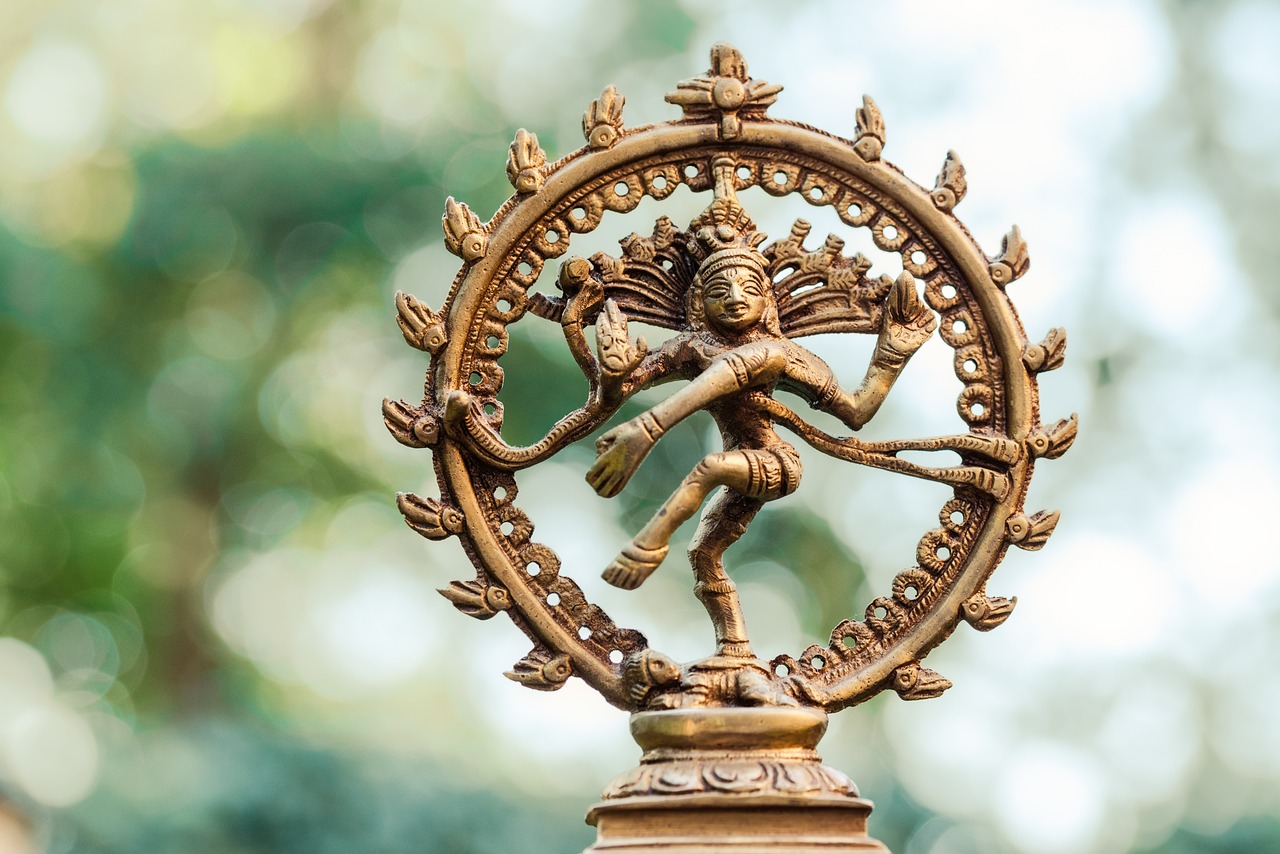
Shiva creating the world by dancing. Image by sabinevanerp on pixlebay
There are discoveries of caves with rock paintings across the world that date back to 4000 BC —one of the best known is the “Dancing Sorcerer” in Trois Frères in France.
Based on prehistory and what was found in these caves, it is shown that the ancient groups of humans danced to the beat of the sounds of nature, applauded and bumped the soles of their feet, among other noises. Dance appears to have had a highly spiritual character during that time of history, since it was used as part of different rituals, religions and traditions that were transmitted from generation to generation. Early circle dances have many of these attributes, many of which have carried on to some modern day practice.
Another example, is a long recorded history of Chinese dances. But some of the dances in the ancient texts mention that they were associated with shamanic rituals. On the other hand, the important dances of the ancient period are considered to be the ‘ceremonial yayue’, dating back to the Zhou Dynasty, 1st millennium BC.
In china, dance had its pinnacle during the Tang Dynasty, and during this period, dancers from many parts of the world performed at the imperial court and Chinese opera. With this came dragon dancing, lion dancing and practices such as foot binding, which can still be seen today.
The arrival of civilizations
Years later, with the arrival of ancient civilizations such as those in Iran, Rome, Egypt, and Greece began to use dance incorporating musical instruments and the voice in religious rituals, dances to divinities, weddings, deaths, and receptions.
It is said that the first in Europe to understand dance as an artistic form were the ancient Greeks, who linked it to the cult of Dionysus —god of fertility, wine, and leisure—, and it was part of the theatrical practices along with music and poetry.
More so, this art had greater importance in ancient Greece in 1200 since their movements represented various histrionic expressions and they named each dance according to the events or event. The slow and heavy dances conveyed a tragic feeling known as Gymnopedias, the fast and euphoric dances expressed a satirical feeling and became known as Pyrrhica and Sikinnis, the energetic and joyous dances combined with songs were Hiporquema and Cordace, to mention the outstanding ones.
As an interesting fact, if you have read Homer’s Iliad and Odyssey, they tell how they practiced these dances in a marriage ritual, describing a collective dance of men and women where they held hands in a circular fashion.
You might also be interest to know that Pole dance history also goes way back, with the earliest mention of Malahamba in the Indian classical Manasollas, written in 1135 AD.
Medieval dance
The Middle Ages were a very dark period for this beautiful art that is dance.
It is especially difficult to learn the history of dance in the time of the Middle Ages. For centuries, only the most learned (nobles and clergy) knew how to write and read. Therefore, there are not many writings about dance in the Middle Ages, since it was only practiced by the common people.
As in many times and events in history, repression appears and dance is also present right in the Middle Ages in the year 476. The Christian church did not approve such movements and saw it as an unscrupulous activity. The nocturnal dances gave rise to excesses condemned by the Church, which tried to simply prohibit this art, without ever succeeding.
Through history, there have been several religions that took a similar stance.
Little by little, religious dances began to disappear to give way to new forms of dance.
Beginning in the 6th century, the people of France invented cheerful dance styles, practiced in a group around a singer. Dance and music were two inseparable activities: the people repeated the singer’s refrain while they danced around him.
The rise of Europe in the history of dance
Dance and music increasingly merged, beginning to see groups of people around a singer while they danced around them —here an important focus for the new era of dance as the modern era begins to develop. It is in the 15th century that a well-known dance for professional dancers appeared: the ballet! It is also when the history of ballroom dance began.
Classical dancing was very popular in France and Italy. Jean Baptiste Lully contributed to this popularity, thanks to his compositions, performed at the royal court, as well as at the Paris Opera. Thanks to the enthusiasm that these shows aroused, the ballet became a means of communication during the political regime, to subtly convey a message.
Initially, masks were often used to favor the bodily expression of the dancers. The dancers’ costumes made the artists feel freer, a feeling that many are also looking for today. The footwear and clothing helped to accentuate the harmony of the body, then the tiptoe posture arose.
For centuries, ballerinas were an emblematic figure of ballet culture. At the same time, some dancers discovered cultured dances, made up of complex choreographies that are difficult to memorize. With a fast tempo, the artists had to demonstrate impeccable intelligence and concentration in order to execute the movements perfectly. The cultured dances were reserved for the elite; today they are accessible to all, thanks to private dance classes and the many annual festivals of cultured dances.
In the Baroque period, the history of dance continued to evolve mostly in France, where the ballet de cour allowed instrumental music to be developed to better suit the dance.
Louis XIV was in charge of turning dance into a great spectacle and even created the Royal Academy of Dance in 1661. The main academic dances that arose at that time were the following: polonaise, minuet, gigue, gavotte, passepied, rigaudon, etc. .
It is important to note that in Spain several popular or social dances also began to be developed, such as the seguidilla, the chaconne, or the fandango.
Romantic dance
Although romantic dance was characterized by a taste for folkloric dances, the history of classical dance was the one that had the greatest evolution: from the characteristic ballet costume, the tutu, to music purely composed for ballet.
The tutu appeared for the first time in Robert le Diable’s Ballet des Monks, in 1831. While the first music exclusively composed for ballet to stand out was Coppélia, in 1870.
During this time, the choreographer Carlo Blasis rose as the father of modern ballet, as he summarized all the technical aspects of the dance in his book The Terpsichore Code.
In addition, in the mid-19th century, the center of dance creation and innovation moved from Paris to Saint Petersburg, where Russian ballet would become a leader in expressions of this art in the following centuries.
The dance of the contemporary era
In the 20th century, dance began to appear much closer to how it is practiced today. After World War II, that was the time when contemporary dance became popular!
Some choreographers, eager to get away from ballet’s reputation for “intellectual” dance, helped popularize modern dance, as well as modern jazz. While classical dance was considered more of a variation of group gymnastics, modern dance favored the freedom of the dancer as such.
Incorporating new movements from different styles (jazz, modern dance, classical dance…), contemporary dance plays with the change of rhythm and dance improvisation. The contemporary dancer seeks above all to express independence and creativity through movements that are both fast and slow, which require great technique. We take a more in-depth look at contemporary dance history here.
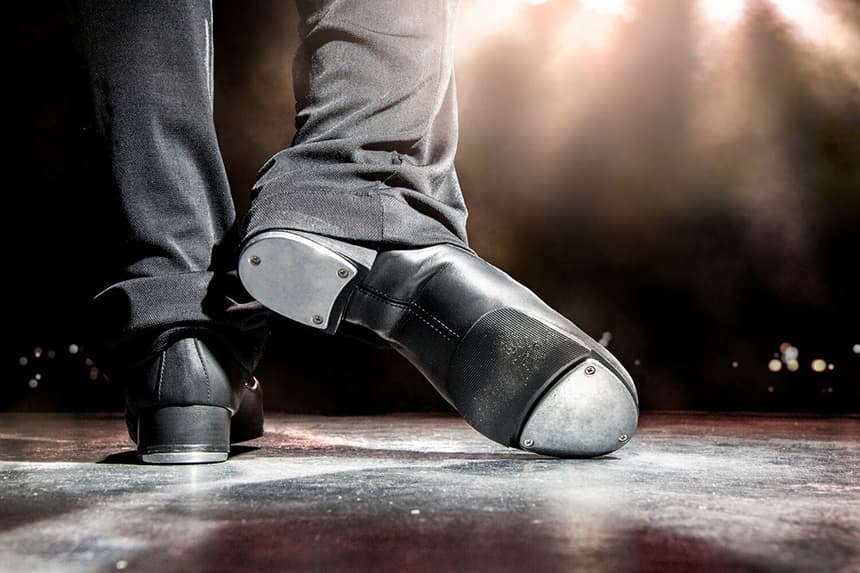
Photo by Josh Blake on Istockphoto.
This has been a whistlestop door. The history of dance in the last 150+ years needs a much more in-depth look different forms of dance, as they evolved into new styles. Here’s a few we’ve covered:
So, in every foot tap, spontaneous swirl and rhythms, the history of dance pulses. From the ancient caves, passing through the modern stages, dance transcends every excuse, threading a great part of our existence. It once adorned rituals, and now evolves freely in many different expressions. As beats change, so does dance, eternally enchanting, mirroring our journey through time.
Improvisation and choreography are equal partners in a dance. Improvisation is the most important direction of choreographic thinking, it organizes ...
Contemporary dance is a popular dance direction characterized by plasticity, emotionality, variety of movements and techniques. Today, this dance has ...