
10 Classical Spanish Dances

Spanish Dances article by Tanya, a dancer who lives in Spain.

The warm, cheerful, and picturesque streets of Spain contain many wonders for anyone who wants to visit them. There is a very rich and diverse culture, and you can get to know so much of this by seeing these traditional Spanish dances – as we’ll introduce you to now.

List of top 10 Spanish dances:

If you have had the opportunity to walk through Seville, Madrid and Barcelona, you have surely seen the famous Tablaos that offer Flamenco shows. But there are so many other beautiful Spanish dances, as we’ll cover in this article, from the Gypsy communities of the south to the Celtic costumes of Galicia.


1. Sevillanas


Previously called “Seguidillas”, they are a dance (and a music style) that’s typical of Andalusia, mainly in Seville, Cadiz, and Huelva. Sevillanas are danced in pairs, and they have a very festive nature.

This Spanish dance originated from La Mancha, but when it came in contact with Andalusian music, it became ‘flamencoized’, and movements from the Bolero dance were added; so it’s not strictly a Flamenco branch but a proper, individual classical dance.

The Sevillanas are an emblem of the famous Feria de Sevilla and of the pilgrimages of Huelva, in festivities like Virgen de la Cabeza (in Jaén).

2. Sardana


The origins of this dance are still uncertain and not really traceable. Some say that Sardanas are as old as the ancient Roman times, but most seem to agree that it was spread in Catalan regions like Roselló and Empordà during the 19th century. This dance, as time passed, became a symbol of the Catalan identity, step by step.

It is a Spanish dance performed in alternating circles of dancing women and men who hold hands and dance to a Cobla, a live band of eleven musicians. This dance, like Sevillanas, is performed during celebrations and public gatherings.

3. Paso Doble

spanish dancing_paso doble_competition
Photo by Ailura, CC BY-SA 3.0 AT, via Wikimedia Commons


Paso Doble is one of the most popular Spainish dances. At its true origin, even though is it is actually French, was a fast-paced march used by the infantry troops of the Spanish military, and goes by 120 steps per minute (which is the double of the standard unit, thus its name of “double step”). The pace is based on the movement and rhythm of a bullfight.

The military march was responsible for the origin of the modern Spanish dance that was used in 18th-century comedies and ballroom dances, often performed in pairs of one woman and one man, him symbolizing the bullfighter (el matador). In our modern times, it’s also a musical genre that has instruments and voices, as well as a version of instrumental music used during bullfights.

4. Fandango


If you are into dance, you have probably heard of this name at least once. Its origin is not actually as a Spanish dance, and according to the Diccionario de Autoridades of 1732, during that time, it was a “dance introduced by those who had visited the kingdoms of the Indias”, thus implying that its real origin is from Hispano-America.

By the 19th century, the Fandango embraced many aspects of the Andalusian Fandangos, and gave origin to the “fandango aflamencao” nowadays considered one the most elemental flamenco palos. This dance has more variations than any other flamenco dance. It’s a big part of the traditions of the Basque Country, Asturias, Valencia, Catalonia, and Portugal too.

This dance is fast-paced and is performed by couples. It has some similarities to boleros, and it’s usually danced with castanets, guitars, and hand-clapping, which makes it a very lively and festive performance.

5. Muñeira

Muñeira Spanish Dancer
Photo by Pieterjan Grobler Via Flikrr https://www.flickr.com/photos/krypty/

The Muñeira (Galician for “miller”) originates from Galicia and is often danced there and other Spanish autonomous communities like Asturias, and Castilla y León (which borders Galicia). In other regions of the country, this dance is called “Gallegada”.
The Muñeira is an example of the Celtic influence on the local culture of Spain, and the most evident parallel with Celtic music is a type of bagpipe called gaita, used to perform the accompanying music. The rest of the instruments are tamborils, bass drums, tambourines, conchas and charrascos.

Apparently, there is no documentation of this dance that goes prior to the 16th century, and nowadays it is an instrumental dance. The name makes reference to the working days in the mills and the spare time that went with the waiting for the milling.

6. Bolero

Bolero dance painting. Spanish dances
Marcelle Lender Dancing the Bolero in Chilpéric (1895-1896) painting in high resolution by Henri de Toulouse–Lautrec. Original from National Gallery of Art. Digitally enhanced by rawpixel.

The origin of Bolero traces back to Cuba, but it is also a very popular dance in Spain. It emerged from the Sevillana and La Contradanza during the crepuscule of the 18th and the early 19th century, more specifically during the years of 1750 and 1772, and became a very popular dance in Murcia, Madrid, Andalusia, and La Mancha.

It has a moderate slow tempo (thus, it is moderately paced) and it is usually performed as solo or with a partner, accompanied by castanets, guitars, and lyrics from the Seguidilla. It has somewhat fallen out of fashion but still holds a very important place in the history of Spanish dances.

7. Zambra


The Zambra (a word that comes from the Arabic Hispanic term “zámra” and “zamr” from classic Arabic and which means “tocata”) is a palo flamenco that originated from the gypsies of Granada in Andalusia, and it was performed at gypsy weddings. There’s the belief that Zambra is a continuation of Moorish dances, as it holds similarities with Arabian belly dance.

This is danced barefoot, with the dancer revealing her stomach by knotting her blouse under her chest. It was prohibited in Spain during the 16th century due to political reasons because Philip II wanted to wipe out traces of culture that didn’t belong to the Catholic religion. It was danced in clandestinity and taken back during the 20th and 21st centuries by known dancers such as Lola Flores.

Gypsies are still dancing it, for them and even for the tourists in the caves of Almeria and the Caves of the Sacromonte Hill in Granada.

8. Zarzuela

La Zarzuela is not precisely a dance style. It is a genre that mixes sung and spoken scenes while incorporating popular and opera-like songs, as well as dancing. A lyrical performance, if you’d like. The etymology of the word is said to come from the Palace of Zarzuela near Madrid, as the entertainment type presented to the court was of a similar fashion to that of the Zarzuela.

It’s traced back to the 17th century and became popular during the 19th century because of the Zarzuela Theatre (located in Madrid) and the work of Francisco Barbieri, a a Spanish composer and musicologist. The Zarzuela fell out of grace during the civil war and was retaken during the decade of the 50’s to the 60’s. It is still being performed nowadays across all of Spain.

Watch an hour long Zarzuela performance  – it really is quite the spectacle.

9. Jota


The Jota is a music genre and a dance style as well. It originated in Aragon and has different versions according to the region it is performed like Asturias, La Rioja, Eastern Andalusia, León, and many others, reflecting the local culture of each place.

The Aragonese Jota can be dated back to the 18th century and became more popular during the 19th century, which gave laboriously choreographed versions for festivals, movies, zarzuelas, and contests.

In is purest forms, this dance is kind of complex, as it has small jumps and rapid foot movements. It also is a visual representation, thus accompanied by singers, castanets and the dancers usually wear regional costumes. The most original and pure form of this dance is still found in places like Zaragoza, Andorra, Calanda, and Albacete.

10. Flamenco

Female Flamenco Dancer in full dancing.
A Flamenco dancer Photo by Alexander Jawfox on Unsplash

And last but not least, we have Flamenco, the heart of the most famous cultural export of Spanish Heritage. This is more than a dance style, it’s actually more of an art form, to the point of being given recognition by the UNESCO as part of the Masterpieces of the Oral and Intangible Heritage.

Flamenco comes from a myriad of folkloric traditions from Southern Spain, and it was made and developed by the Gypsies of Andalusia, and was present in Murcia and Extremadura.

The Romani Gypsies made a significant contribution to the professionalization of Flamenco, but the unique Andalusian style has contributions by both non-gypsy and gypsy heritages. The oldest record of Flamenco music traces back to the book of Las Cartas Marruecas by José Cadalso in 1774.

Flamenco was originally a form of political protest, and that is the origin of the famous tablaos. Franco Spanishized it by taking it away from the gypsies, prohibiting its lyrics, dance form, and giving it a different tinge to the original. However, the indelible mark of the gypsies could never be eliminated, and although it is one of the best know Spanish dances, it is recognized and known today that it has gypsy and Arab origins.
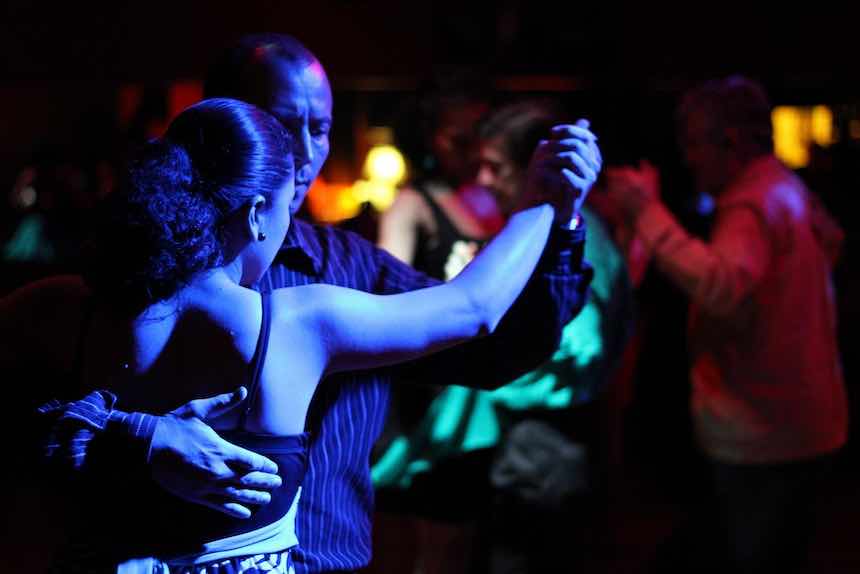
Milonga Dance: The uptempo relative of the Argentine Tango

Milonga dance celebrates Argentine Culture. A ballroom dance sharing many characteristics with the better known Argentine tango and considered to be the forerunner to Tango. A fluidity gives dancers the opportunity to express the vibrant energy and flirtatious spirit often associated with the milonga music. This is a known for its playfulness and joy – as well as its complicated, intricate steps and movements.

Are you looking to find out more about the techniques and music of Milonga, its similarities and differences with Argentine Tango? Well read on!

couple dancing the milonga in an evening
Image by Luis Fernando from Pixabay

History and origins of Milonga dance

The origin of the milonga dance is closely tied to the Afro-Argentine community. We’ll cover more about this in the ‘language’ section below – as it is an African word.

This period seems to have been less covered but we across this quote from Professor or Art History at Yale, Robert Farris Thompson, who noted “Tango started black, and milonga, the dance preceding it, even more so”.

In terms of its more widely covered origins, we trace back to The Río de la Plata, separating the cities of Montevideo and Buenos Aires – port cities, leading to ‘the pampas’ cattle ranches, as well as mining areas of the Andes. Because of this geography, international influence and nature of work, in the1870’s to 1900’s, the area had an influx of gauchos (cowboys), sailors, soldiers, stablemen – the lower classes of society.

Milonga was mainly danced by who mixed various global folk dances and dance at brothels and parlours, beginning as a walking dance and incorporating more sexualized movements, often ahead of the other activities taking place at these locations.

Hence milonga was frowned upon by the upper classes of Argentine society, to the point that you actually needed a permit to run dance around the city!

However, by the late 1870s, composers and singers began creating milonga songs, which contributed to its popularity and widespread adoption throughout Argentina.

By the early 1900s, milonga and tango became socially acceptable, even reaching craze status in fashionable European circles by 1915. It is believed that this started, in part, through wealthy families sending their sons on a coming of age, ‘grand tour’ to Europe.

There  were events and gatherings, at which these travellers would share their dance the tango, vals (waltz), and milonga, began to attract a wider audience. These events, initially spreading through then beyond Paris to gain more popularity across Europe and in the mainstream.

During this period, there were also a number of European contributions to the Milonga. These include:

  • The waltz, adding to to Milonga’s rotating movements and elegant flow.
  • The polka helping shape Milonga’s rhythm and high energy.
  • The mazurka, adding further sentimentality and drama

As milonga gained popularity, it started to merge with other dance styles like the Cuban habanera and flamenco, ultimately evolving to develop the Argentine tango that is known today.

Milonga is still celebrated, danced in classes, clubs and dancehalls around the world.

How to dance milonga

Getting the rhythm

First we need to get a grasp for the basic Milonga rhythm. It uses an upbeat 2/4 rhythm, with quick, syncopated steps. Listening to Milonga music and tapping your foot or hand to the beat is one way to get familiar with the rhythm ahead of taking any steps.

Next, focus on mastering the basic Milonga step patterns.

These include

  • the salida (the basic walking step)

In this video, Ana Padron from Tangoforall.com says “think of a Salida as the period (or ‘full-stop’) at the end of a sentence. You can also see the steps described here

  • the back ocho – steps that form a figure eight on the floor


  • the forward ocho


Milonga often incorporates fun, theatrical elements like small lifts, jumps and kicks. On mastering the basic steps, dancers can start exploring these more advanced moves. Remember to keep your movements careful and controlled to avoid disrupting your partner or other dancers.

Partnership

The lead and follow dancers working in harmony is what creates a smooth, connected dance experience to the rhythm. Good communication between partners, and signalling movements using the leader’s chest, arms, weight shifts and body movements to signal show clear intention to the follower. Followers need to be attentive and responsive to these subtle cues.

Posture

A Milonga posture is upright. You ensure that your chest is slightly forward, and weight over the balls of your feet, with knees are slightly bent. The embrace in Milonga is often very close – similar to Argentine Tango.

Dance styles and techniques

The two primary dance styles within milonga are Milonga Lisa and Milonga con Traspie.

Milonga Lisa

Milonga Lisa, sees the dancer make steps on every beat, displaying smooth and continuous movements. It’s good for beginners to familiarize themselves with milonga dance, using simple moves

Milonga con Traspie

A more advance dance. Milonga con Traspie is more syncopated and intricate. Rhythmic changes, include shifting weight from one foot to the other and back again in double time, or three steps in two beats. This gives the dance energy, as do the additional techniques:

  • Quebradas are breaks in the dance pattern where the couple momentarily pause or uses a different rhythm before resuming their dance.
  • Cortes, are brief interruptions in the movement, here dancers can showcase creativity and skills in improvisation.
Milonga dancers in competition
Photo by PreIllunination Seth on Unsplash

Similarities and differences between Milonga and Tango

Similarities between milonga and tango

Milonga and tango are both Argentine dances. They share a deep cultural and historical bond as they both originated from the The Río de la Plata area

Differences between milonga and tango

Music & tempo: Milonga is danced at a much faster tempo than tango, following a 2/4 rhythm. Tango is slower and more deliberate allows dancers to interpret the music through pauses, slow and quick movements and includes a variety of melody.

Movements: Milonga dance has faster, sharper and more flowing movements, with a more relaxed posture.

Embrace: Milonga dancing maintains a tighter embrace than tango, to support the faster, more intricate footwork required.

Milonga Music

Milonga music typically includes various instruments that are essential to its unique sound:

  • Bandoneon: An often used, type of concertina. It’s similar to an accordion.
  • Piano: providing harmony and syncopation.Often used in Milonga.
  • Violin: adding and emotion to the music, playing both melodic and rhythmic parts
  • Double Bass: a foundation for the music, adding depth and anchoring the melodic instrument
  • Guitars showcase the dance’s connection to traditional Argentine and Uruguayan folk music

Musical Influences

The origins of milonga music can be traced back to a combination of musical genres and influences. This includes:

  • Habanera, a Cuban dance rhythm that found its way to Buenos Aires in the late 19th century
  • The vals (waltz) contributed to the development of the milonga style with its flowing and graceful melodic elements.

Famous Composers & Contributors to Milonga Music

Great musicians and composers have been central to the development of Milonga music and the dance style more broadly. Some of the most well-known contributors include:

  • Ástor Piazzolla: A revolutionary Argentine composer.
  • Carlos Gardel: Known as the “King of Tango,” but also very influential on the development of milonga music
  • Aníbal Troilo: A significant composer, bandleader and bandoneon player bandleader during mid-20th century.
  • Villoldo: known as the father of tango

Some others who made considerable contributions to the music include: Rodolfo Biagi, Edgardo Donato, Gabino Ezeiza, Juan D’Arienzo, Angel Vargas, and Roberto Firpo.

Some of the individuals notable in the transition from Milonga to Tango include: Francisco Canaro, Lucio Demare, Pedro Laurenz, and Domingo Federico. Carlos Di Sarli is famed for mastering both styles.


Milonga etiquette for the dance floor

Off to your first Milonga, fear not, here’s some tips to get started.

  • Go with or arrange to meet a friend or partner. It will be much more fun to have someone to dance with. Once you become more familiar, you will be more likely to have opportunities to meet with other dancers.
  • Instead of asking a stranger to dance and the potential for embarrassment this creates, in Milonga, use eye contact (“mirada” as in ‘mirror’) is made with a potential partner. If this is held, a slight nod of the head “cabaco” is made and, if returned, the leader will walk the follower to the dance floor.
  • Dress to impress, think more fancy restaurant than club. Some events are more casual but as a rule you’re dressing up.
  • Firstly, understanding the flow of the dance floor is essential, so you can enter the dance floor safely. Dancers follow the “ Ronda”, an imaginary line of dance by moving counter-clockwise around the room, allowing everyone to enjoy the space without causing disruptions. Ensure any approaching leader has seen you before moving into and maintaining space on the dance floor.
  • During a Milonga, the music is organized in tandas, which typically consist of three to four tangos from the same genre or orchestra. It is considered proper to dance with the same partner for the entire tanda.
  • At the end of each tanda, a short musical break called a ‘cortina’ provides an opportunity for dancers to change partners, rest or socialize.
  • Leaders should be aware of their partner’s comfort, avoiding excessive force or uncomfortable body positions.
  • If its getting hot and sweaty, bringing a change of outfits, like shirts for men and extra (but not overpowering) perfumes, mints and deodorants can be a good idea – after all, you’re up very close in a Milonga embrace!
  • Thank your partner after each dance.

Famous Milonga Dancers

Want to see great examples of Milonga in action? Checkout these amazing dancers:

  • Miguel Zotto and Daiana Guspero are prominent figures in the world of milonga dance.
  • Angel Coria and Claudia Sortino are another example of celebrated milonga dancers. They are known for infusing their routines with humor and joy.
  • Dani Garcia and Luna Palacios have significantly contributed to the milonga dance scene.

Milonga Meaning

As a word itself, Milonga has African origins, meaning ‘argument’ / ‘issue’ in Kimbundu or ‘lines of dancers’ in Ki-Kongo. Milonga is also a term with multiple meanings in the context of Argentine culture and dance.

Musical genre:

As a musical genre: “Milonga is an excited habanera.” Often the music accompanying the dance, with a related history.

Milonga dance:

As we’ve spent the last few minutes describing, dancers perform the milonga with smooth and gliding movements, intricate footwork and rhythm.

Milonga event:

Milonga is also a word describing a social event, where people dance. The styles danced also include the Argentine tango and vals. Attendees, known as milongueros, enjoy a night of dancing and socializing. Often the events are a relaxed and social affair with a sense of community.


Related articles:

Spanish dancers performing

10 Classical Spanish Dances

Spanish Dances article by Tanya, a dancer who lives in Spain. The warm, cheerful, and picturesque streets of Spain contain many wonders for anyone who wants to visit them. There is a very rich and ...
Conga line dancing

Conga Line: How to Conga at parties in 3 steps

Conga lines have long been a favorite for parties and social gatherings, helping break the ice and getting that party vibe going. If you’ve never experienced a Conga Line, it’s good fun. In this article  ...
couple dancing the milonga in an evening

Milonga Dance: The uptempo relative of the Argentine Tango

Milonga dance celebrates Argentine Culture. A ballroom dance sharing many characteristics with the better known Argentine tango and considered to be the forerunner to Tango. A fluidity gives dancers the opportunity to express the vibrant ...
Ballet feet exercise. Ballerinas feet warming up stretching

Ballet foot exercises

10 Ballet Foot Exercises: Warm-up, Boost Your Technique and Foot Strength Foot exercises are an essential part of a ballet dancer’s training as they provide important strength and technique benefits. Developing strong and flexible feet ...
Male and Female doing a Tango dance before a crowd. Photo by Preillumination SeTh on Unsplash

Tango Dance

Tango Dance is a passionate and expressive form of dance that originated in Argentina in the late 19th century. It is characterized by its close embrace, intricate footwork, and dramatic flair. Tango Dance is known ...
Crowd gathered gor a parade with samba dancers in full costume

Samba Dance

The Samba is a Brazilian dance that has become popular all over the world. It is characterized by its lively and energetic steps and is often performed to music with a strong beat. The origins ...

Why not check out our article on Conga lines too.

Tango Dance

Tango Dance is a passionate and expressive form of dance that originated in Argentina in the late 19th century. It is characterized by its close embrace, intricate footwork, and dramatic flair. Tango Dance is known for its sensual and intimate nature, as well as its ability to evoke strong emotions in both the dancers and the audience.

Over the years, Tango Dance has evolved and spread to become a popular dance form around the world. It is now enjoyed by people of all ages and backgrounds, from amateur dancers to professional performers. Whether you are a seasoned Tango dancer or just starting out, there is something for everyone to appreciate and enjoy in this mesmerizing and captivating dance style.

Male and Female doing a Tango dance before a crowd. Photo by Preillumination SeTh on Unsplash
Photo by Preillumination SeTh on Unsplash

History of Tango Dance

The origins of Tango Dance can be traced back to the lower-class neighborhoods of Buenos Aires, Argentina in the late 19th century. It was a fusion of various cultural influences, including African, Spanish, and Italian, and was initially associated with the working-class and immigrant communities.

Tango Dance was originally danced in the streets, taverns, and brothels, and was seen as a rebellious and controversial activity. However, it gradually gained popularity and respectability, and by the early 20th century, Tango Dance had become a popular form of entertainment in Argentina and other parts of South America.

In the 1920s and 1930s, Tango Dance spread to Europe and the United States, where it became a craze and was embraced by high society. It was during this time that Tango Dance underwent significant changes and evolution, with new styles and techniques being developed and added to the traditional Argentine Tango. The precursor to this is a dance known as Milonga

Photo by Preillumination SeTh on Unsplash

Types of Tango Dance

There are several different types of Tango Dance, each with its own unique characteristics and influences. Some of the most popular types of Tango Dance include:

Argentine Tango

This is the original and most traditional form of Tango Dance, characterized by its close embrace, intricate footwork, and dramatic flair. Argentine Tango is danced to music with a 2/4 or 4/4 time signature, and is known for its improvisational nature and the connection between the dancers.

Ballroom Tango

This is a more formal and standardized version of Tango Dance, developed for ballroom dancing competitions. It is characterized by its strict adherence to specific dance patterns and techniques, and is danced to music with a 4/4 time signature. Ballroom Tango is popular in the United States and Europe, and is often seen as a more polished and refined form of Tango Dance.

Nuevo Tango

This is a more modern and experimental form of Tango Dance, developed in the 1980s by Argentine Tango dancers who wanted to break away from the traditional style. Nuevo Tango is characterized by its use of open embraces, flowing movements, and a wider range of music styles. It is often seen as a more expressive and creative form of Tango Dance.

Alternative Tango

Alternative Tango is a term used to describe Tango Dance styles that deviate from the traditional Argentine Tango or Ballroom Tango styles. Alternative Tango styles often incorporate elements from other dance forms, such as salsa, jazz, or contemporary dance, and may involve more open embraces, fluid movements, and improvisation. Alternative Tango styles are often seen as more experimental and creative, and may be more suitable for dancers who are looking for a less structured and more expressive form of Tango Dance.

Uruguayan Tango

Uruguayan Tango is a style of Tango Dance that originated in Uruguay, a small South American country located between Argentina and Brazil. Uruguayan Tango is characterized by its slower tempo, smooth and flowing movements, and use of the gancho (a leg hooking movement). Uruguayan Tango is often seen as a more relaxed and intimate form of Tango Dance, and is enjoyed by dancers of all levels.

Finnish Tango

Finnish Tango is a style of Tango Dance that originated in Finland, a country located in northern Europe. Finnish Tango is characterized by its emotional and melancholic melodies, and is often seen as a more introspective and introverted form of Tango Dance. Finnish Tango is an important part of Finnish culture, and is enjoyed by dancers of all ages and backgrounds. Some of the most famous Finnish Tango musicians include Olavi Virta and Reijo Taipale.

Tango Music and its Influences

Tango Music is an integral part of Tango Dance, and is characterized by its rhythmic and melodic complexity, as well as its emotionally evocative lyrics. Tango Music has a rich and varied history, with influences from a wide range of cultures and musical styles.

The origins of Tango Music can be traced back to the African and Spanish rhythms that were brought to Argentina by slaves and immigrants in the 19th century. It was later influenced by the music of the Italian immigrants who arrived in Argentina in the late 19th and early 20th centuries, as well as the European classical music that was popular at the time.

Tango Music has evolved significantly over the years, with different styles and influences emerging at different times. Some of the most influential and popular styles of Tango Music include:

  • Golden Age Tango: This is the classic style of Tango Music that emerged in the 1920s and 1930s, and is characterized by its ornate melodies and romantic lyrics. Golden Age Tango was popularized by legendary Tango singers and musicians such as Carlos Gardel and Astor Piazzolla.
  • Nuevo Tango: This is a more modern and experimental style of Tango Music that emerged in the 1980s, and is characterized by its incorporation of various musical styles and influences. Nuevo Tango was popularized by musicians such as Astor Piazzolla, who blended Tango Music with elements of jazz and classical music.
  • Electronic Tango: This is a more recent style of Tango Music that emerged in the 21st century, and is characterized by its use of electronic instruments and production techniques. Electronic Tango has been popularized by artists such as Gotan Project, who have blended Tango Music with elements of electronica and trip hop.

In addition to these styles, Tango Music has also been influenced by various cultural and musical movements over the years. For example, Tango Music has been influenced by the folk music of Argentina and other Latin American countries, as well as the jazz and blues music of the United States. It has also been influenced by various European classical music styles, such as opera and symphonic music.

Overall, Tango Music is a dynamic and diverse art form that has evolved significantly over the years. It continues to be an important part of Tango Culture and a vital aspect of Tango Dance.

Tango Dance Steps and Techniques

Tango Dance is known for its intricate footwork and precise movements, and there are a wide range of steps and techniques that are used in Tango Dance. Some of the most common Tango Dance steps include the ocho, the giro, and the boleo.

Ocho

The ocho is a step in which the dancer takes a sideways step and pivots on their foot. It is typically done in a back and forth or circular pattern, and is used to create fluid and graceful movements. The ocho is a key element of Tango Dance, and is often used to move around the dance floor or to create dramatic and expressive movements.

Giro

The giro is a step in which the dancer rotates around their partner, either in a clockwise or counterclockwise direction. It is often used to change direction or to create a sense of momentum in the dance. The giro is a key element of Tango Dance, and is often used in combination with other steps to create dynamic and expressive movements.

Boleo

The boleo is a step in which the dancer swings their leg outward in a circular motion, either to the front, back, or side. It is often used to add flair and drama to the dance, and is a key element of Tango Dance. The boleo is typically done by the follower, and is used to accentuate the movements of the leader.

In addition to these basic steps, Tango Dance also involves a wide range of techniques and movements, including turns, dips, and lifts. Tango Dance is a highly expressive and improvisational form of dance, and dancers are encouraged to be creative and expressive in their movements.

Tango Dance steps and techniques are an essential part of this dance form, and are used to create fluid and graceful movements, as well as to add drama and flair to the dance.

Tango Culture and its Role in Society

Tango Culture is a rich and vibrant aspect of Tango Dance, and encompasses the music, art, literature, and social customs that are associated with this art form. Tango Culture has played a significant role in the history and development of Tango Dance, and continues to influence and shape its evolution.

One of the most distinctive features of Tango Culture is its emphasis on social and emotional connection. Tango Dance is known for its close embrace and intimate nature, and this sense of connection is reflected in the music, literature, and social customs of Tango Culture. Tango lyrics often deal with themes of love, loss, and longing, and the music is often described as being emotionally evocative and expressive.

In addition to its emotional significance, Tango Culture has also played a role in shaping the social and cultural identity of Argentina and other South American countries. Tango Dance and music have become an important part of the national identity of these countries, and are often used to celebrate and promote their cultural heritage.

Tango Culture is also an important part of the global arts and entertainment scene, with Tango Dance and music being featured in a wide range of media and cultural events. Tango Dance has become a popular form of entertainment and competitive sport, with numerous Tango Dance festivals and competitions being held around the world. Tango Music and dance have also been featured in numerous films, television shows, and stage productions, further increasing the popularity and visibility of Tango Culture.

Overall, Tango Culture plays a vital role in the history and development of Tango Dance, and continues to influence and shape its evolution. It is a rich and vibrant aspect of this art form that celebrates the emotional and social connection that is at the heart of Tango Dance.

Man and a woman in a dark room, engaged in dancing Argentine Tango. Photo by Preillumination SeTh on Unsplash
Photo by Preillumination SeTh on Unsplash

Tango Etiquette and Traditions

Tango Dance has a number of etiquette and traditions that are followed by dancers around the world. These guidelines are designed to create a respectful and enjoyable environment for everyone, and help to preserve the cultural and artistic integrity of Tango Dance.

Lead and Follow

In Tango Dance, one dancer (the lead) initiates and directs the movements, while the other (the follow) responds and follows the lead’s cues. It is important for the lead to be clear and concise in their movements, and for the follow to pay close attention and respond appropriately. This interaction between the lead and follow is an essential part of Tango Dance, and helps to create a sense of connection and communication between the dancers.

Personal Space

Tango Dance involves close physical contact between the dancers, and it is important to respect each other’s personal space. Dancers should be mindful of their partner’s comfort level and avoid invading their space or touching them in an inappropriate manner. It is also important to maintain good hygiene and to dress appropriately for Tango Dance.

Invitation to Dance

In Tango Dance, it is traditional for the man to ask the woman to dance. This can be done by making eye contact, nodding, or extending an arm. It is important for both parties to be respectful and gracious in their acceptance or refusal of an invitation to dance. Once on the dance floor, the lead should guide the follow through the dance, and both parties should work together to create a enjoyable and harmonious experience.

Dance Floor Etiquette

Tango Dance is typically done in a counterclockwise direction around the dance floor, and it is important for dancers to be aware of their surroundings and to avoid colliding with other couples. It is also important to be mindful of the flow of the dance and to avoid disrupting it. In addition, it is generally accepted that the couple on the inside of the dance floor has the right of way.

Overall, Tango Etiquette and traditions are an important part of this dance form, and help to create a respectful and enjoyable environment for all dancers. By following these guidelines, dancers can fully embrace the beauty and passion of Tango Dance.

Tango Competitions and Festivals

Tango Dance has a vibrant competitive scene, with numerous Tango Dance competitions and festivals being held around the world. These events are a great opportunity for dancers to showcase their skills and passion for Tango Dance, and to connect with other dancers from around the world.

Tango Dance Competitions

Tango Dance competitions are typically organized by dance organizations or Tango Dance schools, and are open to amateur and professional dancers. Competitions are typically divided into categories based on skill level and age, and are judged by a panel of experts. The judges evaluate the dancers on their technique, style, and overall performance, and award prizes to the top performers.

Tango Dance competitions are a great way for dancers to improve their skills and to gain recognition in the Tango Dance community. They also provide a platform for dancers to showcase their talents and to connect with other dancers and fans of Tango Dance.

Tango Dance Festivals

Tango Dance festivals are large-scale events that celebrate the culture and art of Tango Dance. These events typically feature live music, dance performances, and workshops, and are open to all levels of dancers. Tango Dance festivals are a great way for dancers to immerse themselves in the culture and traditions of Tango Dance, and to connect with other dancers from around the world.

Some of the most famous Tango Dance festivals include the Buenos Aires Tango Festival and the Tango Festival Amsterdam. These events attract thousands of dancers and fans from around the world, and area great opportunity to experience the energy and passion of Tango Dance. In addition to the main events, Tango Dance festivals often include additional activities such as Tango Dance parties, exhibitions, and cultural events, providing a truly immersive and enriching experience for all attendees.

Overall, Tango Dance competitions and festivals are an important part of this dance form, and provide a platform for dancers to showcase their skills and passion for Tango Dance. They also help to promote and celebrate the rich and vibrant culture of Tango Dance, and provide a way for dancers and fans of Tango Dance to connect and share their love of this art form.

Conclusion and Future of Tango Dance

Tango Dance is a rich and vibrant art form that has a long and fascinating history. From its humble beginnings in the lower-class neighborhoods of Buenos Aires, Argentina, Tango Dance has evolved and spread to become a popular dance form around the world. Today, Tango Dance is enjoyed by people of all ages and backgrounds, and continues to captivate and inspire dancers and audiences alike.

Tango Dance is a deeply expressive and emotive form of dance, and its close embrace and intricate footwork create a sense of connection and communication between the dancers. It is this connection, combined with the drama and flair of Tango Dance, that makes it such a mesmerizing and captivating art form.

As Tango Dance continues to evolve and grow in popularity, it is likely that it will continue to influence and be influenced by other dance forms and cultural influences. With its rich history and cultural significance, Tango Dance is sure to remain a beloved and enduring art form for years to come.


Related ballroom articles:

Spanish dancers performing

10 Classical Spanish Dances

Spanish Dances article by Tanya, a dancer who lives in Spain. The warm, cheerful, and picturesque streets of Spain contain many wonders for anyone who wants to visit them. There is a very rich and ...
couple dancing the milonga in an evening

Milonga Dance: The uptempo relative of the Argentine Tango

Milonga dance celebrates Argentine Culture. A ballroom dance sharing many characteristics with the better known Argentine tango and considered to be the forerunner to Tango. A fluidity gives dancers the opportunity to express the vibrant ...
Male and Female doing a Tango dance before a crowd. Photo by Preillumination SeTh on Unsplash

Tango Dance

Tango Dance is a passionate and expressive form of dance that originated in Argentina in the late 19th century. It is characterized by its close embrace, intricate footwork, and dramatic flair. Tango Dance is known ...
Crowd gathered gor a parade with samba dancers in full costume

Samba Dance

The Samba is a Brazilian dance that has become popular all over the world. It is characterized by its lively and energetic steps and is often performed to music with a strong beat. The origins ...
Why not also checkout our article on conga lines

Samba Dance

The Samba is a Brazilian dance that has become popular all over the world. It is characterized by its lively and energetic steps and is often performed to music with a strong beat. The origins of the Samba date back to the nineteenth century, when it was first danced by slaves in Brazil. Since then, it has evolved into several different styles, each with its own unique characteristics, and even became one of the dances in the competitive ballroom dancing program (latina). In this article, we will explore the history and origins of the Samba Dance, as well as how you can learn to perform it yourself!
Crowd gathered gor a parade with samba dancers in full costume
Samba dancers in full costume. Cover photo by VENUS MAJOR on Unsplash

What is the Samba dance?

The Samba is a Brazilian dance that originated in the Afro-Brazilian culture. It is a lively, rhythmic dance that is often performed to festive Brazilian music. The Samba can be danced solo or with a partner and is traditionally danced in a group setting. The steps and movements of the dance vary depending on the region where it is being performed, but the basic steps are relatively simple and easy to learn.

The Samba is an incredibly popular dance, both in Brazil and around the world. It is often associated with Carnival, a major festival that takes place in Brazil each year. Carnival is a time when people dress up in costumes, dance, and celebrate in the streets. The Samba is often seen as the symbol of Carnival and is one of the most popular dances performed during the festival.

Samba has been influenced by many different cultures over the years. It was originally created by African slaves who were brought to Brazil. The African rhythms and movements can still be seen in the Samba today. Over time, the dance has also been influenced by European dances. As a result, the Samba is a truly unique dance that blends together various cultures and traditions.

History of Samba Dance

Samba is a Brazilian dance and musical genre originating in Bahia, Brazil. It is recognized around the world as a symbol of Brazil and the Brazilian Carnival. Considered one of the most popular Brazilian cultural expressions, samba has become an icon of Brazilian national identity.

The samba dance history can be traced back to the early days of Brazil’s colonization by the Portuguese. African slaves brought their own dances and music to Brazil, which became blended with the music and dances of their new homeland. One of these African dances was the lundu, which was a slow, sensual dance that was often performed by couples. The lundu eventually evolved into the samba.

While there are many different theories about the exact origins of the samba, there is no doubt that it has its roots in Africa. It is known that the word “samba” has existed in the Portuguese language since the 19th century. But the first recorded use of the word “samba” in Brasil was in the late 1920s.

The first samba school was founded in 1928 by Geraldo Pereira, a Brazilian composer, and musician. Pereira’s goal was to promote the samba as a symbol of Brazil’s African heritage. The school soon became popular, and eventually evolved into the Escola de Samba, which is now one of the most famous samba schools in Brazil.

The first samba Carnival parade took place in Rio de Janeiro in 1933. Since then, the Carnival has become an annual event in Brazil, and the samba has become its official dance. Every year, millions of people flock to Rio de Janeiro to watch the spectacular procession of floats and dancers that make up the Carnival parade.

The Samba has also become a popular dance outside of Brazil. In the United States, samba schools have been founded in cities such as Los Angeles, New York, and Miami. These schools typically offer classes for both beginners and advanced dancers.

Characteristic Features of the Samba Dance

Samba is a lively, rhythmical dance of Brazilian origin in 2/4 time danced to samba music. Effortless and graceful, samba appears deceptively simple, but actually requires excellent timing and coordination.

The basic step of samba is quite simple: Just shift your weight from one foot to the other, allowing your hips to sway as you move. The arms are kept at the sides, with the hands on the hips or raised above the head. As you become more comfortable with the basic step, you can add embellishments such as arm waves or hip movement.

One of the most distinctive features of samba is its “bounce”. This bounce is created by bending the knees slightly and “rebounding” up as you shift your weight from one foot to the other. The result is a smooth, flowing dance that looks effortless and graceful. This is the most important distinguishing feature of this dance. Bounce is not only the movement of the knees but also the movement of the hips, which makes this dance so bright and fluid, even at a high tempo of the performance.

Types of Samba Dancing

There are many different types of samba dancing, each with its own unique moves and steps. Some of the most popular types of samba dancing include:

Samba no pé:

It is a traditional form of samba, aka samba on the feet, which originated in the streets of Rio de Janeiro. It is characterized by fast and energetic movements and the use of props such as umbrellas and canes.

Samba de Roda:

This type of samba originated in Bahia State and is characterized by slower and more sensual movements. Dancers of the samba de genre often form a circle, in which one or two girls usually dance while singing along. The men perform the musical accompaniment and the women sing along while clapping their hands.

Samba de Gafieira:

The samba de Gafieira is a type of Brazilian samba dance that originated in the Rio de Janeiro region. It is danced in pairs, with one person leading and the other following. The lead dancer typically improvises steps and movements, while the follower mirrors these movements.

The Samba de Gafieira has a similar feeling to ballroom dances such as the waltz or tango, but with a distinctly Brazilian flavor. The music is also unique, blending African rhythms with European instruments such as violins and flutes.

Samba Axé:

This is a more contemporary form of samba that combines elements of both traditional and modern styles. It is characterized by its fast pace and sexually suggestive moves.

Samba Reggae:

This type of samba combines the rhythms of reggae music with the traditional moves of samba dancing. It originated in the favelas (slums) of Rio de Janeiro and is characterized by its use of props such as drums and percussion instruments.

Pagode:

Pagode is a type of samba that originated in the suburbs of Rio de Janeiro. It is characterized by its slow and relaxed rhythms, as well as its use of acoustic instruments such as guitars and mandolins.

Samba Ballroom Dance

Ballroom samba is a type of samba and is danced at ballroom dance competitions. As with all ballroom dances, the international ballroom samba has strict rules which govern the movements that are allowed. These rules are designed to ensure that the dancers maintain a consistent look and feel so that judges can accurately compare their performances.

There are some key differences that set samba apart. One of the most distinctive features of samba is its “bounce”, which is created by quickly transferring weight from one foot to the other. This bounce gives samba its characteristic energy and style. Samba is typically danced to upbeat, fast-paced music with a strong rhythm. The tempo of the music ranges from about 50 beats per minute (bpm) to about 60 bpm.

International ballroom samba competitions are divided into two categories: “open” and “restricted”. In open competitions, dancers of all levels can compete against each other. In restricted competitions, only dancers who have achieved a certain level of proficiency are allowed to compete. The restricted competition at the Blackpool Dance Festival is regarded as the most prestigious samba event in the world. To be eligible to compete in this event, dancers must first win a qualifying event at another competition.

Samba Dance Costumes

While there are many different ways to dress for a Samba dance, there are some key elements that are essential to any good costume. The right costume will help you to exude the sensuality and energy that is characteristic of the Samba, while also ensuring that you are comfortable and able to move freely.

Some of the most important elements of a Samba costume include:

  1. A short, fitted skirt that twirls easily. This can be either a traditional Brazilian-style skirt or a shorter, more Western-style mini skirt.
  2. A brightly colored top, preferably with sequins or other embellishments. Again, this can be either a traditional blouse or a more modern tank top or crop top.
  3. Comfortable shoes that allow you to move easily and stay on your feet for long periods of time. Samba dancers often wear high heels, but flats or other low-heeled shoes can also be fine.
  4. Accessories, such as jewelry, headbands, and scarves, can add a touch of personality to your costume and help you to stand out on the dance floor.

With these key elements in mind, you can start to put together a Samba costume that expresses your own unique style. Remember, the most important thing is to feel comfortable and confident in what you’re wearing so that you can let loose and have fun on the dance floor!

Music for Samba

Samba music is characterized by a strong beat and a fast tempo. The rhythm is usually provided by drums, clapping, or both.

Here are some popular songs that are sure to get you in the samba mood:

  1. “Esto Riko”
  2. Dj Ice – Con Calma (Daddy Yankee Cover)
  3. Tico Tico (Original song by Carmen Miranda (No Fuba)
  4. “Mambo Tropical”
  5. “Samba de Janeiro” by Bellini
  6. “The Girl from Ipanema” by Astrud Gilberto
  7. “Mas Que Nada!” by Sergio Mendes feat. Black Eyed Peas
  8. Dj Ice – Bailando (Enrique Iglesias Cover)
  9. Day O “Banana Boat Song”

Conclusion

The samba is a Brazilian dance that originated in the late 19th century in the city of Rio de Janeiro. The dance is characterized by its fast tempo and lively rhythm. It is often danced to upbeat, fast-paced music with a strong drumbeat.

Samba is a popular dance worldwide and is especially popular in Brazil. There are many different types of samba, including ballroom samba, which is danced competitively in international competitions.

Whether you’re watching professional dancers or just enjoying a night out at a Brazilian club, the samba is sure to get your feet moving! So put on some good music, find a partner, and let loose! You’ll be dancing the samba in no time!


Spanish dancers performing

10 Classical Spanish Dances

Spanish Dances article by Tanya, a dancer who lives in Spain. The warm, cheerful, and picturesque streets of Spain contain many wonders for anyone who wants to visit them. There is a very rich and ...
couple dancing the milonga in an evening

Milonga Dance: The uptempo relative of the Argentine Tango

Milonga dance celebrates Argentine Culture. A ballroom dance sharing many characteristics with the better known Argentine tango and considered to be the forerunner to Tango. A fluidity gives dancers the opportunity to express the vibrant ...
Male and Female doing a Tango dance before a crowd. Photo by Preillumination SeTh on Unsplash

Tango Dance

Tango Dance is a passionate and expressive form of dance that originated in Argentina in the late 19th century. It is characterized by its close embrace, intricate footwork, and dramatic flair. Tango Dance is known ...
Crowd gathered gor a parade with samba dancers in full costume

Samba Dance

The Samba is a Brazilian dance that has become popular all over the world. It is characterized by its lively and energetic steps and is often performed to music with a strong beat. The origins ...
Man and lady ballroom dancers, dancing in a dark room with spotlights. Ballroom Etiquette article

Ballroom Etiquette: Basic Guidelines for Dancers

Ballroom Etiquette Overview: From the beginner to the experienced dancer, it is an honour and a privilege to attend any dance. The time spent at dances by all age groups is precious. For many of ...
Best ballroom dance shoes.

Best ballroom dance shoes

Best ballroom dance shoes (Updated 2023) - Ultimate guide and review Capezio Best Opened Ballroom dance Sandals View at Amazon CLEECLI Best Price View at Amazon Very Fine Best Closed Ballroom dance Shoes View at ...


Ballroom Etiquette: Basic Guidelines for Dancers

Ballroom Etiquette Overview:

From the beginner to the experienced dancer, it is an honour and a privilege to attend any dance. The time spent at dances by all age groups is precious. For many of us, ballroom dance provides an opportunity to socialize with friends, meet new people, learn new skills, try something different or just have fun. No matter your age, dance etiquette is a code of behavior that makes everyone’s time at the dance worthwhile and pleasant.

The following guidelines are not intended to be legalistic rules, but simple courtesies for all dancers so we can share the pleasure of dancing with dancers and guests alike. They apply to both female and male dancers. Each dancer should practice dance etiquette to maintain an enjoyable atmosphere for all.

There are some guidelines or even rules for the ballroom dance community, following which you show respect to your colleagues and make the event – competition or training – an enjoyable and interesting pastime for everyone. Let’s take a look….

Man and lady ballroom dancers, dancing in a dark room with spotlights. Ballroom Etiquette article
Photo by Marko Zirdum on Pexels

List of Ballroom Etiquette

  1. Always arrive on time for your lessons and the dance. If you cannot arrive on time please let your instructor know in advance. Do not expect that someone else will cover for you.
  2. If you are not dancing, make yourself useful by helping to clean up any spills, removing chairs from the dance floor at the end of each dance, controlling music, etc.
  3. Avoid wearing heavy perfume or cologne. Keep your clothing neat and clean. Some people like to wear perfume or cologne to dances, but others find it overwhelming. It’s best to avoid wearing any kind of fragrance so that everyone can enjoy the dance. You should also make sure your clothing is neat and clean so you don’t smell like you’ve been sweating all day.
  4. When you’re dancing, always try to stay in the line of dance. This means that you should be dancing in the same direction as everyone else. It helps keep the flow of the dance going and makes it more enjoyable for everyone. It is customary to dance counterclockwise in ballroom dance competitions and dance classes.
  5. Anything can happen in a dance when several couples are dancing. If you accidentally hurt or push someone, try to apologize. It happens often, but still do not neglect this rule of decency, calmly apologize and move on the floor with your partner.
  6. When you come to class, it is important that you are healthy. This means that you should be free of any colds or flu symptoms. If you are not feeling well, please stay home and rest. You don’t want to spread your illness to your partner. And since you often dance in close contact, the likelihood of infecting someone greatly increases.
  7. Personal hygiene and bad breath. Don’t embarrass your partner when he or she is uncomfortable pairing up with you for a dance. Make sure you don’t give off any unpleasant odors. If necessary, chew gum BEFORE the class (you should not do it during the dance).
  8. A good partner tries to lead the lady gently and confidently, unobtrusively suggesting the direction of movement, making an effort to avoid discomfort when dancing.
  9. If you have not been asked for advice, refrain from giving it.
  10. Always thank your teacher and try to improve yourself for the next time.

Ballroom Dance Competition Etiquette

Know the courtesies of how to act at dance competitions.

  1. The invitation to the dance begins with a bow of the inviting person. The response to the invitation is also accompanied by a bow.
  2. After the invitation, the gentleman gives the lady his right hand and leads her to the dancing area, observing all the rules of etiquette.
  3. It is not recommended to leave the dance before its completion unless there is a good reason for that.
  4. The couple looks at each other, not under their feet.
  5. As far as possible, it is better to avoid collisions with other couples and try not to touch fixed structures and equipment of the hall.
  6. At the end of the dance, the gentleman should thank the lady and escort her off the floor.
  7. It is good if the dancing hairstyle of the lady does not interfere with the partner (often a ponytail or braid during pirouettes can hit the partner).
  8. Competitors are required to adhere to the ballroom dance shoes and costume rules of this competition.
  9. No matter how good or bad your performance was, smile, be confident, bow, and leave the dance floor gracefully, politely, and beautifully.

And there you have it. Of course most of ballroom etiquette is simply common decency. Good manners and courtesy will make everybodiess experience more enjoyable and memorable! Happy dancing!


Related ballroom articles:

Spanish dancers performing

10 Classical Spanish Dances

Spanish Dances article by Tanya, a dancer who lives in Spain. The warm, cheerful, and picturesque streets of Spain contain many wonders for anyone who wants to visit them. There is a very rich and ...
couple dancing the milonga in an evening

Milonga Dance: The uptempo relative of the Argentine Tango

Milonga dance celebrates Argentine Culture. A ballroom dance sharing many characteristics with the better known Argentine tango and considered to be the forerunner to Tango. A fluidity gives dancers the opportunity to express the vibrant ...
Male and Female doing a Tango dance before a crowd. Photo by Preillumination SeTh on Unsplash

Tango Dance

Tango Dance is a passionate and expressive form of dance that originated in Argentina in the late 19th century. It is characterized by its close embrace, intricate footwork, and dramatic flair. Tango Dance is known ...
Crowd gathered gor a parade with samba dancers in full costume

Samba Dance

The Samba is a Brazilian dance that has become popular all over the world. It is characterized by its lively and energetic steps and is often performed to music with a strong beat. The origins ...
Man and lady ballroom dancers, dancing in a dark room with spotlights. Ballroom Etiquette article

Ballroom Etiquette: Basic Guidelines for Dancers

Ballroom Etiquette Overview: From the beginner to the experienced dancer, it is an honour and a privilege to attend any dance. The time spent at dances by all age groups is precious. For many of ...
Best ballroom dance shoes.

Best ballroom dance shoes

Best ballroom dance shoes (Updated 2023) - Ultimate guide and review Capezio Best Opened Ballroom dance Sandals View at Amazon CLEECLI Best Price View at Amazon Very Fine Best Closed Ballroom dance Shoes View at ...


Best ballroom dance shoes

Best ballroom dance shoes (Updated 2023) – Ultimate guide and review

Capezio Women's SD02 Rosa 2.5 Flared-Heel Sandal.
Capezio
Best Opened Ballroom dance Sandals
CLEECLI Women's Ballroom Dance Shoes – Best Price.
CLEECLI
Best Price
Very Fine Dance Shoes Competitive Dancer Series CD5024M 2.5 Heel.
Very Fine
Best Closed Ballroom dance Shoes

Attention all ballroom dancers! Are you tired of suffering from blisters and sore feet after a night of dancing? The solution to your two-left-feet woes may just be a new pair of ballroom dance shoes. So it might be time to invest in a new pair of ballroom dance shoes. These specialized shoes are designed to provide the support and stability you need to effortlessly glide across the dance floor. So say goodbye to sore feet and hello to ballroom dance floor domination with the best ballroom dance shoes on the market.

Our TOP-10 has both Latina and Standard Ladies shoes:

Latin Ballroom Dance Shoes Women (Opened Style)

For Latina dancing, it is best to wear specialized sandals with a closed heel and strap. The strap should be secured under the foot rather than the ankle for comfort and safety. It is also important to choose sandals with a soft and flexible footbed to allow for proper movement.

The heel height depends on the dancer’s height and her anatomy, because some people find it easier to dance on a higher stiletto than on a 2-inch heel.

Capezio Women’s SD02 Rosa 2.5″ Flared-Heel Sandal

Capezio Women's SD02 Rosa 2.5 Flared-Heel Sandal.

It is no exaggeration to call these sandals the best ballroom shoes because of their high durability, sophistication, look and great price.

CAPEZIO professional dance products are respected and known all over the world for their high quality. The Rosa ballroom dance shoes are no exception, because they are durable, but no less graceful looking. Note that the stripes are slightly thicker than some models of other brands, due to how they provide increased foot control, reducing wear and tear.

The flared mid-height heel is stable, but don’t forget the heel protectors, they add another ⅛ inch of height. The crossed strap gives extra support, but also makes the shoes look even more graceful on the foot.

Pros:
  • Sturdy and durable
  • Medium high heel
  • Durable stripes
  • Available in two colors
  • Extremely comfortable dance shoes
Cons:
  • There may not be enough holes to fasten the strap

Supadance Ladies High Heeled Ballroom Dancing Shoes 1063

Supadance Ladies Dance Shoes 1063.

Supadance has a half-century history in professional dancing shoes and it is a benchmark of quality and a trendsetter in fashion ballroom shoes. Supadance is considered the best brand in the industry. All ballroom dance shoes are made in England, with a factory located in London.

This is a really professional pair of sandals, suitable for both training and competition appearances. These Latin shoes are very narrow, so they will fit perfectly on a narrow foot.

Seven perfect thickness and strength straps are connected in the middle by a diamond-shaped bundle and perfectly hold the foot and toes. Stable heel makes it possible to perform dance steps with confidence.

The buckle is a quick-release hook fastener. The buckle strap wraps around your ankle or foot twice for extra stability.

Pros:
  • Great quality
  • Available in different colors and shades
  • Stable
  • Very sophisticated and perfect design
  • Light
  • Flexible sole
Cons:
  • Wouldn’t fit on wide feet
  • A little expensive

S92307 2-Inch Heel Very Fine Ballroom Latin Dance Shoes for Women

Very Fine Ballroom Latin Dance Shoes for Women S92307 2-Inch Heel.

This is a more affordable ballroom dance sandals that’s also more versatile: you can easily adjust the width thanks to the two rhinestone buckles on the front of the shoe.

The lower heel model will suit those who are just starting to dance on heels. Those who want to buy a higher heel can also choose this model, but with a 3-Inch heel height. They have a fairly soft sole, although slightly thicker than the previous Supadance. The heel is stable, and additional comfort is achieved by the double strap wrap. To get a snug fit, it is recommended to order half a size smaller than your street shoes.

The relatively affordable price of the Very Fine brand makes it one of the main suppliers of ballroom shoes in the American market. Considering that ballroom dancing can really become an expensive activity, the price of the shoes matters. Try experiencing Very Fine’s quality at an affordable price and you too!

Pros:
  • Width adjustment
  • Affordable price
  • Different color available
  • Stable
  • Comes with a shoe brush

CLEECLI Women’s Ballroom Dance Shoes – Best Price

CLEECLI Women's Ballroom Dance Shoes Best Price.

If you are a beginner and just want to experience dancing on heels, try these cheap ballroom dancing sandals. Buying them at the most affordable price, you won’t spend much, you’ll be able to practice wearing them and see how comfortable you are, what you’d like to change.

This design is characterized by the presence of mesh fabric, which gives the gracefulness of the foot. The mesh is very soft, it does not chafe, though it can be a little thin and rubbed over time. The sandals fit really well on the foot, and look good while dancing. They are very comfortable, so that long dance classes are easy and your feet almost do not get tired of the heel.

When buying pay attention to the size chart and clearly follow it, then get exactly the size you need.

Pros:
  • Cheap
  • Look good on your feet
  • Stable
  • Available in different colors
  • Soft
Cons:
  • Mesh is not strong enough
  • Not the most durable

Freed of London Women’s Ballroom Dance Shoe

Freed of London Women's Ballroom Dance Shoe.

Next is a pair of shoes from Freed of London, another revered brand in the world of ballroom dancing. The company, indeed, specializes in the production of dance shoes for decades, so there is no reason to doubt the quality of their products.

Unlike the sandals from Supadance and Capezio where the straps are connected without any decoration, this model has a beautiful diamante centerpiece and diamante buckle. It looks very nice and delicate on the foot. This is a great shoe for performances and tournaments.

These sandals will be a great way to complete your look at any, even the world competition. This is your perfect choice if you’re looking for something very pretty and dressy.

Pros:
  • Leather sole
  • Handmade
  • Incredible beautiful design
  • Available in two colors
  • Soft and Lightweight
  • Ultra Slim Heel
Cons:
  • Not cheap

Standard (Closed Styles)

The European Standard Dances rules require women to wear closed style ballroom dance shoes. These are classic pumps with a thin heel, can be with a strap or without, such as an elastic band. Ideal ones won’t shrink or dangle on your foot, moreover the worst-case scenario is when they’re bigger than when they’re a little too tight. That’s because dance shoes’ uppers are made of either leather or satin which are materials that stretch out a bit over time and allow your foot to sit comfortably in them. Let’s look at the market and see what’s best to buy out of all the available variety.

Very Fine Dance Shoes Competitive Dancer Series CD5024M 2.5″ Heel

Very Fine Dance Shoes Competitive Dancer Series CD5024M 2.5 Heel.

The best ballroom shoes for standard dance have been the shoes from Very Fine. They are inexpensive, stable, comfortable, and fully meet all the expectations and requirements that are usually imposed on this category of dance shoes.

Right after you buy them, you need to wear them out a little bit, because they might be a little tight on your foot. But they do stretch. This is normal.

The heel is very stable, the sole is soft and comfortable, the foot does not sweat in them, thanks to the non-slip nanofiber insole. They have a classically slightly rounded toe, a fully closed foot, in the manufacture used heavy-duty materials. These shoes are guaranteed to last a very long time. Perfect for regular dance classes and competitions!

Pros:
  • Leather sole
  • Durable and reliable
  • Stable
  • Very comfortable
  • Inexpensive
Cons:
  • You have to wear it out, at first, it can be tight

Dance Club 7904 Women’s Dance Shoes

Dance Club 7904 Women's Dance Shoes.

This style of shoe is slightly different in shape, more shapely and interesting. Those, who often feel pressure on the bones of their ankles, will not find it suitable, because this model has a slight rise in this area. Instead, Dance Club shoes are great for small and narrow feet, because they fix the foot very well. A rhinestone embellished buckle complements the standard strap; this small addition makes this pair of shoes even more exquisite.

The shoes are very soft, lightweight, they almost do not feel on the foot. Moreover, they complement your foot, giving you extra cushioning due to the soft suede sole and extra padding. This classic quality of the famous Ballroom dance shoe manufacturer is what you need for guaranteed comfort during your dance moves.

Pros:
  • Leather sole
  • Buckle embellished with crystals
  • Good foot retention
  • Average price
  • Cushioning and softness
Cons:
  • Will not fit if this shape squeezes at the ankles bones

Supadance Ladies Dance Shoes

Supadance Ladies Dance Shoes.

These shoes are interesting for their design which is more open and with a diagonal strap. Additionally, the elongated toe, the diamond buckle, and the thinner heel also give this shoe a special aesthetic. Because of this incredibly elegant model looks very sophisticated on the foot and will decorate any dancer’s style.

The rest, Supadance doesn’t make you doubt the quality of the product being made: soft cushioning sole, locking shape and tightly fastened strap, quality, and durable satin. If you are on the lookout for more open shoes for slow European ballroom dancing, these might be the best buy. They are very elegant indeed.

Pros:
  • Solid, durable
  • Comfortable, soft, cushioning
  • Very elegant design
  • Leather sole
  • Buckle embellished with crystals
  • Cross Strap
Cons:
  • Price
  • Available in one color

International Dance Shoes IDS American Flex

International Dance Shoes IDS American Flex.

The next two items are the best for american smooth dances. In this competition category, partially open shoes for women are allowed, so you can safely choose one of the options we offer.

International is a world-renowned brand. These soft, ultra-light, easy-to-bend slow dance shoes fit your foot perfectly, don’t squeeze, and help you move to the beat of the music.

Very high-quality satin and soft suede outsole provide the comfort of movement and durability of use. A soft elastic band and double strap prevent the shoes from slipping off the foot.

Pros:
  • At the same time elastic and fixes the foot
  • Gel lining
  • Nice double strap
  • Unmatched comfort level
Cons:
  • Expensive

Freed of London Women’s Ballroom Dance Shoe

Freed of London Women's Ballroom Dance Shoe.

The shoes with the elongated toe, partially open foot, and cross strap feel very comfortable in the dance. They are super soft, so you’ll have no trouble with heel movements and half-finger lifts, and the battements will look even more precise and technical.

Pros:
  • Elegant design
  • Soft and lightweight
  • Good flexion
  • Available in three colors
Cons:
  • Expensive

Buyers Guide – How to Buy Best Ballroom Dancing Shoes

Purchasing quality dance shoes is not only the basis of effective training but also your health. To avoid a sprain or other ankle injury, it is advisable to pay attention to several factors when choosing sandals or shoes.

Size. Adult dancers need to choose dancing shoe size to size, otherwise, you will look like a dancing child with shoes “overgrown”. If you choose Latin dance sandals, do not worry if the toe slightly protrudes over the sole, it is extremely important for you to feel contact with the floor. Standard shoes when buying should also sit tight, and even cramped. Leather tends to stretch, so by buying a loose model, you run the risk of losing your shoes after a couple of exercises, like Cinderell

Material. Shoe manufacturers mostly use natural leather, suede and satin. Certainly, a leather shoe is the best alternative, its main advantage is that it does not let the foot sweat, and does not require special care. However, the satin shoes are in great demand among professional dancers. It is light and comfortable, fairly practical, as it is washable, dyeable and other actions. The only drawback is that it has to be changed much more often, because the fabric is still a fabric. These shoes wear out more quickly, losing their original appearance. Their wearing time is about six months.

Last, but not least important detail is the heel. It must be comfortable. If you get tired of standing on it after a couple of minutes of trying it on, you probably will not be able to dance on it. Beginners ballroom dancers are better to take a heel of 2 inches.

You should buy protectors of heels for your shoes, they help to keep the heel from wear and tear longer. This detail will give you stability on the floor and keep it from scratches. Protectors are made of silicone, usually, they are chosen in the tone of the heel (can be transparent or black).

Care of dancing shoes

It is necessary to take care of the shoes after training and competitions, you should dry and clean them, lubricate the soles with castor oil (this will provide the necessary care and the shoes will be much less slippery), and store them in a special bag. Do not leave dancing shoes in plastic bags!

FAQ

What shoes do ballroom dancers wear?

Ballroom dancers wear shoes from Capezio, Supadance, Very Fine, Freed of London, International, Dance Club brands and manufacturers.

Are ballroom dancing shoes more comfortable?

Yes, ballroom shoes, indeed, more comfortable. Ballroom dance shoes are not accidentally called dancing, they are made of natural or special eco-leather, they are softer than everyday shoes and more follows the anatomy of your foot. Ordinary shoes have a too thick sole, which will not allow you to feel the parquet. Even orthopedic models do not have such a bendable supinator as dancing shoes, especially this is true for Latin sandals. Dancing wearing ordinary shoes, you will not be able to stretch the toe, the movements will be stiff and incorrect.

What are the best dance shoes?

The Best Ballroom Latin Dance Sandals is Capezio Women’s SD02 Rosa; the best ballroom closed style dance shoes is Very Fine Series CD5024M

How are ballroom dance shoes different?

Ballroom dance shoes are different by extremely soft and light soles which helps the dancer to point his or her toe while having stability and support in the foot.

Bottom Line

If you are a ballroom dancer, no matter professional or beginner, you know how hard it is to dance all of these moves sometimes. You have to stay straight posture while your legs, feet, hips and hands are moving in different ways, so your body creates really amazing and beautiful forms.

It’s important that every dancer must wear only good fitting and quality made shoes to protect himself or herself from the traumas now and over the years, even when the dancer’s career will be in the past.

Choose the ones of this best-list or try the shoes of one of the mentioned brands. It can be more expensive or harder to buy but it is your health guarantee and way to be the best.

Dance, enjoy and win!

Standard Dances

Standard dances are a group of 10 pairs of dances that have different origins and are divided into Latin and Standard Programs.

Standard Dances (International) – a group of 5 dances, which are performed with advancement along the line of dance (in a circle in a counter-clockwise direction) in constant contact between partners.

List of Standard Dances:

A couple ballroom dancing
Photo by Preillumination on Unsplash

Today standard dances have evolved into a competitive sport, with specific techniques and guidelines for both the dance and the appearance of the dancers. Women should wear appropriate ballroom dresses, and men should be dressed in black or dark blue tailcoats and a butterfly or tie.

Slow Waltz

Slow or English Waltz is an essential part of the European ballroom dancing program now. The appearance of a slow waltz is associated with the reaction of the world to the Viennese waltz, which is more dynamic and fast. The pace of the Vienna Waltz was quite fast, and soon composers began to write music that was much slower. From this music developed a new style of Waltz, called Boston, with slower turns and longer, sliding movements.

The main movement is a step, a step to the side, a prefix.

Tango

Tango originated in Buenos Aires, Argentina. Tango is one of the most mysterious dances in the world. After all, it combines the restraint of characters, the austerity of lines, and unconcealed passion at the same time.

Modern tango has many varieties. Among them, there is a strict ballroom style and passionate Argentinian and unusual Finnish. Ballroom tango is a sports dance with strict dance norms and rules; there is no place for improvisation in it. Dancers perform ballroom tango with bent knees, it is distinguished by the sharpness of lines, and expressive performance.

Slow Foxtrot

Foxtrot originated in the 20th century and was named after its founder, Hary Fox. The steps of the dance are long, smooth, and sliding. Performing a slow foxtrot is difficult enough because dancers require good balance and constant control over each movement.

Quickstep

Quickstep is a type of foxtrot. It is performed easily, and gracefully, and dancers as if weightless floating above the dance floor. The dance consists of quick and slow combinations. Slow combinations are performed on two musical accompaniment accounts, fast – on one. The main figures of quickstep are the chassis and the main step.

Viennese Waltz

The Viennese Waltz is one of the varieties of waltz. The first Viennese Waltz dates from the 12th to the 13th century. Despite the fast pace, the Viennese waltz is characterized by smooth execution, and grace that does not interfere with the rapid whirling and turns. The number of figures is quite limited, but despite this, the dance looks very dynamic and varied.

Related ballroom articles:

Spanish dancers performing

10 Classical Spanish Dances

Spanish Dances article by Tanya, a dancer who lives in Spain. The warm, cheerful, and picturesque streets of Spain contain many wonders for anyone who wants to visit them. There is a very rich and ...
couple dancing the milonga in an evening

Milonga Dance: The uptempo relative of the Argentine Tango

Milonga dance celebrates Argentine Culture. A ballroom dance sharing many characteristics with the better known Argentine tango and considered to be the forerunner to Tango. A fluidity gives dancers the opportunity to express the vibrant ...
Male and Female doing a Tango dance before a crowd. Photo by Preillumination SeTh on Unsplash

Tango Dance

Tango Dance is a passionate and expressive form of dance that originated in Argentina in the late 19th century. It is characterized by its close embrace, intricate footwork, and dramatic flair. Tango Dance is known ...
Crowd gathered gor a parade with samba dancers in full costume

Samba Dance

The Samba is a Brazilian dance that has become popular all over the world. It is characterized by its lively and energetic steps and is often performed to music with a strong beat. The origins ...
Man and lady ballroom dancers, dancing in a dark room with spotlights. Ballroom Etiquette article

Ballroom Etiquette: Basic Guidelines for Dancers

Ballroom Etiquette Overview: From the beginner to the experienced dancer, it is an honour and a privilege to attend any dance. The time spent at dances by all age groups is precious. For many of ...
Best ballroom dance shoes.

Best ballroom dance shoes

Best ballroom dance shoes (Updated 2023) - Ultimate guide and review Capezio Best Opened Ballroom dance Sandals View at Amazon CLEECLI Best Price View at Amazon Very Fine Best Closed Ballroom dance Shoes View at ...

Also interesting to read:


List of Latin Ballroom Dances

We don’t know if you can tell samba from salsa and rumba from bachata, but we bet – you don’t know the FULL list of Latin dances. We get it. Below is a list of all Latin American dances with detailed explanations and videos of the respective dance.
Important!

Latin dances are a collection of dances that have formed in Latin America. They include both folk (so-called social) and sports ballroom dances (International Latin).

List of latin dances - a man and lady couple enjoying a latin dance in a studio
Photo by Preillumination SeTh on Unsplash

List of Latin Ballroom Dances

The Latin program consists of 5 main dances such as:

  • Samba;
  • Cha-Cha-Cha;
  • Rumba;
  • Paso Doble;
  • Jive.

(this list specified in the order of performance of dances at the contest, only in the category of professionals the first dance – chacha, the second – samba).

Ballroom Latin dances are strictly standardized, as part of the competition, there are clear rules and requirements for dresses and costumes of dancers, for their hairstyles. For each age category, there are strictly defined permitted dance figures and movements.

And it is only by moving into higher categories that the dancer has more and more opportunities to express himself: dresses become more unusual and brighter, the heel of the ballroom shoes is higher, and movements more diverse, sensual and technically complex. This is the magic of ballroom dancing: when you come to the dance class as a child, you look at the senior dancers and look forward to being able to dance and perform just like them.

Well, let’s discuss each dance separately.

Samba

Samba is a dance characterized by hip movements and springy movements by the knees, the so-called “Samba Bounce”. The movement of the partners takes place along the line of the dance.

  • Time signature: 2/4 or 4/4, accentuated in the first and third (first more) kick.
  • Tempo: 50-52 beats per minute.
  • Basic moves: botafogo, corta jaca, volta, whisk.

Cha-Cha-Cha

Cha-Cha-Cha got its name and character because of the special repetitive main rhythm and specific instrument of maracas. In the cha-cha-cha, the dancers step on each beat, be sure to straighten their knees after each step, and actively work with their hips. The main characteristic movement for the cha-cha is the lock-step – the attachment of the non-supporting leg to the supporting one so that they join at the knee (when moving back and forth).

  • Time signature: 4/4.
  • Tempo: 30 beats per minute.
  • Basic moves: Basic, New Yorkers, Under Arm Turns, Away & Back, Chasses, Spot Turns.

Rumba

This is a very sensual and romantic dance, unlike his Cuban rumba. This dance is quite slow, but every score and every moment of the music is filled with sensual and elaborated movements of partners. The peculiarity of performing rumba figures – transferring body weight to the “one” account without taking a step – makes the dance more interesting due to accented stops and accelerations; the dance seems to have its own breath.

  • Time signature: 4/4.
  • Tempo: 25-27 beats per minute.
  • Basic moves: Basic, Cucaracha, Side Step, Under Arm Turn, New Yorker, Hand to Hand, Aida.

Pasodoble

The Pasodoble dance, which originates from Spain, is inspired by bullfighting and includes choreography that represents the roles of the toreador and the muleta. A key aspect of the dance is the posture of the dancers, which involves the chest being lifted and the hips pushed forward. The weight is often placed on the front of the feet and steps are typically performed with the heels.

  • Time signature: 2/4 or 6/8.
  • Tempo: 56 beats per minute.
  • Basic moves: Appel, Attack, Spanish Line, Flamenco Taps, Huit, Sixteen, Shasse to Right.

Jive

Fast and incendiary jive is the last dance of the competitive Latin program, so the dancers must show that they are not tired and are ready to perform it with greater return. Jive has basic steps made up of a fast syncopated steps left and right, together with a slower step back and return to the front. Jive is also characterized by the clear and quick kick movements.

  • Time signature: 4/4.
  • Tempo: 40-44 beats per minute.
  • Basic moves: Basic, Fallaway Rock, Fallaway Throwaway, Hip Bump, American Spin, Walks.

List of Social Latin Dances

The types of Latin dances described below are folk dances, that is, they were created on the streets of Cuba directly by the local population. These dances are not as standardized as a ballroom, but no less energetic and sensual.

Salsa

Salsa has managed to harmoniously combine typical African folk dances with Cuban folklore. It dances in pairs as well as in groups. It has two main types – circular and linear. The main movements consist of a fast, fast, and slow step with 4 musical scores.

Interesting!

Read about the history of the salsa dance in our article – “Salsa Dance Origins“.

Bachata

Bachata is a pair dance, which is distinguished by its intimacy, romanticism, sensuality. Its basis is very close finding partners in relation to each other. This is the main feature of the style – sensual romanticism. The movements are very smooth, wavy, the bodies of dancers often touch. The main movement of bachata is 4 steps from side to side, the last of which is highlighted by the accent (putting your foot forward or putting your foot on the sock).

Merengue

Merengue is characterized by dance movements in close contact paired with the soft swaying of the hips. It has a faster tempo than bachata, although the two dances are very similar in many ways. In the merengue, improvisation of partners and flirting is important.

Reggaeton

Reggaeton can be very different (duro, romantico, perreo), everything depends on the music, the dancer, and his preferences. The main characteristic is muscle isolation, i.e. moving one part of the body relative to a fixed body or another part of the body. This gives the dance contrast and distinguishes it from other Latin dances.

Mambo

Greater temperament, freedom of expression of emotions, and luxurious musical accompaniment distinguish this dance. At the end of each tact, there is a slowdown, on the count of “four”, in the amount of 4/4. The dance is characterized by a clear rhythm and fast tempo.

Kizomba

The dance is performed slowly and very smoothly. It is danced exclusively in pairs. Slow and smooth movements, very close contact with a partner, mesmerizing Portuguese music create the atmosphere of dance kizomba.

Zouk

Zouk consists of three counts. Dance moves are saturated with beautiful bends of the upper part of the body and deflections. The steps and turns are complemented by circular rotations, wave-like movements, and turns of the head. There are several types of Zouk, such as the Caribbean and Brazilian Zouk.

Macarena

This well-known dance appeared under the influence of the popular song of the same name by the group Los del Río, in the clip of which the dance movements were shown.

Here’s some other ballroom & latin dance articles you may be interested in:

Spanish dancers performing

10 Classical Spanish Dances

Spanish Dances article by Tanya, a dancer who lives in Spain. The warm, cheerful, and picturesque streets of Spain contain many wonders for anyone who wants to visit them. There is a very rich and ...
Conga line dancing

Conga Line: How to Conga at parties in 3 steps

Conga lines have long been a favorite for parties and social gatherings, helping break the ice and getting that party vibe going. If you’ve never experienced a Conga Line, it’s good fun. In this article  ...
couple dancing the milonga in an evening

Milonga Dance: The uptempo relative of the Argentine Tango

Milonga dance celebrates Argentine Culture. A ballroom dance sharing many characteristics with the better known Argentine tango and considered to be the forerunner to Tango. A fluidity gives dancers the opportunity to express the vibrant ...
Male and Female doing a Tango dance before a crowd. Photo by Preillumination SeTh on Unsplash

Tango Dance

Tango Dance is a passionate and expressive form of dance that originated in Argentina in the late 19th century. It is characterized by its close embrace, intricate footwork, and dramatic flair. Tango Dance is known ...
Crowd gathered gor a parade with samba dancers in full costume

Samba Dance

The Samba is a Brazilian dance that has become popular all over the world. It is characterized by its lively and energetic steps and is often performed to music with a strong beat. The origins ...
Man and lady ballroom dancers, dancing in a dark room with spotlights. Ballroom Etiquette article

Ballroom Etiquette: Basic Guidelines for Dancers

Ballroom Etiquette Overview: From the beginner to the experienced dancer, it is an honour and a privilege to attend any dance. The time spent at dances by all age groups is precious. For many of ...
Cover photo by Preillumination SeTh on Unsplash

Salsa Dance History

Let’s dance salsa! After all, this is one of the most incendiary rhythms of Latin dances. Real salsa lurks in its roots – in the history of origin and development. Let’s learn how salsa appeared syncopated rhythms, its main steps, and hip movements, how this dance was enriched with different dance movements from other dance styles.
Two salsa dancers, a man in a suit and a women in a dress, dancing under a spotlight, with a dark background
Photo by Marko-zirdum on Pexels

So, bellow you can find the timeline and facts about salsa dance origin.

History of the Term Salsa

Yes, originally in Spanish, the word “salsa” means sauce. Only in the 30s of the 20th-century salsa began to be called the musical genre and style of dance, which has its roots in African tribes. But about everything in order…

There are several theories about the origins of the dance known as salsa. One of these theories states that the dance got its name in 1928 when Cuban musician Ignacio Pineiro shouted out “Echale Salsita!”, which translates to “Let’s add some spice!” while performing a new, energetic song. The phrase was eventually shortened to “salsa,” and the dance that accompanied the music became extremely popular. During the 1970s, the term “salsa” referred to a blend of various Latin American dance styles and rhythms, including cha-cha, mambo, pachanga, guaracha, and rumba.

Salsa’s Origin

Although salsa is considered a Cuban dance, its history began far beyond Latin America…

So, in 1492 Christopher Columbus sailed to the shores of Cuba (he actually discovered it). The Spanish invaded the new lands and exterminated almost the entire population of Cuba. But someone had to do some hard work there. To do this, the Spaniards brought slaves from West Africa to the territory of Latin America. The supply of slaves went on for a long time, until 1886 when slavery was officially abolished. On this basis, it was the people of Africa who played a huge influence on the origin and development of salsa dance.

Around the second half of the 19th century, Cuban music, until then little different from European music, began to acquire special characteristic features. The reason for this is the influence of African culture, which was becoming stronger as the slave system on the island weakened.

That is, Afro-Cuban dance, which includes salsa dance, appeared as a result of the merger of two cultures: Spanish and African. Spanish culture brought string instruments and melody to music, while African culture (especially the Bantu, Yoruba and Karagali tribes) brought drums and other less known percussion instruments to music.

It is also worth noting!

Cuba’s slave-holding system was slightly different from that of the United States at the time. In Latin America slaves were not forbidden to make music, so they often sang in church choirs and played European musical instruments. This had a huge impact on the formation of music and dance culture in the local population.

Contradanza, Danzon, Son are the forefathers of salsa dance

It is believed that the first danzon, Las alturas de Simpson, was written by the mulatto Miguel Failde in 1879. However, this is a very simplified vision of the question. Ballroom dancing styles are not created “suddenly”, out of nothing. As a rule, they “grow” from older dances, evolving under the influence of many external circumstances. It was the same with the danzon dance.

The ancestor of the danzon dance was the contradanza. It took a difficult and long way in Cuba: having appeared in England, it spread to France and then was brought to Espanola (Haiti). And it was not until 1791, when a brutal slave uprising broke out in Haiti, that the mass flight of French colonists led many of them to Cuba, where they settled in the eastern part of the island. As a result, the French contradanza, similar to the minuet, took root surprisingly quickly on Cuban soil and was popular for almost the entire 19th century.

In the beginning, the rhythms of danzon did not differ much from the rhythms of the contradanza. The Danzon dance was the name of a paired dance, which gradually replaced the figure dance, ie the contradanza. At the end of 1877, composer Miguel Failde composed four danzon. This date is usually considered as the start of a period of huge spread and “acceptance” of dance danzon. The romantic of closeness of the partners, the swinging of the hips and the use of minimum space for dance gave the danzon its special feature.

Until the 1920s, danzon was the national dance of Cuba. However, by the 1930s, danzon had almost disappeared in Cuba. The rise of another dance called Son in Havana in the 1920s played a significant role in the decline of danzon.

The Son Dance developed in parallel to the contradanza, but unlike the second, the Son is purely folk dance. The contradanza was performing by orchestras; the Son was a song accompanied mainly by drums. The merit of the Son dance lies in the fact that the freedom they afforded to spontaneous folk expression helped to enrich the dancing moves.

But by the end of the 1930s, jazz and swing brought to Cuba by the Americans did their job – danzon and son, so sweet to the heart of Cubans, began to lose popularity among the islanders…

Mambo

“Mambo’s Father” Damaso Perez Prado was born in Matanzas in Cuba in 1916. From an early age he studied the piano. By the 1940s, thanks to his energetic manner of playing, he had become a well-known musician.

In 1948 Perez Prado left his native island and moved to Mexico, where he formed his own orchestra. Taking as a basis a rhythms of son-montuno, popular at that time in Cuba, the musician decided to bring his sound closer to the music of popular American big bands of that time. To do this, Perez Prado added trombones and saxophones to his orchestra, as well as increasing the pace of his compositions. Perez Prado, his orchestra and his new musical and dance style – mambo – quickly gained popularity in Mexico and then in the USA (one day, music producer Sonny Burke, who was on holiday in Mexico, heard Perez Prado’s song and published it in America, where it became a real hit).

The popularity of mambomania in the 1950s and 60s had a significant influence on Latin American dance. It was Perez Prado who helped bring Latin American music and dance to the United States and the rest of the world. This period was crucial for the growth and development of salsa dancing, as Latin dances gained popularity not just in Cuba, but all over the world.

So where’s the salsa dance?

The origin of salsa dance is not a single, isolated event, but rather the result of the merging and blending of various cultural and dance influences. The development of salsa dance can be traced back to the long history of the evolution and spread of Cuban dance styles.

Cuban movements and dances in the form of mambo, cha-cha-cha, and others have gained wide popularity in the US. The turning point in the “standardization” of salsa as a dance was two major factors: the widespread use of household video equipment and the commercialization of salsa. And here we should mention two Torres, Eddie, and Alberta.

Since childhood, Eddie Torres was fond of Latin American dance, was a regular visitor to Latin American discos in New York. Being already a famous dancer, in 1995 Eddie Torres released his first video course called Salsa Nightclub Style. The video became popular and spread throughout the USA and then around the world.

The other pole of salsa dancing standardization was Los Angeles in California. The other Torres, Albert, played a leading role in spreading salsa on the West Coast. Albert Torres was the man who “promoted” salsa on the West Coast. He opened several salsa clubs, toured the best salsa dancers, was the first to hold salsa congresses.

That is, the name “salsa” and the standardization of movements and techniques, Latin American dances have already received in the United States. What about the Cuban style, you ask? In Cuba, there are more Casinos and Rueda de casinos dancing than salsa dance brought from abroad.

It is not surprising that Cubans began dancing salsa almost the same way as the Son dance. Only the pace became higher, and the number of various “knots” increased. For a long time, it was not even a question of mass introduction of any standard – simply because Cubans did not need it. People did not learn salsa in dance schools, but naturally – dancing to their pleasure on holidays with friends and acquaintances. That is why the peculiarities of the dance varied from one city to another, and in Havana – and from district to district. It must be admitted, however, that thanks to Cuban television and, in particular, the popular program Para Bailar, the Cuban salsa dance style has almost taken shape.

Today salsa is a popular social dance. Salsa competitions, and salsa dancers’ congresses are held all over the world, more and more schools are opened where salsa is taught.

Tell us if this article was useful for you if you learned much about salsa dance history. Perhaps you thought the salsa was a native Cuban dance, as we did before.

In any case, share your impressions with us!

Also interesting to read:

Other types of latin and ballroom dance:

Spanish dancers performing

10 Classical Spanish Dances

Spanish Dances article by Tanya, a dancer who lives in Spain. The warm, cheerful, and picturesque streets of Spain contain many wonders for anyone who wants to visit them. There is a very rich and ...
couple dancing the milonga in an evening

Milonga Dance: The uptempo relative of the Argentine Tango

Milonga dance celebrates Argentine Culture. A ballroom dance sharing many characteristics with the better known Argentine tango and considered to be the forerunner to Tango. A fluidity gives dancers the opportunity to express the vibrant ...
Male and Female doing a Tango dance before a crowd. Photo by Preillumination SeTh on Unsplash

Tango Dance

Tango Dance is a passionate and expressive form of dance that originated in Argentina in the late 19th century. It is characterized by its close embrace, intricate footwork, and dramatic flair. Tango Dance is known ...
Crowd gathered gor a parade with samba dancers in full costume

Samba Dance

The Samba is a Brazilian dance that has become popular all over the world. It is characterized by its lively and energetic steps and is often performed to music with a strong beat. The origins ...
Man and lady ballroom dancers, dancing in a dark room with spotlights. Ballroom Etiquette article

Ballroom Etiquette: Basic Guidelines for Dancers

Ballroom Etiquette Overview: From the beginner to the experienced dancer, it is an honour and a privilege to attend any dance. The time spent at dances by all age groups is precious. For many of ...
Best ballroom dance shoes.

Best ballroom dance shoes

Best ballroom dance shoes (Updated 2023) - Ultimate guide and review Capezio Best Opened Ballroom dance Sandals View at Amazon CLEECLI Best Price View at Amazon Very Fine Best Closed Ballroom dance Shoes View at ...

History of Ballroom Dancing

The history of dancing, in general, begins with the emergence of culture and even earlier. It is unlikely that we can not call tribal dances around the campfire dances. This article explores the history of ballroom dancing from the 15th century onward.
History of ballroom dance. A ballroom dancing couple in competition
Photo by Cinematics on Pexels

15th-century – The appearance of the term “ballroom”

We can say that since the 15th-century dances – the ancestors of ballroom dancing – were born. In the Middle Ages and the knightly era, different kinds of meeting people like balls enjoyed great popularity. At such gatherings, court dances were roundelays, brunl (dance with jiggles and tributaries) and the pavana, which often was performed with candelabra in hand.

But based on an analysis of literary sources found that ballroom dancing and the term “ballroom” itself appeared in the 15th century in Italy and France. They became widespread due to the passion of secular society for balls – secular evenings when men and women gathered to dance.

17-18th-century

17th-century, France – dance masters and teachers produce a variety of self-taught dancing. In 1661, by order of Louis XIV in Paris was opened “Academy of Dance” where was testing the knowledge of dancers, issued diplomas, arranged balls and evenings.

In the 18th century, new ballroom dances appeared: Pushpier, Museet, Rigdon, contradance. After the Great French Revolution ballroom dancing lost its aristocratic and magnificent character. The dances of lansier, landlord, mazurka, polonaise, gallop, cancan, polka, cotillion, cardingash won popularity.

In the 70s of the 18th century, the word “waltz” was used to refer to the peasant dance of some regions of Southern Germany and Austria, which since the beginning of the XIX century has become popular in all sectors of society in these countries, especially in Vienna and in the works of Johann Strauss, “king of waltzes”.

History of Waltz.

During the 19th century, ballroom dancing gained popularity in many countries in Old World. The waltz emerged as a particularly popular dance, known for its simple movements and exhilarating melodies.

20th-century – the emergence and spread of competitive ballroom dance

More and more kinds of ballroom dancing were appearing, which made it necessary to standardize and systematize them. In 1904 in England there was the Imperial Society of Teachers of Dancing – ISTD.

And already by the 20s of the 20th-century, ISTD decided to standardize the dances known at that time (slow waltz, tango, Viennese waltz, slow foxtrot, quickstep). We can say that even then, the European competitive program of sports ballroom dance formed, as it is today.

In the same years, the first ballroom dancing competitions began to be held. There was a division into competitive and social ballroom dancing. Social dancing has remained a form of non-professional dance.

It is worth noting! England is the rightful leader of competitive ballroom dancing, where the English school of ballroom choreography was founded and still remains important. Blackpool Dance Festival, the most popular and prestigious ballroom dancing competition, is held in England.

In 1935, the Federation Internationale de Dance pour Amateurs – FIDA was organized in Prague. In 1956 the organization broke up, but a year later International Council of Amateur Dancers (ICAD) was founded.

At the end of the 40s of the 20th century, five Latin American dances (cha-cha-cha, samba, rumba, pasodoble, jive) joined the European ones.

In the early ’80s the term “dance sport” was introduced to denote a competitive form of ballroom dancing.

The 1990s – recognition of ballroom dance as a sport

Further development of ballroom dancing is closely connected with the process of its recognition as a sport and ICAD activities. ICAD was renamed the International Dance Sport Federation (IDSF) in 1990.

In 1995, the International Olympic Committee (IOC) provisionally recognized IDSF and DanceSport. And two years later, in 1997, the International Olympic Committee recognized dance sport and IDSF became a member of the IOC.

2011 – IDSF renamed to World DanceSport Federation – WDSF.

To date, there are two styles of ballroom dancing – sports, that is, competitive and social. A strictly defined dozen dances of the European and Latin American programs belong to sports dance. Social dances also include bachata, salsa and other types of pair dance.

Nowadays

In modern sports dances, there are many different figures, movements, ligaments, lines that can be used to create a program. The technique of athletes is constantly improving, absorbing the most significant technical aspects of the performance of the best dancers of the past and present. Outstanding dancers and their followers form various schools with their own individual styles. Some of them unite to form their own directions in sports dances. Competition rules strictly regulate the number and complexity of movements and figures in combinations for each of the categories. There are also rules for competitive suits and dresses.

The future. The tasks of the World Federation for the next fifty years are to include dance sport in the program of the Olympic Games, Paralympic Games, and Youth Olympic Games.

Sources:

Related ballroom articles:

Spanish dancers performing

10 Classical Spanish Dances

Spanish Dances article by Tanya, a dancer who lives in Spain. The warm, cheerful, and picturesque streets of Spain contain many wonders for anyone who wants to visit them. There is a very rich and ...
couple dancing the milonga in an evening

Milonga Dance: The uptempo relative of the Argentine Tango

Milonga dance celebrates Argentine Culture. A ballroom dance sharing many characteristics with the better known Argentine tango and considered to be the forerunner to Tango. A fluidity gives dancers the opportunity to express the vibrant ...
Male and Female doing a Tango dance before a crowd. Photo by Preillumination SeTh on Unsplash

Tango Dance

Tango Dance is a passionate and expressive form of dance that originated in Argentina in the late 19th century. It is characterized by its close embrace, intricate footwork, and dramatic flair. Tango Dance is known ...
Crowd gathered gor a parade with samba dancers in full costume

Samba Dance

The Samba is a Brazilian dance that has become popular all over the world. It is characterized by its lively and energetic steps and is often performed to music with a strong beat. The origins ...
Man and lady ballroom dancers, dancing in a dark room with spotlights. Ballroom Etiquette article

Ballroom Etiquette: Basic Guidelines for Dancers

Ballroom Etiquette Overview: From the beginner to the experienced dancer, it is an honour and a privilege to attend any dance. The time spent at dances by all age groups is precious. For many of ...
Best ballroom dance shoes.

Best ballroom dance shoes

Best ballroom dance shoes (Updated 2023) - Ultimate guide and review Capezio Best Opened Ballroom dance Sandals View at Amazon CLEECLI Best Price View at Amazon Very Fine Best Closed Ballroom dance Shoes View at ...


Also interesting to read:

Styles of Ballroom Dancing

Confused about the number of styles of ballroom dancing? Let’s figure out together why in some sources they write about 12 or more styles of ballroom dancing, and in some – only about 10. We will cover in detail about each of the different styles with the best video examples to bring these to life.

Styles of Ballroom Dancing.

Well, let’s get started.

American VS International Ballroom Dance Program

For starters, let’s point out that ballroom dancing is a pair thing. There are two programs of ballroom dancing: American and International. American Program is danced mostly only in the U.S., International – around the world.

The International ballroom dancing program is strictly standardized and is a sport. For it is assigned a candidate for master of sports and therefore a master of sports. Competitions are held with the qualifying division of dancers into categories:

  • children;
  • juveniles;
  • juniors;
  • adults.

Each category also implies a division between beginners and professionals.

Sports ballroom dancing list

Latin American programme:

  • samba;
  • cha-cha-cha;
  • rumba;
  • pasodoble;
  • jive.

Standard (European Programme):

  • slow waltz;
  • tango;
  • foxtrot;
  • Viennese waltz;
  • quickstep.

Typically, when couples start ballroom dancing, they dance and compete in both the Latin American and standard programs, also known as the “ten dances.” However, in the future, they often choose to specialize in one of the programs and only professionally dance in that style.

Let’s analyze each of the directions in more detail and start with Latin Styles.

Samba

– a dance that is characterized by frequent changes in partners’ positions, hip movements, the so-called bounce (springing movement in the knees at every step) and expressiveness. The rhythm of the dance is syncopated, which is typical for African American music in general.

The main movements: Samba-Walk, Whisk, Botafogo, Volta. Partners do not always dance the samba as a couple inseparably, they can perform some elements at a considerable distance from each other, such as Batucada or Crusade Walk.

Let’s see how beautiful samba performed by champions Riccardo Cocchi and Yulia Zagoruychenko.

Cha-cha-cha (Cha-cha)

Musical size – 4/4. Tempo moderately fast, 30-32 tact per minute. It is performed energetically and playfully, with movements around the hall.

The country of origin of this style in Cuba. The dance has received the name because of special repeating basic rhythm: cha-cha-1-2-3. The main movements: New York, Fan, Opening Out, Alemana. The movements are characterized by clarity and accuracy.

Rumba

Musical size – 4/4. The tempo is moderate. Tactics per minute: 27-31. Emphasis: on 1 and 3 (1 stronger) kick. Performed in pairs, sensually and passionately, with movements around the hall. The rumba is characterized by hip movements and syncopic rhythm of steps, it emphasizes body movements more than legs. During the performance, the dancer as if fills the music with movements of the hips, arms, torso.

It is worth noting that rumba is a very romantic dance. It is a dance about love and all its movements are filled with sensuality. The main movements: Rumba Basic Movement, Alemana, Fan, Cucaracha, Natural Top, Opening Out, Spot Turn.

Pasodoble

– a Spanish bull toreador dance. The partner in this dance plays the role of the cloak, which wriggles around the toreador. Musical size – 2/4. The tempo is moderately fast, 60 beats (120 beats) per minute. Performed following the dramatic nature of the music, with active movements on the stage.

The pasodoble is characterized by expressive strokes of hands, “Spanish” poses, causing a marching rhythm of the music. The main movements: Appel, Appel, Huit, Flamenco Taps, Spanish Line, Coup de Pique, Separation.

Jive

Musical size – 4/4. The pace is fast, 44 beats per minute. This is the last dance of the obligatory competitive Latin American program. It’s fervent, inflammatory, and often very fast. In the course of dance steps, partners often open out of the pair, move away from each other, a lot of work with his hands and body. The steps are made from the toe.

Jive can be conditionally divided into swing and jump. In jumping jive figures are made with jumps, kicks, and flicks. In swing – by movements of the body, knees, and thighs. However, this division is conditional and usually during performances the figures of jumping and swing jive are combined.

5 dances of the European Programme

Slow Waltz

The Slow Waltz was formed on the basis of the Viennese (classical), which was quite often criticized. Dissatisfaction was caused by its exhausting and fast pace, constant rotation. Gradually, the music of the waltz became slower, a new kind of ballroom dancing appeared – the slow waltz. The slow waltz at balls is performed much less frequently than the Viennese one.

The musical size is ¾. The pace is moderate, 32 beats per minute. Performed smoothly and quietly, with movement in a circle. The dance is characterized by climbing the half fingers and lowering the whole foot with softening the knee, long and sliding movements, as well as slow turns.

The main movements: Whisk, Impetus Turn, Reverse Turn, Weave, Natural Turn, Natural Spin Turn.

Tango

Musical size – 2/4, 4/4. The tempo is moderate, 33 tacts per minute. Performed in close contact with a partner, with the advancement of the line of dance. The dance is characterized by the absence of ups and downs – tango dances almost constantly with bent knees.

For the tango of the sports ballroom international program is characterized by sharp changes in position, expressive movements, full contact partners in the hips, sharp elbows, in contrast to other dances of the European program.

Foxtrot

Slow foxtrot is a long line, continuous, smooth progression, restrained force, and flight. This dance requires good balance and constant control over each movement.

Slofox is the most difficult ballroom dance to study. The biggest difficulty is to perform fast steps without acceleration, and not too much to delay the step on the account of “slow”. It’s performed as a pair moves in a circle.

Viennese waltz

– is a special dance in which the dancing couples demonstrate graceful and smooth movements, the ability to control space at high-speed rotation and movement in the hall.

Musical size – ¾. The pace is fast, 60 beats per minute. Performed in pairs, the sixth leg position, with a wide movement in a circle. During the competition, unlike other dances of the European subgroup, the performance of the Vienna Waltz is only one minute.

Characteristic movements: Natural Turn, Reverse Turn, Change Step, Fleckerl.

Quickstep

– is light, lively, cheerful, filled with jumps, jumps with turns right and left.

Currently, the quickstep is dancing at a pace of 200 beats per minute. The main movements are progressive steps, chassis, turns, many other movements borrowed from foxtrot. The basic movement for beginners is the quarter turn. But the main it’s the difference from other European dances are “jumping”, as in promotion, when a couple as if “poured along the parquet”, with or without turns, and on the spot, with the original kicks and more complex movements.

Quickstep is a very beautiful and elegant dance. Its movements are performed in the rhythm of “slow, slow, fast, fast, slow”. When performed correctly, they show great legwork. The lively steps, combined with light syncopated jumps, look very attractive and give the impression of fluttering.

The American ballroom dancing program:

  • Smooth:
    • Waltz;
    • Tango;
    • Foxtrot;
    • Viennese Waltz.
  • Rhythm:
    • Cha Cha;
    • Rumba;
    • East Coast Swing;
    • West Coast Swing;
    • Bolero;
    • Mambo;
    • Samba.

Ballroom dancing – both sports and social – makes the body stronger, more resilient, sensual and plastic. Dance on an amateur level or professionally. But the main thing is to have fun with it!

Happy Dancing!


Other related ballroom dancing articles:

Spanish dancers performing

10 Classical Spanish Dances

Spanish Dances article by Tanya, a dancer who lives in Spain. The warm, cheerful, and picturesque streets of Spain contain many wonders for anyone who wants to visit them. There is a very rich and ...
couple dancing the milonga in an evening

Milonga Dance: The uptempo relative of the Argentine Tango

Milonga dance celebrates Argentine Culture. A ballroom dance sharing many characteristics with the better known Argentine tango and considered to be the forerunner to Tango. A fluidity gives dancers the opportunity to express the vibrant ...
Male and Female doing a Tango dance before a crowd. Photo by Preillumination SeTh on Unsplash

Tango Dance

Tango Dance is a passionate and expressive form of dance that originated in Argentina in the late 19th century. It is characterized by its close embrace, intricate footwork, and dramatic flair. Tango Dance is known ...

You may also be interested in reading: