19 Famous belly dancers from round the world

Belly Dance, at its most basic can be traced back for centuries (and even possibly millennia). It is within the past century, roughly the last hundred years that this dance underwent a metamorphosis into the art currently identified as ‘raqs sharqi’ or more commonly known, as ‘belly dance’.

This fascinating evolution owes a considerable debt to the incredible women who etched their names as the stars of belly dance, and those who have continued their legacy.

That’s why today, we want to show you who a few of these women are. Get comfortable lets take a tour of, famous belly dancers, artistry and history!

A famous belly dancer
Photo of belly dancer by vishnudeep-dixit on Pexels


The godmother of modern Belly Dance: Badia Masabni

Photo of Badia_Masabni
Badia Masabni, unknown photographer, Public domain, via Wikimedia Commons

As always, one must start at the beginning. So the first place of this list goes to Badia Masabni. She is considered the creator of modern belly dancing. A vibrant Syrian/Lebanese actress and dancer, Badia embarked on a journey to Egypt where she established a pioneering music hall in Cairo during the 1920’s. This venue showcased an eclectic array of talents, spanning singing, rhythmic dancing, and number of captivating entertainment acts.

The indelible mark of Badia lies in the evolution of belly dance — a transition from its traditional origins to a vivacious stage performance tailored for larger audiences. This evolution introduced features like ballet-inspired arm movement and graceful lines and a dynamic utilization of space through intricate traveling steps. It was also an innovation to include the veil as a compelling prop. Unsurprisingly, she was named “The Godmother of Belly Dance” because of her profound influence.

Also, beyond these contributions, Badia played a pivotal role in shaping the careers of two prominent figures in belly dancing, Samia Gamal and Tahiya Carioca. Her legacy continues.


Famous Belly dancers from Egypt:

As Egypt is a spiritual home of Belly dance, it makes sense that 8 of our list of 19 originate from here (with several of the others being drawn to Egypt and other parts of the Middle East, Africa and Arab World at later points in their lives).


Dina Talaat


Dina is renowned in Egypt and beyond, not only for her  belly dancing but also for her vast acting talents. She was born into affluence, then worked her way to a degree in philosophy. The roots of her dancing journey trace back to her involvement with a folk group at the tender age of nine. This was the outset of her artistic journey.

As the 1980s unfolded, Dina’s solo career grew, elevating her into fame. Dina’s pathway into belly dancing was unfortunately riddled with resistance from her family. Her passion for the dance style ignited arguments and ultimately distanced her from her parents. This persisted for a staggering three years, before reconciliation.

In stark contrast to some of the more traditional Egyptian belly dancers, Dina stands out for her own distinctive style. She has a very expressive aura, and uses unconventional attire, far removed from the established norms of Egyptian belly dance costume.

Dina’s resilience and audacity, are traits that, combined with her dance talents, position her as an avant-garde force in the world of belly dance. Her dance form is revered for its seamless beauty and graceful fluidity.


Amie Sultan


Growing up and working extensively across Egypt, Singapore and South Est Asia, Amie Sultan initially pursued a career as a ballerina, dancing key roles in ballets such as SwanLake and Don Quixote. Whilst on tour in 2014, she discovered the beauty of Raqs sharqi and there was no looking back.

Having danced across multiple countries and for some of the world’s elite, Amie confirms she is one of the most sought after and highest paid Egyptian dancers.

With a strong profile and following, Amie has appeared in for many of the world’s largest media outlets and uses this as an opportunity to raise awareness of both cultural and feminist issues associated with belly dance.

As with some of the other dancers in this list, she is keen to reduce the sexualized, more misogynistic interpretation and take it take to its roots as a basis for feminine empowerment. She will pick off tricky subjects like  “How to treat a Belly dancer by a Bellydancer”.  However, Amie prefers terms such as ‘Dance of the East’, Egyptian Dance’ or Baladi Dance’ as an alternative to the term to “Belly Dance” as a more accurate cultural descriptor.

Amie is an advocate of preserving the dance, one of the appeals to her, in her words: “dance and music is a heritage art and an expression of civilization” She is working on getting the Egyptian dance recognized by UNESCO to register the dance as a national intangible heritage to help safeguard this art form for future generations.

You can find out more at Amie Sultan’s website www.amie-sultan.com/en/


Soheir Zaki

Soheir Zaki Famous belly dancer
Soheir_Zaki by Anefo, CC0, via Wikimedia Commons

Soheir was born in Mansoura 1945, and moved to Alexandria, Egypt at the tender age of nine. Her initiation into the world of dance unfolded through the captivating allure of cinema.

As Soheir immersed herself in movies featuring renowned dancers like Taheyya Kariokka and Samia Gamal. Soheir drew inspiration from their performances.

Soheir Zaki started her journey initially through wedding performances. However, once spotted by a television producer called Mohammed Salem, it wasn’t long before the glimmer of TV and the silver screen beckoned her, with opportunities to grace over a hundred movies between the 1960’s and 1980’s.

A frequent dancer in Egyptian nightclubs and venues, Soheir has danced for a number of famous world leaders and politicians.

Soheir Zaki’s charisma and talent has made her one of the most celebrated and sought-after dancers of her time. Even after her ‘retirement’ as a dancer, Soheir taught belly dance in Cairo.


Samia Gamal

Samia Gamal
Samia_Gamal by alwafd.org, Public domain, via Wikimedia Commons

Samia Gamal, who earned the honour of being known as the “Queen of Oriental Dance was born 1924, growing up in Cairo, where she first became captivated by dancing. She trained professionally ballet and modern dance alongside her passion for belly dance

Samia’s career started at Badiaa Masabni’s Opera Casinoand eventually became a film actress during what was said to be ‘the golden era of Egyptian cinema’ in several musical films.

Also known for an ability to dance barefoot and making a large contribution to the evolution of belly dance costumes. Samia Gamal passed away in 1994 but leaves a legacy which continues to inspire.

Take a look at her dancing in this video.


Nagwa Fouad

Najoua Foued bellydancer
Photo of Nagwa Fouad, Public domain, via Wikimedia Commons

Nagwa Fouad born 1936), is a belly dance celebrity who found fame in the 1960s. She is known for combined traditional oriental dance with more modern choreographed stage performances, to an enchanting result.

Like several others on this list, Nagwa Fouad’s career began in the Egyptian film industry, where she was an actress and dancer in several movies. Catching the attention of composer Mohammed Abdel Wahab, in 1976 he wrote an entire musical piece exclusively for her dance show, titled “Amar Arbatashar” (the Full Moon of the 14th). This marked a turning point from purely traditional dance to more elaborate stage performances.

Throughout her career, Nagwa performed for many famous people during their visits to Egypt. She starred in approximately one hundred television musicals. All of this meant her fame spread way beyond Egypt. She truly was one of the most famous dancers in the Arab world during the 1970s.

Nagwa has often been referred referred to as the ‘Queen of Raqs Sharqi’.  Samia, Tahiya, and Naima provided a basis for her style, but she personalised it with her own unique flair.

Nagwa’s style included aspects of acrobatics and drama, creating a truly spectacular performance.


Taheyya Kariokka


Taheyya Kariokka (born 1915), is a belly dance legend. She became an Egyptian symbol of femininity and power. The famous club owner Badiaa Masabni launched her career and she went on to dance in most Arab states and star in many films. In these movies, Kariokka was acted alongside famous Arab movie stars such as as Farid Al Atrache and Mohamed Abdelwahab.

High points in her career included films like “Hubb Hatta Al-Ebada” and “Bint al Hawa”.

Beyond impressive dance skills, Taheyya Kariokka has been known for her influential personality, which led her to participate in various political activities and causes.


Naima Akef


Naima Akef (born 1929) was born in Tanta on the Nile Delta, to a family of acrobats who ran the famous Akef Circus. This upbringing shaped her career – she utilized a wide variety of talents in circus skills, acting, singing, and dancing – which made her relatively unique in her early career performing in nightclubs.

Naima was nominated as best dancer in a folklore contest at the Youth Festival in Moscow. Naima Akef’s exceptional skills meant a successful career in Egyptian film, with the first musical film being The first of such films was “Al-Eïch wal malh” (bread and salt).

Naima Akef’s life was tragically cut short, as she  died of cancer aged 36, in 1966.


Fifi Abdou

Fifi Abdou (born 1953) added extra layers to her belly dance performances, with circus tricks and even rapping! She takes her presentation very seriously, with The Moroccan newspaper La Vie Eco reporting (2004) that she possessed over 5,000 costumes!

Fifi has experienced some difficulty along the way like many of the dancers. 1991, she was charged with ‘depraved movements’, being sentenced to jail for three months.

In addition to her success as a belly dancer, Fifi Abdou also was a model and actress in Egyptian films and television. With charm and charisma she is known as a well-rounded and versatile artist.

Fifi retired from belly dancing in the late 1990s, now one of the wealthiest women in Egypt and philanthropist.

Take a look at Fifi performing on YouTube.


Male Belly Dancer: Mohamed El Hosseny


A special mention for Mohamed El Hosseny, the only man on this list. He is a notable Arabic male belly dancer who carved his name into dance history. Aged just 9, his artistic journey began through music.

However, it was his stint as the accordion player for a youthful folk dance ensemble at eleven that ignited a dance passion within him. For Mohamed, dance isn’t merely a performance, it’s carries messages and energy, flowing through his entire being.

Mohamed has graced numerous television shows, securing his identity as Egypt’s trailblazing male dancer. His background in ballet has given him an unparalleled mastery over his dance technique, strength, and body.

Hosseny’s expertise transcends a numerous dance styles. These include the vibrant tapestry of Egyptian folk styles including Fellahi, Nubia, Saidi, and Simsimiyya (the dance of his hometown Suez) to the more contemporary strains of Oriental dance.

Today Mohamed El Hosseny runs a dance school which carries his name, contactable via www.elhossenydance.com/ giving classes primarily in Helsinki, Finland, as well as further around the world. As a teacher, he is known to be patient but demanding, giving his students a solid basis in techniques, as well as the choreography.


Famous belly dancers from elsewhere across the Middle East, Africa and Arab World

Sofinar Grigoryan (Safinaz)


Sofinar Grigoryan born 1983) known by the stage name Safinaz, is an Armenian belly dancer who has gained very popular across the Arab World. Initially a ballet dancer but she found fame in belly dance and moving into acting, appearing in several major films since 2013.

Safinaz hit the global news on more than one occasion, where she has danced with the Egyptian flag colours in her dress or the fans she was using as a prop, which was frowned upon by the Egyptian courts.


Didem


Born in 1986 into a Turkish Romani family, deeply ingrained in the traditions of live music and dance, Didem Kinali had family roots deeply embedded in the rhythm of performance.

Didem’s initial foray into the world of dance took place within the embrace of Avcilar, a suburban enclave that witnessed her earliest steps on the dancing stage. As her journey unfolded, she embarked on a transformative partnership with her mentor, Sema Yildiz, leading them to the illustrious heights of Takism.

This vibrant district, pulsating at the core of Istanbul’s nightlife, provided the backdrop for their performances to resonate with even greater intensity. It’s her captivating beauty and innate talent converged that leave audiences enchanted and enthralled.


European Belly Dancers: Dutch, French, Ukrainian, Greek

Mata Hari

Mata Hari Bellydancer
Mata Hari, Public domain, via Wikimedia Commons

Mata Hari, born as Margaretha Geertruida Zelle. Mata was born in the Netherlands and graces the world as an exotic dancer. The alias by which she is known draws its origins from Indonesian roots, translating to ‘Sun’.

As her name implies, Mata commanded the stage with her enchanting dance performances. Her allure is magnetic, captivating audiences with a tantalizing interplay of flirtatiousness, sensuality and a kaleidoscope of body movements.


Amelia Zidane

Amelia was born in Grenoble France, initially studying to become a children’s psychologist, but followed her passion into dance.  She notes:

“I have the music in my blood, the dance in my skin & the Art in my heart”

Since 1994 she’s choreographed a number of her own shows, often fusions with other dance styles such as hip-hop and flamenco.

With several European and world tours to her name, she’s performed in front of hundreds of thousands, if not millions of people, in major media outlets and alongside superstar musicians, DJ’s and dancers. Take a look at Amelia performing.


Lia Verra


Lia Verra is distinguished not only as a performer, but also as a choreographer, dance instructor, and the driving force behind the esteemed international LDB Greece festival.

Although born in Greece, she grew up in Germany, where she first began to dance. On the way she earned a dance diploma – studying Latin and Ballroom dance, as well as classical belly dance.

One of Europe’s most triumphant and exceptionally gifted Oriental dancers, Lia Verra captivates her audience with performances that are an embodiment of natural grace, elegance, and sheer breathtaking allure.

But the influence of Lia extends far beyond her enchanting performances. Lia Verra’s presence serves as a continued source of inspiration. Today she teaches students and teachers alike in person but also through her online dance classes. Find out more at her website: https://liaverra.com/


Alla Kushnir


Alla Kushnir (born 1985) is a renowned Ukrainian belly dancer and choreographer. She says “I was very lucky to become a performer of Oriental dance. He helped me achieve harmony in myself”.

Alla has been a finalist in the world championship over four times, as well as ‘Ukraine’s got Talent’Season 1. She Initiated a Ukrainiane Belly Dance Championship and has starred in several TV documentaries. Along with a solid teaching following, Alla is making a significant contribution to belly dance.

You can find out more on her website: https://allakushnirbellydancer.com/


Famous belly dancers from elsewhere in the world (North America / USA, Cuba, Columbia)

Rachel Brice


Rachel Brice is a prominent figure within American belly dance. She not only graces the stage with the ‘Bellydance Superstars’ but also holds the roles of artistic director and choreographer within the Indigo Belly Dance Company.

The roots of Rachel’s deep-seated passion belly dance can be traced back to the early 1990’s. Her heart was captured by a performance of Hahbi Ru, an encounter which served as the catalyst for her lifelong love affair with the art.

The display presented by the performers left a permeant mark on Rachel Brice. The opulent fabrics, facial tattoos and tribal jewelry, featured throughout their presentation are said to have captivated her and from there, there’s been no looking back.


Amar Gamal

Amar Gamal (born 1975) is originally Cuban but grew up in Florida. Amar started to belly dance at the aged 13, next perform with the Mid-Eastern Dance Exchange company, Miami Beach. Amar also trained in various other dance styles, including tap, ballet, and flamenco. She has a captivating stage presence and exceptional talent.

Amar Gamal has been a high calibre teacher at dance institutes in the United States As a mentor, inspiring dancers of all ages and abilities in art of belly dancing worldwide.

She demonstrates well she can teach technique and choreography as a low-impact workout planning classes to also feature cardio, strength training and stretching.

The other thing that Amar achieves through her teaching and wider publicity is ‘reclaiming’ some of the roots of the dance, through weaving history and culture into her lessons and addressing some of the misconceptions. In this interview with Amar in the Boston Voyager, Amar shared:

“Teaching belly dance has helped me bring awareness of the beauty of this dance not just as a cultural dance but, also as a women’s empowering dance”, “and not for the sole purpose of the male gaze and seduction”.


Shakira

Shakira, yes that’s right, the Latin American recording artist, who has achieved global stardom. Born 1977, in Barranquilla, Colombia. As well as her singing, is known for her enchanting belly dance performances becoming a core part of her on-stage presence.

Shakira has blended belly dance with her own modern contemporary style but also a sheer dedication to belly dance as an art form over the expanse of her career.

Wrapping up:

All of our dancers on this list, whether from the golden age of Egyptian cinema or in todays social media fuelled world, have achieved extraordinary things. There are many others we would love to have covered, but we would have need ed a book!

Many hail from outside of the traditional homes of belly dance but all are making their own contributions to the promotion, heritage and evolution of this memorizing dance style.

Jean-Léon Gérôme Sabre Dance in a Cafe. Oil on canvas painting

Belly Dance Movements: Where Did They Come From?

As a dancer, many times during class, my mind would start to wonder about the origins of that new bellydance step that the teacher was ...
Arabian dance in the nutcracker

The “Arabian” Dance in The Nutcracker
Christmas is around the corner, and if you are a Ballet enthusiast like me, you probably know that The Nutcracker recital has come to almost ...
Belly dance and Arabian dance costumes

Belly dance costumes

Arabian dance, just like the many other dance styles, is not only about the movements. It has a wide range of costumes and accessories like ...
A famous belly dancer

19 Famous belly dancers from round the world

Belly Dance, at its most basic can be traced back for centuries (and even possibly millennia). It is within the past century, roughly the last ...

Best Street Dancers in the World

It is nearly impossible to accurately rank the top street dancers in the world, as each has their own distinct style and talent.

While there are many skilled street dancers today, some have made a particularly significant contribution to the hip-hop scene and have become a part of its history. These iconic figures in hip-hop dance culture are widely recognized and respected within the professional dance community.

Therefore in order to broaden understanding of dance culture in general, we have created this list of the best and most popular freestyle, hip-hop, and break dancers in the world. This is not a ranking, and we have not given anyone a place. We merely offer to get acquainted with the iconic figures as one of the best hiphop dancers. So let’s begin!

street dance
street dancers competing

List of the best hip hop dancers in the world

This list starts with the fathers of hip-hop dance culture and continues with modern and outstanding professional hip-hop dancers. Of course there’s far to much talent out there to name everyone but we think this is a solid start!

Buddha Stretch

Buddha Stretch was one of the first to promote Hip Hop on the world stage. He was the one who took the popularity of hip-hop to a totally new level, in particular with the help of music videos. Also, it is believed that he started the so-called freestyle hip hop, which combined Old School and New School hip-hop dance. Later on, Buddha Stretch assembled a dance team of the best freestyle dancers named Elite Force and even worked with the most popular artists of the world.

While Buddha himself says he never planned to pursue dance and hip-hop professionally, it became so all-encompassing that it completely consumed him.

Mr Wiggles

Steffan “Mr. Wiggles” Clemente is a virtuoso performer of Bboying, Locking, Popping. The first mentor who introduced Stefan to the techniques of the emerging dance culture was his sister Wanda. She taught her little brother elements of the popular at the time Rockin dance. After that, he took up the study of top-rock and break-dance.

Soon Mr. Wiggles gets into the Rock Steady Crew. It was great luck and a good start for a novice dancer. After that he receives an invitation from another core group of funk and hip-hop culture – The Electric Boogaloos and he accepts it gratefully. He becomes a very popular hip-hop dancer in the ’90s and ’00s.

A hip-hop veteran, the New York Bessie Award winner is still in great shape today. He passes on his skills to young people at numerous masterclasses and takes part in the creation of educational films.


Les Twins

Les Twins – Larry & Laurent Bourgeois – are the most popular brothers who have become popular not only among dancers but all over the world. After watching the performance, even a person who is not connected with the choreography surely wants to try his hand at hip-hop. Because the guys’ dance is so beautiful that it involuntarily mesmerizes.

The brothers learned to dance from watching their idols on TV and then on the streets of the city. For the first time, people started to talk about these young Frenchmen in 2008, after their performance at the international dance contest Juste Debout. At the beginning of 2011, they became the winners of the popular talent show and won the hearts of the audience for good.

They have starred in advertising campaigns for companies such as Adidas, and have also worked extensively with popular artists, both as dancers and as choreographers.

To date, Les Twins have toured dozens of countries with master classes and performances. They are still very popular to this day, and in 2019 they even starred in Men in Black International.

Philip «Pacman» McChbeeb

The hip-hop performer and choreographer from the United States is now considered one of the best dancers in the world. He started dancing at 15, and at 16 he founded his own studio in Houston. At the same time, Philip is an engineer-physicist. Popularity came after participating in the dance show “So You Think You Can Dance”. In 2010, together with Dee (Moon) Zang created the team I.aM.Me, which became after winning the show “America’s Best Dance Crew” one of the world’s strongest hip-hop dance groups.

Pacman travels around the world with his workshops, regularly participates in dance shows, and puts on plays for Hollywood movies (for example, he participated in the filming and staging of plays for Step Up Revolution and Step Up All In).

Bboy Storm

Nils Robitsky – Bboy Storm – has been presenting HipHop and Funk styles since 1983 and is one of the leading dancers in this field. Popping, Locking, and Bboying have made him world-famous. This legendary man is honored with the title of the founder of breakdancing in Europe, along with some other famous breakdancers.

He won many breakdancing competitions in the nineties. In addition, he hosted the HipHop Magazine “Freestyle” on the German TV channel Viva. But by 1996 the work on the magazine “Freestyle” ends and something new begins. The name of the conceptually new and successful Berlin-based project is: “STORM and Jazzy Project”. A couple of gorgeous productions in the format of this project opens the door for STORM to the best halls of the world.

Besides all of the above, Niels worked on another creation – a book about the evolution of break and the history of breakdance in Germany.

To this day, he actively teaches, puts on performances, and conducts numerous master classes in breakdancing, popping, and locking.


Ashley Banjo

Ashley Banjo is an English street dancer, choreographer, and actor. He started dancing as a child. He is the leader of the Diversity Dance Company, which he organized with his younger brother in 2007. They gained huge worldwide popularity after winning the third season of Britain’s Got Talent in 2009. After that Ashley participated in many television programs both as a member of the jury and as a guest.

Today Ashley is one of the most popular media dancers in the world, thanks to his participation in many television shows. He has 1 million followers on Instagram, and Diversity continues to successfully perform and win the hearts of fans. Ashley Banjo is an official ambassador of the United Dance Organization.


Best Female Hip Hop Dancers

This is a list of famous hip hop female dancers who have conquered this not always easy and forceful style of dance. Look at how they dance and what they have achieved in the field of professional street dance. Then you will never be able to say that it is “not a woman’s” dancing.

Luam

This American is known primarily for her unconventional choreographic approach, all of her dance productions are the embodiment of the brightest and most interesting hip-hop features.

She began dancing, like many people, while still in high school. She experimented with different dance styles, which influenced her own style so much. Pursuing her dream of dancing, in 2002, she left her main job completely and put all her energy into perfecting her skills. She was able to fully dedicate herself to dance and choreography. Her efforts have not gone unnoticed.

Today she has already worked with major brands and many world-renowned artists. She teaches at the world-famous studio in New York City – Broadway Dance Center as well as gives master classes all over the world. She is one of the permanent teachers of Monsters of Hip-Hop along with such dance stars as Nappytabs, Marty Kudelka, Kevin Maher, etc.


Besides choreographic activities, Luam also hosts a podcast and an Instagram blog where she discusses important social topics and issues in the dance world.

B-girl Logistx

Bgirl Logistx is a young champion with great promise. Her real name is Logan Edra. Logan has been breaking since she was 9 years old (since 2011). In 2016, the family even decided to move to Los Angeles for Logistx to expand her dance prospects. Her first and main team is Underground Flow. In 2018 b-girl Logistx won the Silverback Open B-Girl Solo, after that win the world noticed her completely.

Besides breaking, Logan practices other styles of dance, such as hip-hop, and teaches commercial choreography, applying that knowledge to breaking. Logan believes that this makes her style special.

The young girl with the cute appearance turns the dance floor upside down, makes incredibly complex mouves – it amazes the audience time and time again.


Marie Poppins

Marie is a member of the trio Femme Fatale. She became interested in street dancing in France when she was a child. Even then she decided that her favorite style was Popping. She went to college in Chicago, so later on she developed and trained in America. She took a lot of part in various competitions and later worked with such artists as Madonna, Justin Bieber, Busta Rhymes, Ne-Yo, Celine Dion, and others. She has also appeared in films and worked as a choreographer in popular TV shows.

Top breakdancers in the world of the latest years

What about top break dancers who get their popularity last few years? Let’s take a look at a few of the most prominent ones.

Lilou

Ali Ramdani, known as Lilou, was born in France in 1984. He first became interested in dance as a child when he saw a performance on TV. Together with his friends in 1999, he founded the Pokemon Crew, a breakdancing team that today has no equal in the world.

In 2005 he took part for the first time in Red Bull BC One, where he won. In 2009 he was able to regain the title (the only one in the world to win this competition twice).

He conquers with his swagger, which is combined with a great sense of humor. Rare battles with his participation pass without impertinent banter that makes the whole audience laugh. His dance routine utilizes classical footwork with power technique. He is known for a move that looks like an “airchair”.

Today Lilou not only dances, but also promotes breakdancing, starring in semi-documentary films.

Lil Zoo

Fouad Ambelj aka Lil Zoo was born in Casablanca, Morocco, and lives in Austria. In 2008 he became a dancer by coincidence. Children in the neighborhood were doing breakdancing, and Lil Zou was fascinated by it. Later he began to train with a popular b-boy Yoriyas, with whom he later faced more than once in battles.

In 2018, he succeeded in winning the RedBull BC One World Finals title.

The hallmark of Lil Zu is positivity. His smile comes out on the dance floor before the dancer himself, which can speak of the man’s cordiality and friendliness. He is always energetic and fresh, and his energy energizes everyone around him. He is able to move quickly and dynamically, stopping sharply in the frieze, without falling out of the music, which gives his style more spectacular.

Physicx

B-Boy Physicx was born on August 23, 1984, in South Korea and currently resides in Seoul. He has a huge number of wins and awards, which makes him one of the best B-Boys in the world. He is a member of the Korean team Rivers Crew and also used to be a member of the legendary Korean team Project Soul. BBoy Physicx himself invented and implemented in breakdancing many elements and movements, most of which are technically very complex.

Cico

Cico’s real name is Mauro Peruzzi. Bboy CICO is a member of the Red Bull BC One All Stars. He began training in 1995 and is currently a member of Spinkings. CICO has participated in numerous events, including RED BULL BC ONE 2005, 2007, 2008 and won major battles in Europe.

With his 25 turns on one arm, this b-boy from Italy left his name in the list of world records and in the minds of thousands of break fans for a long time.


So there you have it – our views on some of the great street dancers.

Check out these related articles on street dancing:
House dance, street dancing

House Dance

Urban and street dances have always been able to go beyond traditional barriers and really connect people through movement. House dance does just this, hand in hand with the electronic ...
Popping dance on the street

Popping: Dance with Precision. 3 beginner techniques.

What is the popping dance technique and how do you 'Pop'? Popping is a style of street dance, where dancers quickly tense and release muscles (sometimes known as ‘hitting’ or ...
An image of a clown at a fair. Article about Clowning dance

Clowning Dance: Tommy the Clown & Hip-hop Clowns

What is clowning dance? Clowning dance (also known as clown dancing) is a unique and entertaining form of dance expression in the early 1990’s. It was developed by Thomas Johnson, ...
Street dance styles. Photo of male breakdancer in square outside tall building

Street Dance Styles

Street dance styles. When you hear the term "street dancing," what comes to mind? Do you think of hip-hop? Breakdancing? House dancing? Street dance is a broad term that encompasses ...
street dance

Best Street Dancers in the World

It is nearly impossible to accurately rank the top street dancers in the world, as each has their own distinct style and talent. While there are many skilled street dancers ...
Breakdancer performing in front of the crowd

What is Break Dance?

What is breakdance? You probably have a pretty good idea of breakdancing but maybe you're not close to the details and how to get started? Let us give you an ...

The 9 Greatest Choreographers of the 20th century

This article see the DanceBible team pick some of the 20th century’s (and all times!) greatest Choreographers, taking a historical slant via some very great and distinct contributions, which together help to describe the formation of modern choreography more broadly.
What did Balanchine do for classical ballet? Why did Martha Graham prove to be the main face of modern dance? How did Merce Cunningham reform the movement? What is Pina Bausch’s dance theatre? Here we will explore these and other questions about the really great modern dancers famous of this era.

It will briefly describe the biographies of nine equal in importance as some of the greatest choreographers of the 20th century but absolutely different in creative approach. Each of them is worthy of much further exploration – but this article serves as an initial introduction to these masters, which you can continue in theatre, books or movies.

Images of dancers on stage - moving to the best choreography, inspired by talented choreographers
Photo by ketan rajput on Unsplash

Martha Graham

1894-1991, USA

– founder of the modern dance style. She created the contraction-release technique.

portrait of Martha Graham in 1948
Yousuf Karsh, Public domain, via Wikimedia Commons

Contraction:

  • It’ s done on an exhalation…
  • A characteristic movement towards the center
  • Rounding of the shapes

Release:

  • On the inhale
  • Moving from the inside out

The contraction-release technique is still considered basic for modern and other styles of dance.


What new things has Martha brought to the choreography and dance:

  • Emotion provokes movement
  • Impulsive nature of movement
  • Use of space by moving on the floor
  • Graphic poses
  • The fabric increases the amplitude of the movement

She was the first to try structuring movements into a kind of system, something that neither Duncan nor Saint-Denis had done before her. As a visionary, she was constantly looking for new ways to dance. Her creative search determined that movement is subject to three basic constants: time, space, and energy. Since, as Martha herself said, she was not interested in dancing and creating productions about non-existent characters and heroes of former eras, she staged and told in her work about contemporary women and people, as well as contemporary issues. Thus, the great Martha Graham was the first to show that non-classical dance can also be intellectual. Without Martha Graham, the entire history of modern dance would have turned out very differently.

In 1926, Martha founded her own troupe – Martha Graham Dance Company – it still exists to this day.

George Balanchine

1904-1983, USA

– founder of neoclassical ballet. He created his own ballet school and professional company in the United States, which is now called New York City Ballet and is the largest company in America.

Kroon, Ron / Anefo, CC BY-SA 3.0 NL by Wikimedia Commons

Balanchine’s choreography is characterized by:

  • Classical poses, BUT hips, knees and feet turned inward while classical ballet’s legs are turned outward
  • Classical movement, but the hips are characterized by forward movement, whereas the classical ballet hips are always tucked
  • Neoclassical passes between poses with hips and knees turned inward

He was born, studied and started working in Russia. But he found his place for art and work when he moved to the United States.

Today, Balanchine’s ballets are performed on all of the world’s greatest stages. The Balanchine Foundation, which was created after the choreographer’s death to preserve the technique and performance skills that Balanchine himself laid down, is very picky about the level and quality of the dancers – they have to be able to dance ballet really well. Although ballet is progressing, Balanchine’s performances are still quite difficult to dance.

One-act storyless ballets are the most original part of his oeuvre. Besides, it”s likely that a modern ballet without Balanchine would not exist at all, the kind without specially written music, without 4-hour productions and complicated hierarchies.

Merce Cunningham

1919-2009, USA

– collaborated with John Cage, Robert Rauschenberg, Andy Warhol, and other avant-garde artists. He is sometimes counted among the creators of postmodern dance.

Photo of Merce Cunningham, one of the greatest choreographers of the 20th century and all time
Photo courtesy Cunningham Dance Foundation archive via Wikimedia Commons

Characteristic:

  • Using classical poses, but toes do not go outwards and with the addition of non-classical hand or foot positions
  • Combination of classical poses and modern techniques, such as contraction-release
  • Changing planes with the body
  • The dancer’s position does not depend on the location of the audience (the dancer can dance with his back to the audience)

He was born, studied and started working in Russia. But he found his place for art and work when he moved to the United States.

Merce Cunningham is one of those who also worked a lot with Martha Graham. However, unlike Martha, he believed that the human body is already beautiful itself, and that each movement is already interesting enough to capture the viewer’s attention. With the help of the Theory of Randomness (where the order of movement is determined not by the choreographer, but by the dice) Cunningham sought to break the movement patterns within which dancers were accustomed to exist.

One more striking feature of Cunningham’s creativity was his conviction that all the arts – music, dance and scenography – are equal and should not “adjust” to one another. Therefore, all of these arts often “met” already on stage in the choreographer’s performances.

Pina Bausch

1940-2009, Germany

– the most famous member of the “dance theatre” movement. She created Tanztheater Wuppertal Pina Bausch.

Characteristic:

  • Spiral motions
  • Impulse into the spiral – following the hand
  • Speed changes
  • Natural foots position
  • Loose body
  • Muscle relaxation
  • Start of movement on breath

Pina Bausch is one of the most popular choreographers among the masses. The most important theme for her was human relationships. She believed the idea that the dancer should move of improvisation and get inspiration from own experience. She could ask the dancer a lot about his parents, childhood, how he feels in different life situations, what he loves and does not love, what hurts him, his aspirations. The drama of human experiences and relationships was the theme of her art.

After Pina’s death, the Pina Bausch Creative Legacy Foundation was founded, which sees its main task as making the Dance Theatre’s legacy available to the public.

Mats Ek

1945, Sweden

– collaborated with the world’s leading dance companies. Mikhail Baryshnikov and Sylvie Guillem have danced in his productions.

  • Hands set the movement direction, the movement follows the hands
  • Using classical jumps, but with a loose body and movable arms and legs;
  • Bent knees and pulled feet
  • Ridiculous movements
  • Working with facial expressions

Many consider him a genius who shook the world of the classics by making us look at it in a different way. Others see his art as blasphemous. Mats Ek is one of the most recognizable choreographers of our time. Mats Ek’s style of choreography is characterized by its parody and tendency toward the theatre of the absurd. He has formed his own choreographic “handwriting”, which has grown out of an original symbiosis of classical, modern, and minimalist gestures.

Mats has combined a lot of knowledge with his sensuality, emotion and talent. He keeps the plastics and choreography simple enough, but very effective.

In 2007 he staged Gluck’s Orpheus at the Royal Swedish Opera.

William Forsythe

1949, USA – Germany

– one of the main living experimenters in the dance industry. He developed a popular computer program for teaching dance called “Technology of Improvisation”.

William Forsythe on a stage, talking to dance students
Photo by Marlon Barrios Solano on Flikrr. Image resized.

Characteristic:

  • Working with geometry (line, point, line from a point, semicircle from a point)
  • Working with lines: “drawing” lines with body parts and with the help of joints
  • Working with memory: coming out of the classical/non-classical pose – recalling the pose – returning to the original position

Forsythe’s works demand from the viewer a more active emotional and intellectual perception. The avant-garde Forsythe pushed the boundaries of the conventional: as opposed to classical ballet the choreographer gives freedom to the movements of the arms and legs. His main approach to dancers was improvisation, which also aimed to free not only the dancer’s body, but also his head.

Ohad Naharin

1952, Israel

– creator of modern dance techniques and improvisation gaga. Since 1990 he has been the director of the Batsheva troupe.

Characteristic:

  • Dance based on improvisation (sensations are set)
  • Moving and other manipulations of different imaginary objects (cubes, balls, etc.) with different parts of the body
  • Shaking
  • The impulse for movement comes from within
  • Muscles are relaxed

Ohad Naharin is one of Israel’s most famous choreographers. Today Ohad Naharin is called a star of contemporary choreography. Naharin is often involved in creating the music for his works. Naharin invites the best stage designers in the country to participate in his productions. He also encourages the dancers with whom he works to open up their own creative resources, giving them the opportunity to improvise. Naharin participates in a number of his works as a performer.

According to the choreographer, the main thing a dancer has to learn is the ability to listen to and understand their own body, and this means much more than obeying the choreographer who tells them how to move. The search for a deep interaction is what gave birth to gaga, both as a choreographic language and as a pedagogical system.

The New York Times and a number of other publications have elevated Naharin to the rank of one of the five best choreographers in the world.

Wim Vandekeybus

1963, Belgium

– one of the representatives of the “Belgian wave” of modern dance. He founded the experimental dance group Ultima Vez.

Ultima Vez / Wim Vandekeybus + Manfred Werner – Tsui, CC BY-SA 3.0, via Wikimedia Commons

“The Tiger’s Leap” (movement behind the hand, and then roll over)

  • Jump tending to parallel with the floor
  • Running in different directions (including back)
  • Emphasized physical strength, brutality
  • Hair increases amplitude

Wim Vandekeibus’s art is characterized by radicality and challenging in the beginning of his career and conservatism in the process of evolution. For example, at the beginning of his career the choreographer urged his dancers to go to every performance as if it were their last. His dancers worked on the verge of human limitations: they dodged bricks thrown at them and descended from dangerous heights without safety equipment. Vandekeibus liked to explore the body’s reflexes in extreme situations, and the audience loved Wim for his recklessness. Now it is in the past. The productions of recent years are characterized by conservatism and even a derision of former radicalism.

The choreographer says that he never thinks only about choreography, it is just a tool for him to tell about something. It has to be said that together with his company Ultima Vez he does this incredibly successfully and accurately.

Crystal Pite

1970, Canada

– a student of William Forsythe; one of the youngest choreographers to gain international fame. In 2002 she founded the Kidd Pivot dance company.

Headshot photo of Crystal Pite
Photo by Kat Baulu, CC by 2.0 via Wikimedia Commons
  • Movement in a spiral with a change of levels and going to the parterre (movement is initiated by the hand)
  • Manipulation (“foreign hand”)
  • Slide

In 1990, she made her debut as a choreographer with the British Columbia Ballet. Since then, Crystal Pite has created more than forty works of choreographic art. Pite’s choreography is known for its quirky humor and fearless

We’re thankful for the greatest choreographers and those who follow them

Hopefully you have been inspired to explore the work of these great choreographers in greater depth and detail.

Without them, there would be no modern choreography as we see it now: experimental, sophisticated, diverse, free, thinking and questioning, exploring movement and the human body.


Related articles:

Arabian dance in the nutcracker

The “Arabian” Dance in The Nutcracker

Christmas is around the corner, and if you are a Ballet enthusiast like me, you probably know that The Nutcracker recital has come to almost every city around the world. If you need to become ...
Ballet feet exercise. Ballerinas feet warming up stretching

Ballet foot exercises

10 Ballet Foot Exercises: Warm-up, Boost Your Technique and Foot Strength Foot exercises are an essential part of a ballet dancer’s training as they provide important strength and technique benefits. Developing strong and flexible feet ...
Ballerinas Feet. 3 ballet dancers stretching

Ballerina Feet: Ballet & Foot Health

If you’ve ever seen ballet or you’re a ballet dancer yourself, you’ll know how graceful dancers’ movements can be. But, of course, becoming a professional ballet dancer takes a LOT of hard work and dedication ...
Images of dancers on stage - moving to the best choreography, inspired by talented choreographers

The 9 Greatest Choreographers of the 20th century

This article see the DanceBible team pick some of the 20th century's (and all times!) greatest Choreographers, taking a historical slant via some very great and distinct contributions, which together help to describe the formation ...

Isadora Duncan

Isadora Duncan a woman whose name in the early 20th century was synonymous with dance and one of the greatest choreographers.

“If you could explain something with words, there would be no point in dancing it.”

Isadora Duncan

is an American dancer considered the founder of free dance, the forerunner of the art nouveau dance.

Isadora Dunkan a woman whose name in the early 20th century was synonymous with dance

Biography

Isadora Duncan was born in San Francisco in 1877 to Joseph Duncan, a banker. Born Dora Angela was the youngest of four children in the family. Soon after Isadora was born, the head of the family went bankrupt and the family lived in extreme poverty for some time.

The father soon left the family and the mother, Mary Isadora Gray, had to work hard to support the four children. But she used to say a lot: “You can do without bread, but you can’t do without art.” In their house there was always music, the family read a lot, played ancient tragedies. Little Isadora started dancing already at the age of two. And at six, she opened the first “school of dance” for neighbouring children: teaching them the movements that she invented herself. At the age of 12, while giving lessons, the young dancer could already earn a part-time job. A year later she left school and devoted all her time to dancing, studying music, literature, and philosophy.

From childhood, Isadora perceived dancing differently from other children – the girl “followed her fantasy and improvised, dancing as she liked”. Dreams of a big scene led in 1985, Duncan in Chicago, where she unsuccessfully went to auditions in different theatres, and then in New York, wherein 1896 the girl got a job with the theatre famous critic and playwright John Augustine Daly. There she took ballet lessons from ballerina Marie Bonfanti. But Duncan is known for her denial and contemptuous attitude towards ballet. Ballet, according to the dancer, was just a complex of mechanical body movements that do not convey spiritual experiences. So, disappointed in classical choreography, Isadora moved to London in 1898 and then to Paris.

Isadora Duncan Biography.

It was in Paris in 1901 there was a fateful meeting between Duncan and Lois Fuller (about which the dance movie “La danseuse” was filmed and which later became the founder of the modern dance). Loi and Isadora had similar views on the dance, seeing it as a natural body movement rather than a rigid system of proven movements like in ballet. In 1902 Fuller and Duncan went on a dance tour in European countries. Together they created new compositions: “Dance Serpentine”, “Dance of Fire”, “The Divine Shoe”. Duncan became very famous in the European cultural scene.

In 1903, the dancer went to Greece. There she initiated the construction of a temple on Kopanos hill for dancing classes.

In 1904 Isadora Duncan moved to Germany and opened her first dance school there and then another one in Paris, but it was soon closed down due to the outbreak of World War I.

Having become a widely popular and revered dancer around the world, Duncan continues to tour Europe, Russia, and America. She never liked it, she believed that the tour distracted her from her true calling to educate young dancers and create something creative.

Personal life

Isadora Duncan’s personal life was filled with tragic twists of fate. But she, as a creative person, found solace in work and creativity, no matter what.

In 1904, she met the director Edward Gordon Craig, and a year later they have a daughter. But the happiness didn’t last long. Craig, who never officially became Isadora’s husband, returned to his former mistress.

In 1910, Duncan gave birth to a second child from billionaire Paris Singer. By the way, the heir to a vast empire of sewing machines needed a lot of effort to win the heart of an incredible and so famous dancer.

Isadora with children.

In 1913, both Isadora Duncan’s children died tragically. The car in which the children were driving in for a trip fell off the bridge in the Seine. The doors in the water jammed, nobody managed to get out. Isadora went down in fever. She didn’t want to live, her strength gradually left her. The doctors sent her inconsolable mother to the resort and prescribed complete peace.

1914. Having become pregnant with the third child by Italian sculptor Romano Romanelli, Isadora also found no consolation: the child died a few hours after birth.

Isadora Duncan and Romano Romanelli.

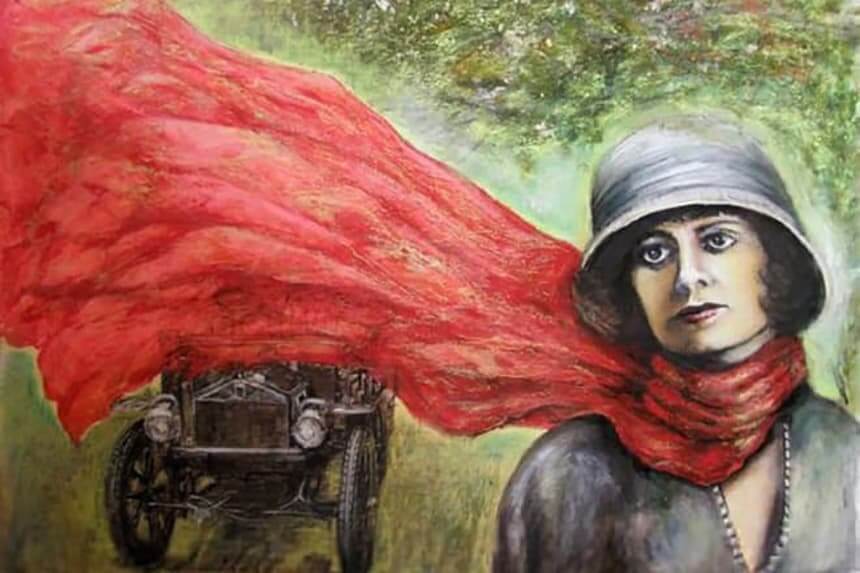
Then Isadora realized that she was not meant to be happy, that her destiny was loneliness. From now on, work is the only thing that holds her back in this life. There is a new detail in the dancer’s stage image – a long red scarf that stood out like a bloody wound against the white tunica. It symbolized the wound that was not healing in her heart.

In 1917, 6 of the first of Isadora Duncan students were adopted by her and were given the name Duncan. This was done so that during the tour to the U.S. there were no problems associated with the German origin of the participants in the tour.

Duncan and Esenin.

In 1921, Isadora Duncan met Sergei Esenin, a famous Russian poet who was 18 years younger than her. It was a bright and discussed love affair because despite the language barrier and age difference the couple was madly in love. At first, they lived in Russia, but soon Duncan had to go on tour to America. To go abroad together, the couple got officially married in 1922. While they lived in Russia, the relationship developed perfectly.

But abroad Esenin stopped writing, began drinking, and most of all he was annoyed that no one here knew him as a poet Esenin. Marriage was officially dissolved in 1924, although a couple separated earlier: Esenin left Duncan and went to Russia in 1923. Two years after the divorce, Duncan received the news of Esenin’s suicide, which also left a sad trace in her soul.

Fact!

Duncan was bisexual. For example, after Esenin, she had an affair with American poetess Mercedes de Acosta. The letters that the girls wrote to each other told historians much about this relationship.

Death

On 14 September 1927, at the height of her fame, the dancer was to give a concert in Nice. A legend that became famous later said that a moment before getting into the car, Isadora exclaimed to her fans: “Goodbye, friends! I’m going to glory!”. The driver touched the car from his seat, but neither he nor the dancer noticed that a long red scarf wrapped around her throat caught the rear wheel axle. After stretching out, he literally strangled Isadora Duncan. The body of the great actress was cremated and the ashes were buried in Paris’ Per Lachez Cemetery.

Dunkan's death.

Dance Heritage

Virtually no video recordings of Isadora Duncan’s dance remained, because the dancer herself believed that the dance could not be recorded, that this is a specific energy that exists right at the moment of the dance.

There is still a perception that Isadora Duncanwent into some kind of trance and improvised when she came on stage. That is certainly not true. According to a June Layson research, Duncan staged almost 223 dances + 20 in “Iphigenia”, of which 176 for herself, 47 for the students.

Innovations introduced by Duncan:

  • The barefoot dance – nobody recognized barefoot dance before her.
  • Light Tunic – Duncan always said that dancing should be about nudity, and tunic helped to show the contours and shape of the body.
  • Music by “serious” composers. Whereas previously ballets and dances had been put on special music by special composers, Duncan chose music by “serious” composers.
  • Cancellation of the corset. At the end of the 19th century, women still wore corsets, but Duncan believed that a corset ugly the body and its shape (including in everyday life).
  • The emancipation of the woman. Duncan fought for a woman’s right to live the life she chooses.

A lot of people say that Duncan didn’t have the technique. In fact, her dance has certain common features, which can be called a Duncan technique.

Component technicians:

  • solo dance (she was the first one to dare to go on stage without an entire troupe of artists);
  • running;
  • jumps;
  • steps;
  • flowability of movements (one movement flows from another);
  • pantomime;
  • expressive gesture.

The origins of Duncan’s choreography:

  • Antiquity;
  • Renaissance;
  • German romanticism;
  • Symbolism;
  • Modern;
  • the dance of the future (the dancer really forced the concept of the dance of the future, because if we now read her essay, published in 1903, we understand that all her prophecies have come true, that the dance really exists for life, the dance somehow corresponds with the forms of the one who moves, etc.).

Dance of the Future Concept

Duncan has developed his own philosophical views. She believed that learning to dance needed everyone to make it a “natural state” for people. Under the influence of Nietzsche’s philosophy, Duncan wrote the book Dance of the Future.

According to her beliefs, it is in the dance that a person is able to express his highest ideals and the process of his own formation as self-overcoming. For Duncan, dance is an affirmation of life, health, sensuality, an expression of life’s impulse.

The main requirement of Duncan is to radically reconsider views on dance, to recognize it as a “high” kind of art, to use symphonic and opera music, to express spiritual impulses through dance. The ideal of Duncan becomes the dancer of the future – a new harmonious man, living in harmony with nature, with his soul and space.

The beautiful movements of this new man should express the impulses of the soul and correspond to the forms of his body. Dance, as Duncan thought, is not an exercise and pirouettes, it is an exaltation of life, theopractics, it is an alternative to the word means to generate ideas. The movement, as she thought, does not need to be thought up, it needs to be invented.

She thought nature was the source of the dance. But Duncan also saw nature in a philosophical way. She learned to observe nature: the movements of waves, clouds, trees, and always sought to bring in his movement a little divine sequence that is inherent in nature.

Another interesting statement by Duncan: “Will is expressed through the use of gravity”. That is, Isadora, denying the unnatural forms of ballet that struggled with gravity, on the contrary, believed that one should feel one’s body, used earth, and gravity to express one’s dance and form.

For her, dance is not only an art but also the basis of a whole concept of life, more refined, natural. Duncan brings morality, beauty, and health to dance. Beauty as understood by Duncan is truth and harmony.

Sources:

  • June Layson “Isadora Dunkan: A Preliminary Analysis of Her work” Dance Research: The Journal of the Society for Dance Research.
  • isadoraduncanarchive.org

William Forsythe: a Revolutionary Look at Classical Dance

Improvisation and choreography are equal partners in a dance. Improvisation is the most important direction of choreographic thinking, it organizes the form of dance and the specificity of dance performance. One of those who made a serious contribution to the art of improvisation as a method of searching for choreographic vocabulary and a tool for developing creative thinking is William Forsythe.
William Forsythe on a stage, talking to dance students
Photo by Marlon Barrios Solano on Flikrr (edited to adjust sizing).

Researchers of modern dance rank Forsythe’s improvisation as postmodern improvisation, or the art of dance performance. Forsythe system has been shaped and honed for 15 years. And in 1994, it was designed in a specialized video manual “Technologies: A Tool for the Analytical Dance Eye”, which is still used for training new dancers of Forsythe’s troupe and is also a part of training professional dancers of modern dance in Europe and the USA.

About William Forsythe’s work and his influence on modern dance – read below.

Life and Career

William Forsythe is a ballet master, a specialist in the field
of modern dance, a researcher of the specifics of human body movement and improvisation. He was born in New York in 1949. He got his choreographic education in Florida. He got at the first dance class at the age of 17 with his roommate by accident, having absolutely no idea what the lesson will be.

In 1971 he joined the Joffrey Ballet (a company famous for the works of contemporary choreographers). It was there that Forsythe first saw Balanchine’s ballets on the stage of the New York City State Theater, which undoubtedly contributed to his development as a researcher of dance and choreography.

Since 1973 W. Forsythe has been working in Germany as a performer in the Stuttgart Ballet. Already in 1976, he was appointed ballet master of the company. For this company, he created his first neoclassical miniature – “Urlicht” – a duet to music by Gustav Mahler.

In 1984 William Forsythe became the head of the legendary Frankfurt Ballet and continued to be so until its closure in 2004. At Frankfurt Ballet, the choreographer worked on productions such as Artefact (1984), Steptext (1985), In the Middle, Somewhat Elevated (1987, Paris Opera), Impressing the Czar (1988), Limb’s Theorem (1990), Loss of Small Detail (1991), ALIE/NA(C)TION (1992), Eidos:Telos (1995), Endless House (1999), KAMMER/KAMMER (2000), and Decreation (2003).

His productions are part of the repertoire of the world’s major theatres, including the New York City Ballet, London’s Royal Ballet, Paris Opera, National Ballet of Canada and the Netherlands Dance Theatre.

This period of the ballet master’s work is characterized by a special radicalism: he puts on performances that are completely different from classical ballet, transforms the aesthetics of classical dance, proclaims freedom in dance from any canons and narratives.

In 1994, the program “Technologies: A Tool for the Analytical Dance Eye” was developed and released.

After 20 years at the Frankfurt Ballet, William Forsythe founded his Forsythe Company troupe in 2004. In addition to appearances at the main venues in Dresden and Frankfurt, the artists were active on tour. Forsythe has staged such ballets for the new company:

  • Three Atmospheric Studies (2005);
  • You made me a monster (2005);
  • Human Writes (2005);
  • Heterotopia (2006);
  • The Defenders (2007);
  • Yes we can’t (2008/2010);
  • I don’t believe in outer space (2008);
  • The Returns (2009);
  • “Sider” (2011).

He worked as a director and ballet master until 2015 in the troupe. As the reason for Forsythe’s resignation, the need to reduce workloads due to health reasons was reported. However, Forsythe has remained a consultant for the company, a guest lecturer and teacher, one of the co-directors and teachers of the European Dance Students’ Network program. The directorship of the Forsythe Company was taken over by Jacopo Godani under a new name The Dresden Frankfurt Dance Company”.

Forsythe produces and participates in the creation of a large number of architectural and performance installations. The installations have been exhibited at the Louvre, the Venice Biennale, and other important venues. His short film “Solo” was presented in 1997 at the Whitney Biennale.

The choreographer has also received special recognition in the field of fine arts, organizing amazing installations, whose viewers themselves become participants in the action.

Today Forsythe regularly holds lectures and seminars at various universities and creative organizations. He lives and works in Vermont.

Exhibitions

Special attention we should pay to Forsythe’s work in the fine arts. The project “Choreographic Objects” includes various installations, including interactive ones. Over the past few years, they have been shown in many museums.


Some of its current* interactive installations:

  • The Fact of Matter (Brisbane, Australia) – December 7., 2019 – April 26., 2020;
  • Acquisition/Körperschaft (Hasselt, Germany) – March 14. – May 10., 2020;
  • Aufand, Doing and Undergoing (Besançon, France) – until April 26, 2020;
  • City of Abstracts, Human Writes Drawings, Backwords (Essen, Germany).

* Expositions are temporarily closed due to the Coronavirus pandemic.

“City of Abstracts” is scheduled to be shown in Essen at Art Basel on September 17-20, 2020.

Forsythe’s Technologies of improvisation

In 1994 the computer program “Technologies: A Tool for the Analytical Dance Eye” was presented. Until now, it is actively used in the process of training dancers of different levels. This work deserves detailed consideration because its importance for the dance world is immeasurably great.

Improvisation technologies basically use the geometrical approach, working with lines, arcs, corners which form a body of the dancer. It was important for Forsythe to use what his dancers already knew. Since they were graduates of ballet schools, they were used to working with lines in body and space. This approach allowed the dancers to forget “how to move” and focus on the inner part of the movement, to overcome “numbness” in improvisation.

The choreographer shows simple movements and techniques in the program. The main purpose of his training is to teach the mind of a dancer to analyze movement in geometrical categories, corresponding parts of his body in space.

It’s useful!

Check out the program, even not only for ballet dancers. You will definitely learn a lot about your body.

For example, here are a few techniques from Forsythe’s technology. In his video lessons, the choreographer shows how to work with lines. For example, you can create an imaginary line with body parts and “move” that line in space, or you can create the same line with one of your body parts. You can also create a line by “pulling” it out of a point, or you can stretch not just a point but an entire line and create an imaginary plane.

You can extend the line by unbending a joint, for example, an elbow. You can work in the parterre by building movements along imaginary lines on the floor. The technique of getting into the line is to find a way that you can “get” into the imaginary line by a part of your body.

William Forsythe’s New Ballets

After leaving Forsythe Company in 2015, the choreographer has staged several ballets:

  • «Blake Works 1» for the Paris Opera Ballet;
  • «Playlist [Track 1, 2]»;
  • «A Quiet Evening of Dance»;
  • «Playlist (EP)» – the work for Boston ballet company;
  • «Artifact Suite».

Influence on modern dance

With the death of George Balanchine, the era of great discoveries in ballet was coming to an end, and few people believed in the possibility of a new revolution in dance. Nevertheless, the postmodern era has made its mark and proclaimed in dance freedom from any canons.

The improvisation and value of the moment “here and now”, the study of the movement and limits of the human body, the importance of the process rather than the final product of art – all this became the basis of contemporary dance. It was William Forsythe who brought ballet into the realm of marginal art, making it speak about contemporary ballet.

The avant-garde Forsythe has pushed back the boundaries of what is generally accepted: while in classical dance the position of arms and legs is fixed, Forsythe gives freedom to both arms and legs, and head. This also applies to his methods of working with dancers.

Improvisation – the main method of working with dancers – requires not only freedom to own their own body in space, but also freedom of thought. In this case, the intellectuality can be called one of the most precise characteristics of the specificity of W. Forsythe’s works.

Opinion!

Forsythe is a new turn. It’s basically a classic, but as if turned from a different angle… It’s as if you look at it through some special optics – and you get Forsythe.

At the same time, despite this release of thought and body, William Forsythe’s approach to choreography is surprisingly algorithmic. Through systematic exploration of the boundaries of space and time, the potential of the body and the mechanics of movement, the choreographer has developed his own author’s method of dance geometry and thus gives rise to a characteristic Forsythe’s style of movement.

The imagery and abstractedness of Forsythe’s ballets deserve special attention. After all, not every spectator is ready for a Forsythe’s form of interpretation, hence the complexity of perception. We can state the mechanical or geometrical style of dance plastics, but certainly not the lack of content.

Forsythe is simply not interested in stories and characters that are important in classical ballet. What is more important in these works is the emotional dynamics of the performers, the way the change in body movement determines the changes in a person’s emotional state. An abstract stage reality is formed on stage, within which a multivariate narrative of philosophical content is performed.

Dance critic Roslin Sulkas highlights the following features in the work of William Forsythe:

  • the presence of so-called “flickering movement” (based on elusive points of presence), performed by dancers with classical training, that is professionally developed in the aspect of ballet plasticity;
  • the use of the principle of inclusiveness – the possibility of including elements of absolutely any kind in the dance, both on the technical and conceptual sides;
  • approach to the realization of a complete work on the basis of the concept of “one theatrical universe”, where each element is a significant part of the multidimensional structure of the dance;
  • the development of a plastic language based on personal ideas of movement, where each element is endowed with volume.

We can’t help but mention the improvisational inserts in Forsythe’s ballets. Certain parts of the composition are performed by dancers in accordance with the concept of dance at their own discretion based on their own vision. Thanks to this, each display of a dance piece becomes unique and each broadcast gives a new reading to the work.

By its nature, modern dance is “dance of the head”, i.e. choreography that stimulates thinking tone not only of the dancer but also of the viewer in the process of perception of dance. Such mutual work of the ballet master and the viewer gives the necessary body and emotional contact. Then the viewer leaves with a huge plume of emotions and thoughts after the performance.

William Forsythe does not like to repeat himself, he always speaks to the viewer through his work in different ways. And no one knows what this choreographer will present to the public next time…

Conclusions

Doesn’t matter whether we call Forsythe by The New Balanchine or The Classic of the Ballet Avant-Garde, many today consider him one of the most important choreographers working today. Having traversed in his life from a dictatorship of ballet to a free of contemporary, William Forsythe has struck the ballet world with radicalism and experimentation. He has transformed and continues to transform the aesthetics of classical dance, has led to a rethinking of the importance of dance improvisation and has made an invaluable contribution to the training of dancers around the world.

Sources: