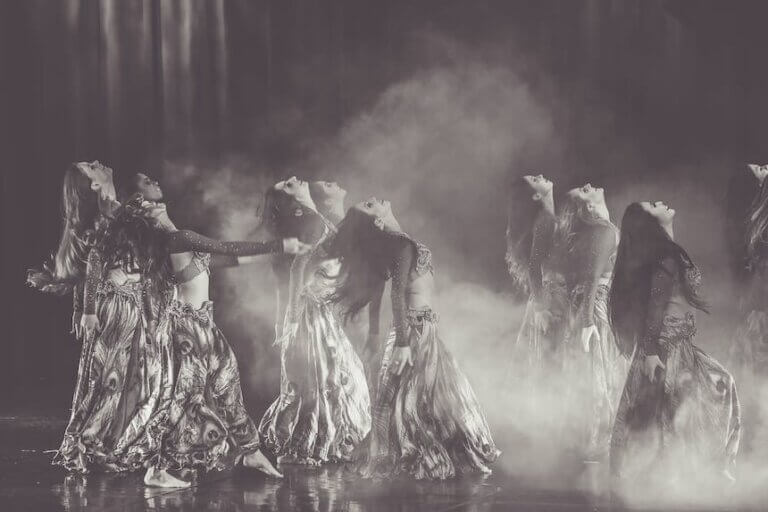
Arabian dance, just like the many other dance styles, is not only about the movements. It has a wide range of costumes and accessories like the sword, the veil and tambourines. They fill the stage with glitter, and are laced with sequins to make an impact in front of the public.
These costumes have been created to make each movement stand out. The best known Belly dance costume is very sensual, with a pronounced neckline, but not all of them are like that. We have in other articles looked at what is belly dance and famous belly dancers – In this article we’ll give you a wider taste of the heritage and splendour of the many dance costumes styles used in Arabian dance.
According to the rhythm that is performed, the bodice changes. Sometimes a transparent vest is placed on top of the bodice. The dancer’s abdomen is always uncovered so that her movements can be shown off. There are thousands of designs around the world, usually with sequins to shine in conjunction with the stage lights.
Belts
In addition to being used in rehearsal classes, they are also used in dance or performance costumes. These as well as the bodice are designed in Egyptian fabric and sequins or lace according to the taste of each dancer.
The hips move quickly and with force in each movement. That is why the belt must have clothes fastenings in the back, so that it does not come loose while dancing. You have to be very careful about that.
Skirts
The skirt is the element that gives the softness and style to the dance costume, as it has lace at the bottom. It can have a short or long opening at one or both sides, but most of the time the skirt must show a part of the leg, and not precisely to show sensuality. It must be like that so the dancer can move with ease around the stage with greater confidence.
Turkish and Egyptian Arabian dance costumes
The most popular producers of Arabian dancing costumes are Egypt and Turkey. However, each has things that make them unique.
Turkish costumes exude an ethereal quality, characterized by their airiness, shimmering textures, and remarkable flexibility. Their construction is often minimalist, incorporating wired frames beneath delicate fabrics for both belts and bodices. This unique design enables costume artisans to craft shaving shapes along the edges of these essential components.
The artistry doesn’t stops there; sculptural effects adorn the body of these costume through intricate beadwork and sequins. Three-dimensional marvels come to life as row of sequins are meticulously sewn with bead spacers, forming captivating floral, butterfly or star patterns.
The pursuit of subtle iridescence is realized through the delicate overlay of sequins. The ensemble is further elevated by the inclusion of delicate fringes, varying in length, bead colors and sizes.
When compared to their Egyptian counterparts, Turkish costumes offer not only aesthetic appeal but practicality as well. They are renowned for their comfort and ease, and they often come in complete sets, with charming sequinned accessories like headbands, hand pieces and necklets.
But they do have a drawback. While many Turkish costume makers have transitioned away from using delicate, easily breakable threads, those who engage in vigorous or frequent dancing may find themselves perpetually engaged in maintenance.
As for the spectators, in order to really appreciate the full impact of the Turkish costumes, the dancer has to be in close proximity to them. The subtle nuances of the crafted beadwork and overlays can be easily looked over in a vast room. Actually, they leave a very significant impression when shown on a table or hung in a wall, as thought they were works of art deserving of admiration.
On the other hand, the Egyptian belly dancing costumes are an embodiment of retro glam and glitter. They are a complete spectacle, with their glimmer which can be seen from afar. They have an innate way of captivating the audience, and they showcase and enhance a dancer’s movements with marvellous precision.
The design and making of these costumes can be equal to that of an Egyptian monument. They are made to last: the bodices and belts are crafted from heavily stiffened, heavyweight buckram, which is decorated with sequins, stones, fabric, beads and and sometimes adorned with fringe and beaded fringes.
Egyptian costumes endure the rigours of performances, and maintain their form independently. This robustness extends to gowns, skirts, veils and all other professional-level accessories hailing from Egypt.
Nonetheless, this opulence comes with a price: altering an Egyptian costume can be very challenging. They are weighty, have a limited flexibility and can cause discomfort and scratching too. Also, finding a well-fitting outfit can be a difficult task. The basic bra is only available in few styles and 3 sizes, so there’s little room for adjustments.
Raks al shamadan
This dance is also known as “candelabra”. It is normally danced at weddings, and during the procession, the dancers and musicians follow the dancer with the candelabra, as in guiding the groom and bride and lightening their way.
This is danced with either the traditional belly dance costume, or with a full dress with no neckline with long sleeves. Sometimes, the dancers might wear a veil underneath the candelabra.
Ghawazee
The Ghawazee costumes evolved pragmatically, influenced by regional styles and fashion trends. Contrary to misconceptions, they resembled everyday Ottoman women’s attire, with added hip scarves for dance.
The Maazin sisters, renowned for their performances, crafted elaborate, heavy skirts to establish their unique identity. These costumes weighed over thirty pounds, with styles shifting over time. Ghawazi performers in Luxor, Quene, and Esna wore 1.5″ heels or wedgies. They also creatively used vintage 1950s jewellery in their crowns, adding charm to their performances.
Beledi
Beledi means “my home town”. This dance has a distinct dress. It is long, close-fitting and of floor-length. The Beledi dress is accompanied by a scarf on the hip and another on the head. Its usually made of natural fibres (like cotton), giving a very folkloric look. It also uses glittery fabric and or sheer, which is used for cabaret belly dance performances.
Khaleegy Dress
These dresses are also known as “Saudi Thobe”, and in arabic its called Thobe al Nasha’ar. It is used for folkloric dances from the Persian Gulf. It is a wide, rectangular tunic and the fabrics are usually transparent, and have heavy embroidery on the wrist, neck and chest areas, as well as bright embellishments and ornaments. It is accompanied with earrings, necklaces and bracelets.
Gallabiya
This dress is the traditional garment of Egypt, and its used daily by both women and men. It’s a full-length dress, and it’s not always used for dancing. Belly dancers use the Gallabiya to cover themselves up before or after dancing, whether to maintaining some mystery, or to differentiate their performing time to their downtime.
Belly Dance accessories:
Finger Cymbals: In belly dancing the cymbals are played by the dancer accompanied by the darbouka. Also called zils, a word derived from the Turkish “zilya”, which means cymbals or zagat, in the Arabic language. These were sacred instruments around 1000 B.C. Used in Turkey and from Arabia to Morocco
The Sword: this element is used in the dance known as Raks al Sayf. The sword dance uses a slow rhythm, such as the masmudi, to execute delicate turns and movements with the sword balanced on different parts of the body such as the head, hips, bust, belly or limbs, although faster rhythms can also be incorporated if desired. The sword is a symbol of male power and therefore this dance expresses strength, imposition, precision, and struggle, so although the dancer dances with grace and sensuality, her expression must accompany the symbolism of power and defiance.
The Veil: In the West the veil has had a great reception, however the importance given to it depends a lot on the country, in Egypt for example it is uncommon to see dancing with veil, since in some places in the East its use is interpreted as a kind of striptease and therefore or do not use it or do it very briefly, shedding it quickly to not discomfort the public. In Lebanon, on the contrary, it is given a lot of importance and many turns and movements are made with it, exploiting to the maximum the possibilities it offers.
Other known dance accessories:
Silk veil fans
Isis wings
Candelabra
Tambourines
Asayas (“canes”)
So hopefully that’s given you a little taste of the breadth of Arabian dance costumes out there.
Belly Dance, at its most basic can be traced back for centuries (and even possibly millennia). It is within the past century, roughly the last hundred years that this dance underwent a metamorphosis into the art currently identified as ‘raqs sharqi’ or more commonly known, as ‘belly dance’.
This fascinating evolution owes a considerable debt to the incredible women who etched their names as the stars of belly dance, and those who have continued their legacy.
That’s why today, we want to show you who a few of these women are. Get comfortable lets take a tour of, famous belly dancers, artistry and history!
Photo of belly dancer by vishnudeep-dixit on Pexels
The godmother of modern Belly Dance: Badia Masabni
Badia Masabni, unknown photographer, Public domain, via Wikimedia Commons
As always, one must start at the beginning. So the first place of this list goes to Badia Masabni. She is considered the creator of modern belly dancing. A vibrant Syrian/Lebanese actress and dancer, Badia embarked on a journey to Egypt where she established a pioneering music hall in Cairo during the 1920’s. This venue showcased an eclectic array of talents, spanning singing, rhythmic dancing, and number of captivating entertainment acts.
The indelible mark of Badia lies in the evolution of belly dance — a transition from its traditional origins to a vivacious stage performance tailored for larger audiences. This evolution introduced features like ballet-inspired arm movement and graceful lines and a dynamic utilization of space through intricate traveling steps. It was also an innovation to include the veil as a compelling prop. Unsurprisingly, she was named “The Godmother of Belly Dance” because of her profound influence.
Also, beyond these contributions, Badia played a pivotal role in shaping the careers of two prominent figures in belly dancing, Samia Gamal and Tahiya Carioca. Her legacy continues.
Famous Belly dancers from Egypt:
As Egypt is a spiritual home of Belly dance, it makes sense that 8 of our list of 19 originate from here (with several of the others being drawn to Egypt and other parts of the Middle East, Africa and Arab World at later points in their lives).
Dina Talaat
Dina is renowned in Egypt and beyond, not only for her belly dancing but also for her vast acting talents. She was born into affluence, then worked her way to a degree in philosophy. The roots of her dancing journey trace back to her involvement with a folk group at the tender age of nine. This was the outset of her artistic journey.
As the 1980s unfolded, Dina’s solo career grew, elevating her into fame. Dina’s pathway into belly dancing was unfortunately riddled with resistance from her family. Her passion for the dance style ignited arguments and ultimately distanced her from her parents. This persisted for a staggering three years, before reconciliation.
In stark contrast to some of the more traditional Egyptian belly dancers, Dina stands out for her own distinctive style. She has a very expressive aura, and uses unconventional attire, far removed from the established norms of Egyptian belly dance costume.
Dina’s resilience and audacity, are traits that, combined with her dance talents, position her as an avant-garde force in the world of belly dance. Her dance form is revered for its seamless beauty and graceful fluidity.
Amie Sultan
Growing up and working extensively across Egypt, Singapore and South Est Asia, Amie Sultan initially pursued a career as a ballerina, dancing key roles in ballets such as SwanLake and Don Quixote. Whilst on tour in 2014, she discovered the beauty of Raqs sharqi and there was no looking back.
Having danced across multiple countries and for some of the world’s elite, Amie confirms she is one of the most sought after and highest paid Egyptian dancers.
With a strong profile and following, Amie has appeared in for many of the world’s largest media outlets and uses this as an opportunity to raise awareness of both cultural and feminist issues associated with belly dance.
As with some of the other dancers in this list, she is keen to reduce the sexualized, more misogynistic interpretation and take it take to its roots as a basis for feminine empowerment. She will pick off tricky subjects like “How to treat a Belly dancer by a Bellydancer”. However, Amie prefers terms such as ‘Dance of the East’, Egyptian Dance’ or Baladi Dance’ as an alternative to the term to “Belly Dance” as a more accurate cultural descriptor.
Amie is an advocate of preserving the dance, one of the appeals to her, in her words: “dance and music is a heritage art and an expression of civilization” She is working on getting the Egyptian dance recognized by UNESCO to register the dance as a national intangible heritage to help safeguard this art form for future generations.
Soheir was born in Mansoura 1945, and moved to Alexandria, Egypt at the tender age of nine. Her initiation into the world of dance unfolded through the captivating allure of cinema.
As Soheir immersed herself in movies featuring renowned dancers like Taheyya Kariokka and Samia Gamal. Soheir drew inspiration from their performances.
Soheir Zaki started her journey initially through wedding performances. However, once spotted by a television producer called Mohammed Salem, it wasn’t long before the glimmer of TV and the silver screen beckoned her, with opportunities to grace over a hundred movies between the 1960’s and 1980’s.
A frequent dancer in Egyptian nightclubs and venues, Soheir has danced for a number of famous world leaders and politicians.
Soheir Zaki’s charisma and talent has made her one of the most celebrated and sought-after dancers of her time. Even after her ‘retirement’ as a dancer, Soheir taught belly dance in Cairo.
Samia Gamal
Samia_Gamal by alwafd.org, Public domain, via Wikimedia Commons
Samia Gamal, who earned the honour of being known as the “Queen of Oriental Dance was born 1924, growing up in Cairo, where she first became captivated by dancing. She trained professionally ballet and modern dance alongside her passion for belly dance
Samia’s career started at Badiaa Masabni’s Opera Casinoand eventually became a film actress during what was said to be ‘the golden era of Egyptian cinema’ in several musical films.
Also known for an ability to dance barefoot and making a large contribution to the evolution of belly dance costumes. Samia Gamal passed away in 1994 but leaves a legacy which continues to inspire.
Photo of Nagwa Fouad, Public domain, via Wikimedia Commons
Nagwa Fouad born 1936), is a belly dance celebrity who found fame in the 1960s. She is known for combined traditional oriental dance with more modern choreographed stage performances, to an enchanting result.
Like several others on this list, Nagwa Fouad’s career began in the Egyptian film industry, where she was an actress and dancer in several movies. Catching the attention of composer Mohammed Abdel Wahab, in 1976 he wrote an entire musical piece exclusively for her dance show, titled “Amar Arbatashar” (the Full Moon of the 14th). This marked a turning point from purely traditional dance to more elaborate stage performances.
Throughout her career, Nagwa performed for many famous people during their visits to Egypt. She starred in approximately one hundred television musicals. All of this meant her fame spread way beyond Egypt. She truly was one of the most famous dancers in the Arab world during the 1970s.
Nagwa has often been referred referred to as the ‘Queen of Raqs Sharqi’. Samia, Tahiya, and Naima provided a basis for her style, but she personalised it with her own unique flair.
Nagwa’s style included aspects of acrobatics and drama, creating a truly spectacular performance.
Taheyya Kariokka
Taheyya Kariokka (born 1915), is a belly dance legend. She became an Egyptian symbol of femininity and power. The famous club owner Badiaa Masabni launched her career and she went on to dance in most Arab states and star in many films. In these movies, Kariokka was acted alongside famous Arab movie stars such as as Farid Al Atrache and Mohamed Abdelwahab.
High points in her career included films like “Hubb Hatta Al-Ebada” and “Bint al Hawa”.
Beyond impressive dance skills, Taheyya Kariokka has been known for her influential personality, which led her to participate in various political activities and causes.
Naima Akef
Naima Akef (born 1929) was born in Tanta on the Nile Delta, to a family of acrobats who ran the famous Akef Circus. This upbringing shaped her career – she utilized a wide variety of talents in circus skills, acting, singing, and dancing – which made her relatively unique in her early career performing in nightclubs.
Naima was nominated as best dancer in a folklore contest at the Youth Festival in Moscow. Naima Akef’s exceptional skills meant a successful career in Egyptian film, with the first musical film being The first of such films was “Al-Eïch wal malh” (bread and salt).
Naima Akef’s life was tragically cut short, as she died of cancer aged 36, in 1966.
Fifi Abdou
Fifi Abdou (born 1953) added extra layers to her belly dance performances, with circus tricks and even rapping! She takes her presentation very seriously, with The Moroccan newspaper La Vie Eco reporting (2004) that she possessed over 5,000 costumes!
Fifi has experienced some difficulty along the way like many of the dancers. 1991, she was charged with ‘depraved movements’, being sentenced to jail for three months.
In addition to her success as a belly dancer, Fifi Abdou also was a model and actress in Egyptian films and television. With charm and charisma she is known as a well-rounded and versatile artist.
Fifi retired from belly dancing in the late 1990s, now one of the wealthiest women in Egypt and philanthropist.
A special mention for Mohamed El Hosseny, the only man on this list. He is a notable Arabic male belly dancer who carved his name into dance history. Aged just 9, his artistic journey began through music.
However, it was his stint as the accordion player for a youthful folk dance ensemble at eleven that ignited a dance passion within him. For Mohamed, dance isn’t merely a performance, it’s carries messages and energy, flowing through his entire being.
Mohamed has graced numerous television shows, securing his identity as Egypt’s trailblazing male dancer. His background in ballet has given him an unparalleled mastery over his dance technique, strength, and body.
Hosseny’s expertise transcends a numerous dance styles. These include the vibrant tapestry of Egyptian folk styles including Fellahi, Nubia, Saidi, and Simsimiyya (the dance of his hometown Suez) to the more contemporary strains of Oriental dance.
Today Mohamed El Hosseny runs a dance school which carries his name, contactable via www.elhossenydance.com/ giving classes primarily in Helsinki, Finland, as well as further around the world. As a teacher, he is known to be patient but demanding, giving his students a solid basis in techniques, as well as the choreography.
Famous belly dancers from elsewhere across the Middle East, Africa and Arab World
Sofinar Grigoryan (Safinaz)
Sofinar Grigoryan born 1983) known by the stage name Safinaz, is an Armenian belly dancer who has gained very popular across the Arab World. Initially a ballet dancer but she found fame in belly dance and moving into acting, appearing in several major films since 2013.
Safinaz hit the global news on more than one occasion, where she has danced with the Egyptian flag colours in her dress or the fans she was using as a prop, which was frowned upon by the Egyptian courts.
Didem
Born in 1986 into a Turkish Romani family, deeply ingrained in the traditions of live music and dance, Didem Kinali had family roots deeply embedded in the rhythm of performance.
Didem’s initial foray into the world of dance took place within the embrace of Avcilar, a suburban enclave that witnessed her earliest steps on the dancing stage. As her journey unfolded, she embarked on a transformative partnership with her mentor, Sema Yildiz, leading them to the illustrious heights of Takism.
This vibrant district, pulsating at the core of Istanbul’s nightlife, provided the backdrop for their performances to resonate with even greater intensity. It’s her captivating beauty and innate talent converged that leave audiences enchanted and enthralled.
European Belly Dancers: Dutch, French, Ukrainian, Greek
Mata Hari, born as Margaretha Geertruida Zelle. Mata was born in the Netherlands and graces the world as an exotic dancer. The alias by which she is known draws its origins from Indonesian roots, translating to ‘Sun’.
As her name implies, Mata commanded the stage with her enchanting dance performances. Her allure is magnetic, captivating audiences with a tantalizing interplay of flirtatiousness, sensuality and a kaleidoscope of body movements.
Amelia Zidane
Amelia was born in Grenoble France, initially studying to become a children’s psychologist, but followed her passion into dance. She notes:
“I have the music in my blood, the dance in my skin & the Art in my heart”
Since 1994 she’s choreographed a number of her own shows, often fusions with other dance styles such as hip-hop and flamenco.
With several European and world tours to her name, she’s performed in front of hundreds of thousands, if not millions of people, in major media outlets and alongside superstar musicians, DJ’s and dancers. Take a look at Amelia performing.
Lia Verra
Lia Verra is distinguished not only as a performer, but also as a choreographer, dance instructor, and the driving force behind the esteemed international LDB Greece festival.
Although born in Greece, she grew up in Germany, where she first began to dance. On the way she earned a dance diploma – studying Latin and Ballroom dance, as well as classical belly dance.
One of Europe’s most triumphant and exceptionally gifted Oriental dancers, Lia Verra captivates her audience with performances that are an embodiment of natural grace, elegance, and sheer breathtaking allure.
But the influence of Lia extends far beyond her enchanting performances. Lia Verra’s presence serves as a continued source of inspiration. Today she teaches students and teachers alike in person but also through her online dance classes. Find out more at her website: https://liaverra.com/
Alla Kushnir
Alla Kushnir (born 1985) is a renowned Ukrainian belly dancer and choreographer. She says “I was very lucky to become a performer of Oriental dance. He helped me achieve harmony in myself”.
Alla has been a finalist in the world championship over four times, as well as ‘Ukraine’s got Talent’Season 1. She Initiated a Ukrainiane Belly Dance Championship and has starred in several TV documentaries. Along with a solid teaching following, Alla is making a significant contribution to belly dance.
Famous belly dancers from elsewhere in the world (North America / USA, Cuba, Columbia)
Rachel Brice
Rachel Brice is a prominent figure within American belly dance. She not only graces the stage with the ‘Bellydance Superstars’ but also holds the roles of artistic director and choreographer within the Indigo Belly Dance Company.
The roots of Rachel’s deep-seated passion belly dance can be traced back to the early 1990’s. Her heart was captured by a performance of Hahbi Ru, an encounter which served as the catalyst for her lifelong love affair with the art.
The display presented by the performers left a permeant mark on Rachel Brice. The opulent fabrics, facial tattoos and tribal jewelry, featured throughout their presentation are said to have captivated her and from there, there’s been no looking back.
Amar Gamal
Amar Gamal (born 1975) is originally Cuban but grew up in Florida. Amar started to belly dance at the aged 13, next perform with the Mid-Eastern Dance Exchange company, Miami Beach. Amar also trained in various other dance styles, including tap, ballet, and flamenco. She has a captivating stage presence and exceptional talent.
Amar Gamal has been a high calibre teacher at dance institutes in the United States As a mentor, inspiring dancers of all ages and abilities in art of belly dancing worldwide.
She demonstrates well she can teach technique and choreography as a low-impact workout planning classes to also feature cardio, strength training and stretching.
The other thing that Amar achieves through her teaching and wider publicity is ‘reclaiming’ some of the roots of the dance, through weaving history and culture into her lessons and addressing some of the misconceptions. In this interview with Amar in the Boston Voyager, Amar shared:
“Teaching belly dance has helped me bring awareness of the beauty of this dance not just as a cultural dance but, also as a women’s empowering dance”, “and not for the sole purpose of the male gaze and seduction”.
Shakira
Shakira, yes that’s right, the Latin American recording artist, who has achieved global stardom. Born 1977, in Barranquilla, Colombia. As well as her singing, is known for her enchanting belly dance performances becoming a core part of her on-stage presence.
Shakira has blended belly dance with her own modern contemporary style but also a sheer dedication to belly dance as an art form over the expanse of her career.
Wrapping up:
All of our dancers on this list, whether from the golden age of Egyptian cinema or in todays social media fuelled world, have achieved extraordinary things. There are many others we would love to have covered, but we would have need ed a book!
Many hail from outside of the traditional homes of belly dance but all are making their own contributions to the promotion, heritage and evolution of this memorizing dance style.