The “Arabian” Dance in The Nutcracker

Christmas is around the corner, and if you are a Ballet enthusiast like me, you probably know that The Nutcracker recital has come to almost every city around the world.

If you need to become more familiar with it, then let us introduce you. The Nutcracker is an old but beautiful ballet performed each year and full of capturing stories about magic land. It was set on a Christmas Eve by Tchaikovsky, with legendary Marius Petipa and Lev Ivanov as the choreographers, and is an adaptation from E.T.A Hoffman’s story.

This classical ballet has many dance pieces from different cultures, like Spanish, Chinese, Russian, and Arabian. “The Arabian” dance in The Nutcracker is what this article will concentrate on today. It is an intriguing and elaborate scene inside this whole ballet and opens the audience up to different cultures, through the various the dance styles.

As someone experienced in both ballet and Arabian dance, today I hope to demystify this dance in the Nutcracker a little, as well as how all of these elements influence audiences and viewers.

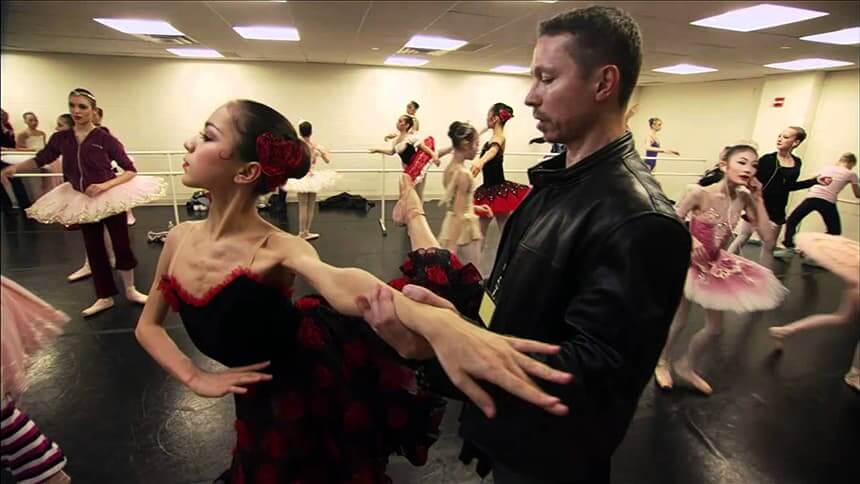
A version of The Nutcracker dance by the City Ballet Academy.   See  an alternative interpretation here by the Boston Ballet. Both lack some of the elements originally true to the performances of years past.


The Westernization

The Nutcracker was first introduced in 1892 at the Maryinsky theatre in St Petersburg. Through the ages, this ballet experienced various choreographic transformations in response to the evolving audience’s taste. “Arabian” dance, a passage of the second act, is probably the most famous one.

The notion of orientalism in discussions regarding the dance is the Western view (specifically the British, French, and Americans) – a animated version of the Middle East:

“a place of romance, exotic beings, haunting memories and landscapes, remarkable experiences” (French Journalist 1975).

Its an image that originally held of the Middle East—a romanticized land inhabited by people who seem different to the typical Westerner in a seemingly eerie setting. Similar to the Orientalist dichotomies, this fictionalized Orient creates one homogeneous identity type characterized by its essence. “Arabian” dance comes as an interpretation of some exotic aspects of Middle Eastern culture but in the style of Western performance.

Editors note: It’s worth saying at this point that what is being described are ‘original views’ of a western society from around 130 years ago, at a time when the Nutcracker was first released and society was less global in its outlook. Today ballet companies are adjusting these particular Acts in the Nutcracker to reflect a more modern, inclusive audience.

Choreographic Variations

The Arabian dance has many variations, some of them have “Egyptians Marilyn Monroes” in pointé, some other focus on the “sultan and harem” scene, portraying a stereotype of lazy men and eager to please women. For example, the typical portrayal of the male forms the foundation of another comedic harem storyline of this ballet. This narrative was a recurring feature in the Louisville Ballet’s Nutcracker for many years.

It depicted a turbaned man adorned in harem pants and a sparkling vest, accompanied by a woman who, while potentially his wife, assumed the role of his servant. The man ostentatiously sipped coffee while the woman dutifully trailed him, replenishing his cup as necessary. She also engaged in acrobatic feats, such as supporting his cup on her extended foot as she lay on the floor or on her bare stomach during a backbend, effectively transforming herself into a makeshift table. We were trying to find a video of this somewhere but are struggling, if you come across one, please share with us.

Nonetheless,  some other versions have a regal look, or an enigmatically cerebral air. The choreography of the Arabian dance has a “vocabulary” of difference, with movements that feature supine postures and angled limbs that have been part of the orientalization of ballet since the nineteenth-century Romanticism period, when the fantasies of fancy harems where the trend. Of course, much of what was originally featured is less inclusive for todays modern audiences and hence ballet companies moving their choreography on.

Interestingly, there is not a single form for what is called the Arabian dance. It has been reworked by different choreographers since it premiered and some of these do go against the normal conventions. Slow-moving and dreamy dances choreographed differently are typical for these sections. Balanchine decided to work it differently, with uncharacteristic briskness that challenges the norms of this specific dance piece.

The movements… are they really Arabian?

Belly dance and Arabian dance costumes
Photo by Vidal Balielo Jr. via Pexels

Even with the many differences, the traditional version usually comprises unique steps that have been persisted through various productions of The Nutcracker. These include distinctive “Egyptian” angled arms, resembling images painted on the old Egyptian vessels. Also, a deliberate slow walking style that has dipping or bobbing motions trace back to the bharata natyam, which roots to ritualistic ambiances.

The “prayer” gesture that involves palms being joined together on the chest or above the head seems more aligned with the dance forms from India other than those of Arabian origin. The lack of precision in the use of “Arabian” is evident within Clara’s dream world and, indeed, in the broader Western context.

Musical Accompaniment and Emotional Impact

Arabian dance in the nutcracker
Image via pexels by Valeria Boltneva

To craft the “sweet and enchanting” music requested by Petipa for the “Arabian” dance, Tchaikovsky initiated the composition by incorporating an aged Georgian lullaby, infusing it with a gentle yet persistent rhythmic motif. The outcome conveys an ambiance often described by musicologists, without apparent controversy, as “Eastern languor.”

However, the music’s background is quite intriguing. The lullabies of Georgian origin, which have been sung to cure sick children through history, give earthiness to the dance and create a magical mood. There is no doubt about the relationship between the music and the emotional effect of the dance, which has an additional depth to the overall experience.

This further reiterates that the Arabian Dance elicits emotions from audiences. In essence, for many, the dance represents the mystical world into which people are temporarily transported; hence the ability to mesmerize the audience. The link to healing traditions as well as the earthly aspects of the songs give another touch of interest for the audience interaction with the performance.

In short…

The Arabian dance in The Nutcracker is an intricate exploration of cultural performance and choreographic creativity within ballet. As an ever-changing art form, it goes beyond any set definition and contains different choreography that ranges from traditional representations to mysterious rituals. The evolving nature of this dance challenges conventional norms.

In essence, this dance piece serves as a poignant illustration of how artistic interpretations can shape and, at times, misrepresent cultural traditions. It compels one to think about the continuous Western practice of romanticism and Orientalizing the East, which is now requiring a more true to life representation of different cultural articulations in the realm of ballet. This of course all changes over time and so does ballet, to reflect new societal norms.

Jean-Léon Gérôme Sabre Dance in a Cafe. Oil on canvas painting

Belly Dance Movements: Where Did They Come From?

As a dancer, many times during class, my mind would start to wonder about the origins of that new bellydance step that the teacher was ...
Arabian dance in the nutcracker

The “Arabian” Dance in The Nutcracker
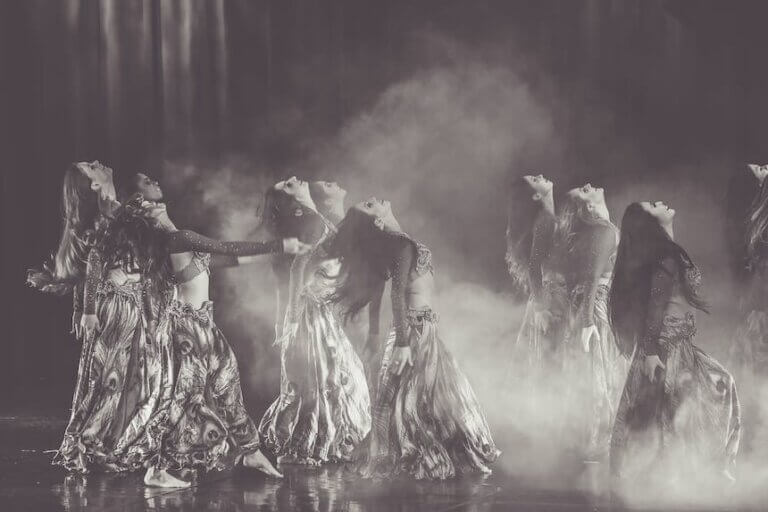
Christmas is around the corner, and if you are a Ballet enthusiast like me, you probably know that The Nutcracker recital has come to almost ...
Belly dance and Arabian dance costumes

Belly dance costumes

Arabian dance, just like the many other dance styles, is not only about the movements. It has a wide range of costumes and accessories like ...
A famous belly dancer

19 Famous belly dancers from round the world

Belly Dance, at its most basic can be traced back for centuries (and even possibly millennia). It is within the past century, roughly the last ...

Ballet foot exercises

10 Ballet Foot Exercises: Warm-up, Boost Your Technique and Foot Strength

Foot exercises are an essential part of a ballet dancer’s training as they provide important strength and technique benefits. Developing strong and flexible feet is a big part of the groundwork you lay as a dancer. Given the exceptionally demanding nature of ballet, appropriate foot exercises help prevent injuries, maintain correct technique, and contribute to achieving the desired aesthetic lines on stage.

After all, dancers’ feet are so central to everyday life as well as to our art that we want to keep them in great shape. In a previous article, we covered some of the injuries that affect ballet dancers’ feet and legs including sprains, strains, and stress fractures. In this article, we’ll cover warm-ups and exercises that you may wish to consider adding to your routine. Remember, if you are experiencing pain, make sure to seek medical advice and let your teacher know – it’s always better to catch potential problems early.

Ballet feet exercise. Ballerinas feet warming up stretching
Photo by Astrid Schaffner on Upsplash

Warm-Up Ballet Foot Exercises

Most dance classes will start by warming up your feet (and the rest of your body). It’s a great way to help prevent injuries. Repeating these exercises as part of a “cool down” at the end of dance class/training can also be very beneficial.

Ankle Circles

Let’s start with a simple warm-up for the ankles. Either sitting or standing, move your ankles in a circular fashion, one ankle at a time, clockwise for 5-10 circles, then change direction to counter-clockwise. Repeat on the other side.

Tennis Ball Circles

Take a tennis ball and roll it under your toes and the balls of your feet in circles as demonstrated in this video:

You can also use products such as foot rollers in a similar way and some dancers report that they have given them relief from various foot conditions. If you need a foot roller, take a look at this one.

Toe Points and Foot Flexes

This classic exercise really helps  warm up and stretch the muscles in your feet, right to the ends of your toes. This can be done either sitting down or standing up.

First, press your toes toward the floor, pointing your feet, and hold the position for 5-10 seconds.

Then switch to flexing your entire foot up toward your body and hold this position for another 5-10 seconds.

Foot Rolls

Next, warm up your arches by lifting your heels off the ground and rolling onto the balls of your feet, one foot at a time, and holding it for 2-3 seconds, as shown in this video. Complete around 5 sets of these.

Strength Training Exercises for Ballet Feet

Now that your feet are warmed up, we move on to ballet foot exercises to strengthen the muscles around the feet and ankles, assisting with both stability and flexibility.

Towel Scrunches

Towel scrunches

Try this standing up. Use your toes to grip and pull the towel closer to you, “scrunching” it up each time and repeating until the towel is pulled all the way toward you. A variation of this is picking up and moving a small ball or similar object with your toes.

Alternatively, in this video, professional ballerina Nikki White shows us the 5 steps to towel scrunches in a sitting position, as well as “reverse towels scrunches” and the “grab and pull”. Ignore the cover image – the video should play fine.

The Ball exercise:

This is a popular strengthening exercise and goes beyond foot strength, helping to develop calf strength and flexibility. First place a ball (or a similar round object) between your ankles. Use controlled sets of lifting and lowering the heels.

TheraBand Resistance

TheraBand exercises are a form of resistance training for the foot, with the bands available in different levels of resistance. With the Theraband wrapped around the foot, there is a wide selection of movements and exercises available. This video shows a great one to start with:

Don’t yet have a theraband? No problem! Check out here.

Domed Foot Presses

Domed foot presses are a great way to activate and strengthen the muscles of the foot. The exercise can be performed effectively by following the steps below:

Place the foot flat on a solid surface. Lift the arch of the foot as high off the floor as possible without bending the toes.

Maintaining healthy feet as a ballet dancer

Nobody wants an injury, so look after your feet – and the rest of your body. We’ve covered a lot in this guide. Here are a few recaps and wider considerations:

1.     Warm Up and Stretch

Never skip warming up your feet as part of your overall warm-up program. We’ve covered a few suitable exercises today including ankle circles, tennis ball circles, toe points and flexes and foot rolls. Equally, remember to perform a “cool down” at the end of your class or training.

2.     Strengthen Foot and Ankle Muscles

We’ve looked at a variety of ways to help build strength including towel scrunches, domed foot presses, the ball exercise and TheraBand resistance training.

3.     Proper technique

A common thread through all these tried and tested techniques featured above (and in dancing generally) is using the right technique. Performing exercises with poor form can have serious consequences, so really pay attention to following the techniques and alignments demonstrated in the videos.

4.     Suitable Footwear

In our guide to the best pointe shoes, we cover some important considerations such as getting the right fit and level of support depending on your specific foot type and ballet experience. Wearing comfy, supportive shoes (i.e. not high heels) outside of dance class, like trainers or Birkenstocks, is a rule many dancers live by.

5.     Gradual Progression

As with any sport, but especially one as physically demanding as ballet, avoid injury by building gradually up to more strength, flexibility and advanced movements. Going too hard, too fast, is counter-productive and likely to cause injury.

6.     Listen to Your Body

Your intuition about those early warning signs your body gives you is important. Listen to this and get help when you’re unsure. Early intervention can prevent more severe injuries from developing.

7.     Get expert help

If you experience any pain or discomfort during or after dancing or exercising, tell your family, dance teacher, doctor, or professional specialising in dance injury. They’re there to help and want the best for you.

That’s it. We hope you’ve found these ballet foot exercises and techniques useful. We wish you happy, healthy dancing!


Other related articles about Ballet:

Disclaimer: We hope you find his guide helpful but please remember that all information, guidance, or advice provided on this site is for informational and educational purposes only and used at your own risk.

Coaching of each move in dance class is often the best way to learn. Improper execution of exercises can cause health problems. Consult your healthcare provider if you are having problems with your feet or are looking to make changes to your exercise regime.

Students learning to ballet dance - beginners moves

Ballet Moves for Beginners

Are you dreaming about a career as a ballerina or just want to try classical dance for yourself? These simple (ha-ha) ballet moves for beginners will help you understand what ballet is and is it ...
Ballet feet exercise. Ballerinas feet warming up stretching

Ballet foot exercises

10 Ballet Foot Exercises: Warm-up, Boost Your Technique and Foot Strength Foot exercises are an essential part of a ballet dancer’s training as they provide important strength and technique benefits. Developing strong and flexible feet ...

Cover photo by Astrid Schaffner on Unsplash.

This article was originally written by our editor Emma, checked and contributed to by Almiria Wilhelm.

Ballerina Feet: Ballet & Foot Health

If you’ve ever seen ballet or you’re a ballet dancer yourself, you’ll know how graceful dancers’ movements can be. But, of course, becoming a professional ballet dancer takes a LOT of hard work and dedication. In addition to practicing many hours every day, dancers also need to take care of their feet. because they are essential tools for performing their art. Foot training for dancers begins on the first day of class and continues throughout their dance career.

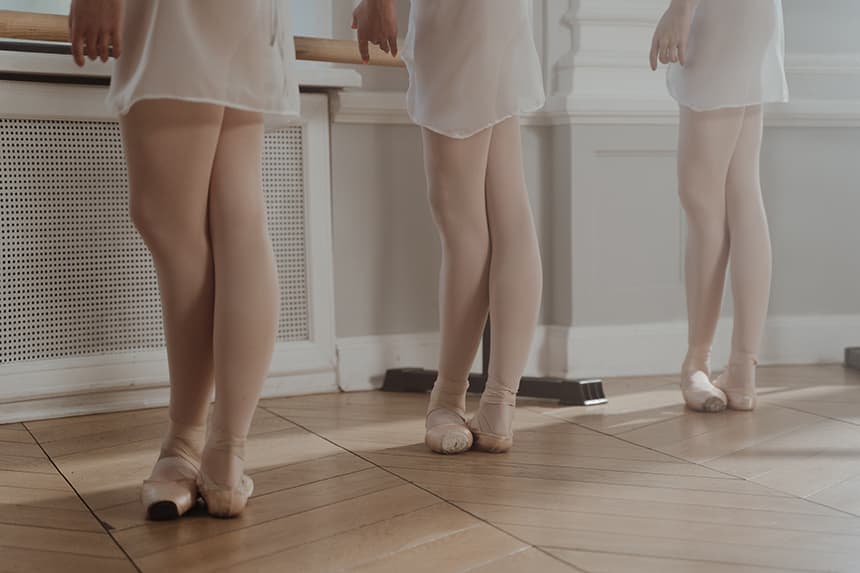
Ballerinas Feet. 3 ballet dancers stretching
Photo by cottonbro studio on Pexels

The effects of ballet on dancers’ feet

The human foot is a complex structure made up of 26 bones, 33 joints, muscles, tendons, and ligaments. This intricate design allows the foot to support the body’s weight and absorb shock when we walk or run. When we put our feet through repetitive motions, such as those required in ballet, we can put stress on these structures and cause injuries.

Dancers are especially susceptible to foot injuries because practice with such frequency. On top of this, baller dancers typically wear shoes that provide limited support and cushioning. Pointe shoes, for example, are designed to allow dancers to dance on their toes but offer little protection from the impact of landing from jumps and other movements. As a result, ballet dancers often suffer from injuries to the bones and joints of their feet.

Despite these risks, ballet can be a healthy activity for your feet if you take some precautions:

  1. First, it’s important to choose the right ballet shoes. Make sure that you are fitted by a professional ballet shoe fitter even for soft ballet shoes. The wrong fit (too large or too tight) can affect your technique and cause injury.
  2. You can also ask your dance instructor for recommendations. As you become more experienced, may need to get pointe shoes. But be sure to buy them from a reputable store with a professional pointe shoe fitter and break them in slowly to avoid injury.
  3. It’s really important to warm up before dancing and stretch afterwards. This will help reduce your risk of injury.

If you start experiencing pain in your feet, be sure to speak to your dance teacher and see a doctor right away.

Is ballet harmful for your feet?

While it’s true that ballet dancers often suffer from foot injuries, these injuries are usually due to overuse or poorly fitted shoes. With the right precautions, you can avoid these injuries and enjoy a healthy career in ballet. Dancers who take care of their feet and warm up properly are less likely to experience injuries.

Typical dance-related foot and leg injuries

The intense physical activity in ballet puts a lot of stress on dancers’ feet and legs. As a result, they can get injured. These are some common injuries:

  1. Achilles tendonitis: an inflammation of the Achilles tendon, which is the large tendon that connects the calf muscle to the heel bone.
  2. Shin splints: pain in the lower leg, usually along the shinbone, as a result of overusing your lower leg muscles.
  3. Stress fractures: tiny cracks in the bones that can occur from overuse or repetitive impact.
  4. Plantar fasciitis: inflammation of the plantar fascia, which is a thick band of tissue that runs across the bottom of the foot. Typically, this causes pain and swelling at the base of the heel and the arch of the foot.
  5. Neuromas: the partial or complete disruption of a nerve can be caused by over-stretching. You may feel a burning or tingling sensation as well as numbness and spasms.
  6. Ankle sprains: these occur when the ligaments that support the ankle are stretched or torn.
  7. Blisters and bunions are also common among dancers. Like all injuries, they should be given proper attention because they can turn into something more serious if untreated.


Prevention is better than cure and the best way to avoid foot problems is to take proper care of your feet. This means wearing the right shoes, warming up, strengthening and stretching your feet regularly, and keeping your feet clean and dry. It’s also important to see a podiatrist on a regular basis so that any problems can be caught early and treated quickly.

Remember! If you experience any pain or discomfort in your feet or legs, it’s important to see a doctor right away. These problems can often be resolved with simple treatments but if they’re ignored, they can lead to more serious injuries.

What pointe shoes are best to protect your feet?

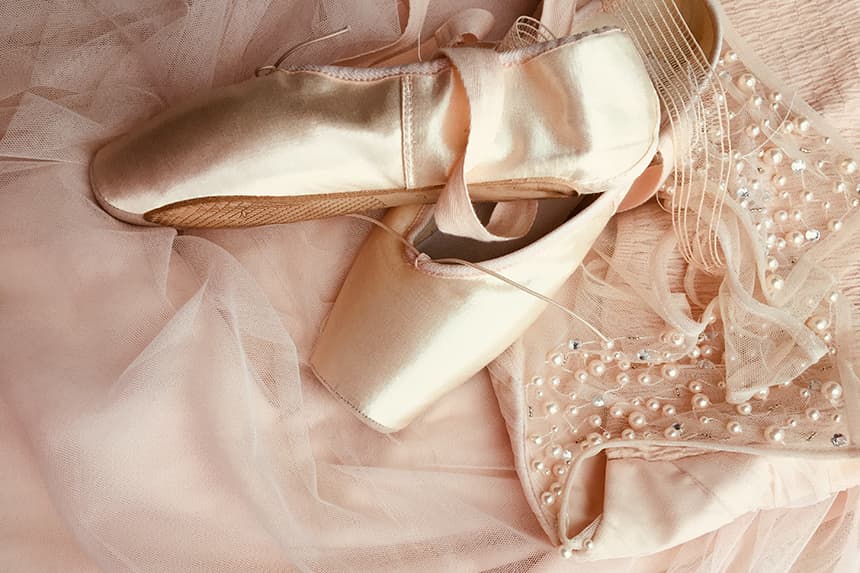
The best way to protect your feet while dancing is to choose the right shoes. All ballet dancers need well-fitting flat ballet shoes and many will require pointe shoes as well. There are many different types of pointe shoes on the market and it’s important to find a pair that fits correctly and provides the right support for your feet. It is essential to have ballet shoes fitted by a professional fitter, especially when buying pointe shoes. Your fitter will take into consideration your foot shape, your experience level and any special requirements you may have. You may need to try several different pairs before they find the perfect brand and style for your feet. Your fitter will also recommend appropriate protection for your feet such as toe pads, toe spacers, additional elastics, etc.

Pointe shoes need to be “broken in” before you wear them for a performance. Your fitter or dance teacher can show you how to break in your shoes. Take note that while many shoes require the back or shank to be softened, some newer brands have carbon fibre shanks that should not be “broken in” or softened. The process of getting your shoes performance-ready can take several weeks and it’s important to do it gradually so that you don’t injure your feet. Once your shoes are broken in, they should be comfortable and provide support while you’re dancing.

To protect against the strains of “ballet feet” or “ballerina feet” and choose the right pair of shoes for ballet, you should read the list of the best pointe shoes here. You’ll find a detailed guide on choosing the right pointe shoes for you.

Ballet feet.
Photo by Merve Sehirli Nasir on Unsplash


How foot type of foot affects your dance/ballet career

The type of foot a dancer has can affect their career in several ways:

  • Dancers with high arches may be more susceptible to injuries.
  • Dancers with flat feet may have trouble with pointe work.
  • Dancers with wide feet may have difficulty finding shoes that fit well.

It’s important to consult your dance teacher or coach to determine what type of feet you have and how to keep them strong and healthy. They can also help you find the right shoes and make sure you’re performing ballet exercises correctly.

While the type of foot a dancer has can affect their career, it’s important to remember that everyone is different. Some dancers with high arches will never experience an injury and some dancers with flat feet will excel at pointe work. Ultimately, it’s up to the individual dancer to find what works best for them.

Enjoy dancing and look after your ballet feet

Now that you know more about how ballet affects your feet, you can take steps to protect them. Dance is a beautiful art form that can be enjoyed by people of all ages and abilities. While there are some risks associated with ballet, these can be minimized by taking proper precautions. With the right shoes and regular exercise, you can enjoy dancing. If you experience any pain or problems with your feet, be sure to consult a doctor so that you can continue dancing for years to come.


Related articles to ballerina and ballet:

Students learning to ballet dance - beginners moves

Ballet Moves for Beginners

Are you dreaming about a career as a ballerina or just want to try classical dance for yourself? These simple (ha-ha) ballet moves for beginners will help you understand what ballet is and is it ...
Ballet feet exercise. Ballerinas feet warming up stretching

Ballet foot exercises

10 Ballet Foot Exercises: Warm-up, Boost Your Technique and Foot Strength Foot exercises are an essential part of a ballet dancer’s training as they provide important strength and technique benefits. Developing strong and flexible feet ...

This article was originally published by dancesbibles admin. Almiria Wilhelm contributed to this article.

The 9 Greatest Choreographers of the 20th century

This article see the DanceBible team pick some of the 20th century’s (and all times!) greatest Choreographers, taking a historical slant via some very great and distinct contributions, which together help to describe the formation of modern choreography more broadly.
What did Balanchine do for classical ballet? Why did Martha Graham prove to be the main face of modern dance? How did Merce Cunningham reform the movement? What is Pina Bausch’s dance theatre? Here we will explore these and other questions about the really great modern dancers famous of this era.

It will briefly describe the biographies of nine equal in importance as some of the greatest choreographers of the 20th century but absolutely different in creative approach. Each of them is worthy of much further exploration – but this article serves as an initial introduction to these masters, which you can continue in theatre, books or movies.

Images of dancers on stage - moving to the best choreography, inspired by talented choreographers
Photo by ketan rajput on Unsplash

Martha Graham

1894-1991, USA

– founder of the modern dance style. She created the contraction-release technique.

portrait of Martha Graham in 1948
Yousuf Karsh, Public domain, via Wikimedia Commons

Contraction:

  • It’ s done on an exhalation…
  • A characteristic movement towards the center
  • Rounding of the shapes

Release:

  • On the inhale
  • Moving from the inside out

The contraction-release technique is still considered basic for modern and other styles of dance.


What new things has Martha brought to the choreography and dance:

  • Emotion provokes movement
  • Impulsive nature of movement
  • Use of space by moving on the floor
  • Graphic poses
  • The fabric increases the amplitude of the movement

She was the first to try structuring movements into a kind of system, something that neither Duncan nor Saint-Denis had done before her. As a visionary, she was constantly looking for new ways to dance. Her creative search determined that movement is subject to three basic constants: time, space, and energy. Since, as Martha herself said, she was not interested in dancing and creating productions about non-existent characters and heroes of former eras, she staged and told in her work about contemporary women and people, as well as contemporary issues. Thus, the great Martha Graham was the first to show that non-classical dance can also be intellectual. Without Martha Graham, the entire history of modern dance would have turned out very differently.

In 1926, Martha founded her own troupe – Martha Graham Dance Company – it still exists to this day.

George Balanchine

1904-1983, USA

– founder of neoclassical ballet. He created his own ballet school and professional company in the United States, which is now called New York City Ballet and is the largest company in America.

Kroon, Ron / Anefo, CC BY-SA 3.0 NL by Wikimedia Commons

Balanchine’s choreography is characterized by:

  • Classical poses, BUT hips, knees and feet turned inward while classical ballet’s legs are turned outward
  • Classical movement, but the hips are characterized by forward movement, whereas the classical ballet hips are always tucked
  • Neoclassical passes between poses with hips and knees turned inward

He was born, studied and started working in Russia. But he found his place for art and work when he moved to the United States.

Today, Balanchine’s ballets are performed on all of the world’s greatest stages. The Balanchine Foundation, which was created after the choreographer’s death to preserve the technique and performance skills that Balanchine himself laid down, is very picky about the level and quality of the dancers – they have to be able to dance ballet really well. Although ballet is progressing, Balanchine’s performances are still quite difficult to dance.

One-act storyless ballets are the most original part of his oeuvre. Besides, it”s likely that a modern ballet without Balanchine would not exist at all, the kind without specially written music, without 4-hour productions and complicated hierarchies.

Merce Cunningham

1919-2009, USA

– collaborated with John Cage, Robert Rauschenberg, Andy Warhol, and other avant-garde artists. He is sometimes counted among the creators of postmodern dance.

Photo of Merce Cunningham, one of the greatest choreographers of the 20th century and all time
Photo courtesy Cunningham Dance Foundation archive via Wikimedia Commons

Characteristic:

  • Using classical poses, but toes do not go outwards and with the addition of non-classical hand or foot positions
  • Combination of classical poses and modern techniques, such as contraction-release
  • Changing planes with the body
  • The dancer’s position does not depend on the location of the audience (the dancer can dance with his back to the audience)

He was born, studied and started working in Russia. But he found his place for art and work when he moved to the United States.

Merce Cunningham is one of those who also worked a lot with Martha Graham. However, unlike Martha, he believed that the human body is already beautiful itself, and that each movement is already interesting enough to capture the viewer’s attention. With the help of the Theory of Randomness (where the order of movement is determined not by the choreographer, but by the dice) Cunningham sought to break the movement patterns within which dancers were accustomed to exist.

One more striking feature of Cunningham’s creativity was his conviction that all the arts – music, dance and scenography – are equal and should not “adjust” to one another. Therefore, all of these arts often “met” already on stage in the choreographer’s performances.

Pina Bausch

1940-2009, Germany

– the most famous member of the “dance theatre” movement. She created Tanztheater Wuppertal Pina Bausch.

Characteristic:

  • Spiral motions
  • Impulse into the spiral – following the hand
  • Speed changes
  • Natural foots position
  • Loose body
  • Muscle relaxation
  • Start of movement on breath

Pina Bausch is one of the most popular choreographers among the masses. The most important theme for her was human relationships. She believed the idea that the dancer should move of improvisation and get inspiration from own experience. She could ask the dancer a lot about his parents, childhood, how he feels in different life situations, what he loves and does not love, what hurts him, his aspirations. The drama of human experiences and relationships was the theme of her art.

After Pina’s death, the Pina Bausch Creative Legacy Foundation was founded, which sees its main task as making the Dance Theatre’s legacy available to the public.

Mats Ek

1945, Sweden

– collaborated with the world’s leading dance companies. Mikhail Baryshnikov and Sylvie Guillem have danced in his productions.

  • Hands set the movement direction, the movement follows the hands
  • Using classical jumps, but with a loose body and movable arms and legs;
  • Bent knees and pulled feet
  • Ridiculous movements
  • Working with facial expressions

Many consider him a genius who shook the world of the classics by making us look at it in a different way. Others see his art as blasphemous. Mats Ek is one of the most recognizable choreographers of our time. Mats Ek’s style of choreography is characterized by its parody and tendency toward the theatre of the absurd. He has formed his own choreographic “handwriting”, which has grown out of an original symbiosis of classical, modern, and minimalist gestures.

Mats has combined a lot of knowledge with his sensuality, emotion and talent. He keeps the plastics and choreography simple enough, but very effective.

In 2007 he staged Gluck’s Orpheus at the Royal Swedish Opera.

William Forsythe

1949, USA – Germany

– one of the main living experimenters in the dance industry. He developed a popular computer program for teaching dance called “Technology of Improvisation”.

William Forsythe on a stage, talking to dance students
Photo by Marlon Barrios Solano on Flikrr. Image resized.

Characteristic:

  • Working with geometry (line, point, line from a point, semicircle from a point)
  • Working with lines: “drawing” lines with body parts and with the help of joints
  • Working with memory: coming out of the classical/non-classical pose – recalling the pose – returning to the original position

Forsythe’s works demand from the viewer a more active emotional and intellectual perception. The avant-garde Forsythe pushed the boundaries of the conventional: as opposed to classical ballet the choreographer gives freedom to the movements of the arms and legs. His main approach to dancers was improvisation, which also aimed to free not only the dancer’s body, but also his head.

Ohad Naharin

1952, Israel

– creator of modern dance techniques and improvisation gaga. Since 1990 he has been the director of the Batsheva troupe.

Characteristic:

  • Dance based on improvisation (sensations are set)
  • Moving and other manipulations of different imaginary objects (cubes, balls, etc.) with different parts of the body
  • Shaking
  • The impulse for movement comes from within
  • Muscles are relaxed

Ohad Naharin is one of Israel’s most famous choreographers. Today Ohad Naharin is called a star of contemporary choreography. Naharin is often involved in creating the music for his works. Naharin invites the best stage designers in the country to participate in his productions. He also encourages the dancers with whom he works to open up their own creative resources, giving them the opportunity to improvise. Naharin participates in a number of his works as a performer.

According to the choreographer, the main thing a dancer has to learn is the ability to listen to and understand their own body, and this means much more than obeying the choreographer who tells them how to move. The search for a deep interaction is what gave birth to gaga, both as a choreographic language and as a pedagogical system.

The New York Times and a number of other publications have elevated Naharin to the rank of one of the five best choreographers in the world.

Wim Vandekeybus

1963, Belgium

– one of the representatives of the “Belgian wave” of modern dance. He founded the experimental dance group Ultima Vez.

Ultima Vez / Wim Vandekeybus + Manfred Werner – Tsui, CC BY-SA 3.0, via Wikimedia Commons

“The Tiger’s Leap” (movement behind the hand, and then roll over)

  • Jump tending to parallel with the floor
  • Running in different directions (including back)
  • Emphasized physical strength, brutality
  • Hair increases amplitude

Wim Vandekeibus’s art is characterized by radicality and challenging in the beginning of his career and conservatism in the process of evolution. For example, at the beginning of his career the choreographer urged his dancers to go to every performance as if it were their last. His dancers worked on the verge of human limitations: they dodged bricks thrown at them and descended from dangerous heights without safety equipment. Vandekeibus liked to explore the body’s reflexes in extreme situations, and the audience loved Wim for his recklessness. Now it is in the past. The productions of recent years are characterized by conservatism and even a derision of former radicalism.

The choreographer says that he never thinks only about choreography, it is just a tool for him to tell about something. It has to be said that together with his company Ultima Vez he does this incredibly successfully and accurately.

Crystal Pite

1970, Canada

– a student of William Forsythe; one of the youngest choreographers to gain international fame. In 2002 she founded the Kidd Pivot dance company.

Headshot photo of Crystal Pite
Photo by Kat Baulu, CC by 2.0 via Wikimedia Commons
  • Movement in a spiral with a change of levels and going to the parterre (movement is initiated by the hand)
  • Manipulation (“foreign hand”)
  • Slide

In 1990, she made her debut as a choreographer with the British Columbia Ballet. Since then, Crystal Pite has created more than forty works of choreographic art. Pite’s choreography is known for its quirky humor and fearless

We’re thankful for the greatest choreographers and those who follow them

Hopefully you have been inspired to explore the work of these great choreographers in greater depth and detail.

Without them, there would be no modern choreography as we see it now: experimental, sophisticated, diverse, free, thinking and questioning, exploring movement and the human body.


Related articles:

Arabian dance in the nutcracker

The “Arabian” Dance in The Nutcracker

Christmas is around the corner, and if you are a Ballet enthusiast like me, you probably know that The Nutcracker recital has come to almost every city around the world. If you need to become ...
Ballet feet exercise. Ballerinas feet warming up stretching

Ballet foot exercises

10 Ballet Foot Exercises: Warm-up, Boost Your Technique and Foot Strength Foot exercises are an essential part of a ballet dancer’s training as they provide important strength and technique benefits. Developing strong and flexible feet ...
Ballerinas Feet. 3 ballet dancers stretching

Ballerina Feet: Ballet & Foot Health

If you’ve ever seen ballet or you’re a ballet dancer yourself, you’ll know how graceful dancers’ movements can be. But, of course, becoming a professional ballet dancer takes a LOT of hard work and dedication ...
Images of dancers on stage - moving to the best choreography, inspired by talented choreographers

The 9 Greatest Choreographers of the 20th century

This article see the DanceBible team pick some of the 20th century's (and all times!) greatest Choreographers, taking a historical slant via some very great and distinct contributions, which together help to describe the formation ...

Best dance bags

Best Dance Bags 2023 – Ultimate guide and review

When you go to dance class or competitions, you probably take a lot of gear with you? Of course, dancers need a lot of space in their dance bags to accommodate dance shoes, outfits, water bottle and other things. It does not matter massively whether the dance bag is a daily use, class or for competitions.

The best dance bags are roomy, durable, comfortable, and stylish; some of these bags feature a rack. Check out our top 10 choices of best dancers backpacks and bags. All the products offered are tested through experience and time, that is why professional dancers and amateurs choose them.

Best Large Competitions Dance Bags – Wheeled and with Garment Rack

Regular trips to competitions and performances, with tons of costumes, makeup, and other stuff, can wear anyone out. But what about a handy wheeled bag with a garment rack? It will help organize belongings, get ready for performances quickly, change clothes. Essentially, it will make any of your trips much more comfortable.

EcoGear 28 Inch Wheeled Duffel with Garment Rack

EcoGear 28 Inch Wheeled Duffel with Garment Rack Best dance bag for Competitions.

This is an absolute must-have for competitive dancing. Unlike many dance suitcases on the market with built-in racks, this one is very sturdy and stable. Hang all your stuff on the rack to keep them looking sleek, and the rack will stand securely without deflecting sideways (its max load of 20 pounds). Plus, it doesn’t take long to install the hanger and it’s easy to do.

Other features of this duffel are the presence of reflective trim, as well as the presence of a large number of compartments and pockets, including shoe compartment.

Pros:
  • Stable rack
  • Sturdy wheels
  • Affordable price
  • Durable fabric
  • Lots of compartments
  • Not heavy
Cons:
  • Available in one dark gray color only
  • Only two wheels

Travolution 28″ Wheeled Drop-Bottom Duffel

EcoGear 28 Inch Wheeled Duffel with Garment Rack Best for dance bag for Competitions.

The Travolution rolling dance bag also offers a wheeled travel suitcase with a built-in rack, which is ideal for trips to dance competitions and gigs. However, it can be used more widely for vacations and travels as well. It is good precisely because it is sturdy and reliable, the hanger is also very stable.

This dance suitcase is not heavy at all. It is made of sturdy fabric. No problems with sagging, tilting, or overturning. The rack is assembled quickly and easily, so you don’t have to spend time on it. There are many convenient compartments inside this suitcase that make it easy to stay organized with a lot of stuff.

This suitcase is slightly more expensive than the previous one, but it is still in the affordable category and much cheaper than its other counterparts (whilst still maintaining a good level of quality).

Pros:
  • Stable rack
  • Convenient bottom hinged compartment
  • Solid wheels
  • Durable fabric
  • Lots of compartments
  • Lightweight
  • Available with pink trim
Cons:
  • Only two wheels
  • The main color is dark gray

Mavii Costume Rack Carry – Best Price for dance bag with rack

Mavii Costume Rack Carry-On Luggage.

If you are looking for a small size suitcase or for a child, this would be your best choice. The Mavii bag is a more compact model that has a built-in rack. That said, it is lighter than the previous two and smaller by a few inches. Although it is an inch taller than the allowed carry-on luggage on most airlines, in most cases, it is suitable as carry-on luggage to take with you into the cabin.

It’s worth noting that the color of this dance bag both inside and out is much nicer than just the dark gray of the previous two. The fabric is very strong. This suitcase has hard walls in the main largest compartment. There are additional compartments on the outside as well as on the flip side inside; there is room to fold shoes separately.

Four wheels are very maneuverable and stable. The rack installs very easily, in a couple of minutes. It is made of aluminum.

By the way, Mavii dance bags were created by the dancer sisters, who designed the product specifically for the dancers’ comfort.

Pros:
  • Size suitable for hand luggage on planes
  • Stable rack
  • 4 stable and secure wheels
  • Rugged premium fabric with security trim
  • Best price
  • Lots of compartments
  • Lightweight
Cons:
  • Only two wheels

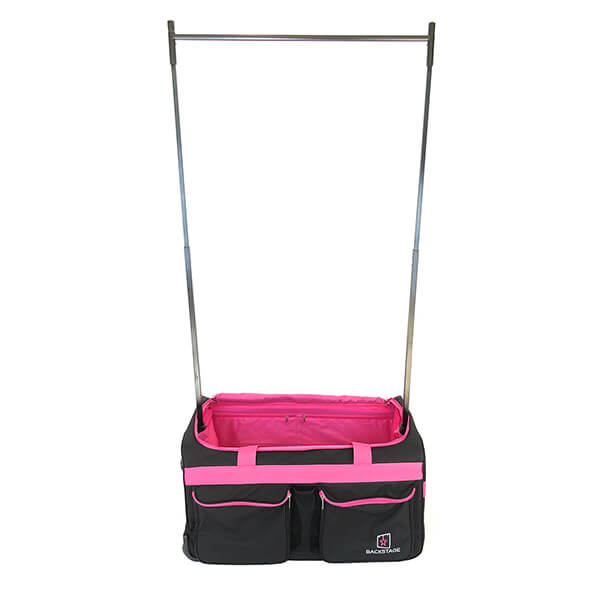
Backstage Dance Travel Bag

Backstage Dance Travel Bag.

Looking for the roomiest suitcase possible? Here it is!

Maximum roomy dance bag for all of your dance stuff. Many functional additional compartments keep your luggage organized, so you know exactly where everything is, even though there may be a lot of stuff! By the way, one of the outer pockets has a cooling function so you can put snacks and water in it, which is a nice touch.

The walls of the dance bag are soft, so when you’re not using it, the bag is easy to house simply by folding walls inward. The fabric is very durable. One of the advantages of this product is the availability of different colors: the main color is black, and you can choose between pink, purple, blue, and all-black (for edging and interior).

Pros:
  • Large size
  • Convenient storage bag out of competition period
  • Has insulated pocket for cooling
  • Available in different colors
  • Stable rack
  • Lots of compartments
  • The inside bag has 8 D-rings
Cons:
  • Only two wheels
  • A little more expensive than others (because of the large size)

Dance Bags for Teens and Adults

An everyday cool bag for dance classes is as important as a comfortable duffel. This is something everyone dancer wears almost every day, so why not buy one that will put you in a great mood? Here are a few of those options.

Capezio Rock Star Duffle Bag – Professional Dance Bag

Capezio Rock Star Duffle Bag.

Caprezio is one of the top brands producing dance equipment and supplies. The company produces high-quality and durable bags, which have already become a real quality mark among dancers. This Caprezio dance bag has shoe compartments, high-quality and soft-touch fabrics, sturdy seams and is highly recommended.

This is an incredibly stylish bag, with textured polyester with a glossy Caprezio logo on the front. The bag features two padded handles and one long strap.

The most important thing that makes this bag the best is its internal compartments. Inside, there are two folding shelves with hooks to safely and conveniently hold your dance shoes. The bags also include a zippered mesh pocket with a wire port, vents in the shoe compartment, as well as an interior back pocket. There is also a zippered side pocket and a mesh pocket without a zipper on the outside. Enough to keep any dancer organised!

Pros:
  • Multifunctional compartment
  • Durable fabric and tailoring
  • Stylish design
  • Comfortable handles and strap
  • Roomy
  • Perfect size
  • Good for both adults and kids
Cons:
  • A bit pricey

Custom Name Teen Dance Class Bag

Custom Name Teen Dance Class Bag.

A customizable bag with your own name or other text or pattern on it is the best option for you if you like getting people’ attention or want a unique design.

Pros:
  • Customized design
  • Affordable price
  • Available in different colors
  • Large and spacious
  • Sturdy fabric and tailoring
Cons:
  • Lack of compartments
  • Non-removable strap length is not adjustable

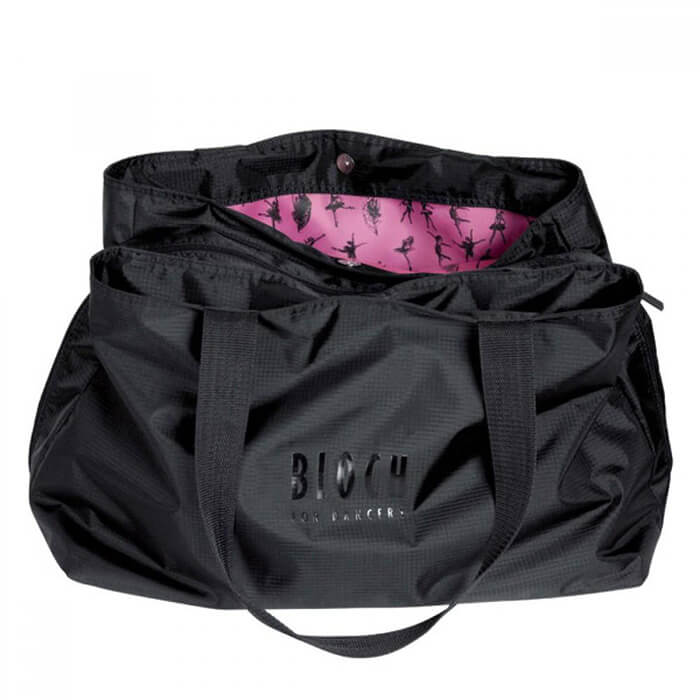
Bloch Dance Unisex Adult Multi – Compartment Tote Bag

Bloch Dance Unisex-Adult Multi-Compartment Tote Bag.

This is a bag by the world-renowned manufacturer of dancewear and accessories, Bloch. This piece consists of three large compartments – two of them with a magnet, the third, the main one, with a zipper. The bright pink lining with dancers’ silhouettes makes a difference and thus the plain black nylon bag gets its own twist and originality.

This dance bag will hold everything from your dance belongings to cosmetics and other bits you might need for class. Good, durable, high quality material ensures that you can carry a ton of stuff in this seemingly small bag. Dance instructors find this one especially useful!

If you are looking for a tote shoulder bag, in a more classic style than previously offered, this is the perfect choice. Especially since Bloch is something that is a symbol of quality.

Pros:
  • Compact looking but very roomy
  • Waterproof
  • Very durable fabric
  • Stylish bright pink lining on the inside
  • Lots of compartments to store different things
  • More classic design
  • Extremely lightweight
Cons:
  • Only available in one color

Dance bags for little girls

A favorite bag that children will always want to go to dance class with!

Silver Lilly Women’s Dance Bag

Silver Lilly Women’s Bag.

A very cute and merely adorable small dance bag for girls with “Dance” printed on it is just what a little dancer needs. Exclusively for dancers!

This kid’s dance bag has room for everything: shoe compartment, outer mesh pocket, outer closed zippered pocket, separate envelope bag with zipper. The main compartment is very spacious, it will hold everything needed. On the bottom on the outside there are rubber “feet” which protect the bottom from abrasion.

The main advantage of this accessory is the design. The product is available in different bright colors like pink as well as in practical black, but with bright pink inserts. Everyone can choose what they like.

Pros:
  • Bright designs and “Dance” lettering
  • Roomy
  • Durable
  • Long detachable and adjustable strap
  • Shoe compartment and more
  • Affordable price
  • Suitable for both girls and boys
Cons:
  • Unlikely to be a good size for very young children, up to 4 years old

Dance Ballet Slippers Duffel Bag

Dance Ballet Slippers Duffel Bag.

This product is specially designed for little ballerinas. The adorable design with little pointe shoes on the outside immediately tells the whole world, “I’m a ballet star”. It”s a great gift for a child, it’s super cute!

The girls’ ballet bags have only one main compartment, there is no shoe compartment, but there are several small pockets on the outside and inside. It only comes with one non-removable long strap. Kids ages 3-6 will definitely love it!

The patches on the sides of the bag do not cling to clothing, this is a positive. The bag is available in different colors, in addition to pink, there is black with pink accents, hot pink and purple.

Pros:
  • Super cute thing
  • Perfect for little dancers
  • Cool design
  • Different colors
Cons:
  • Not waterproof (although the manufacturer claims so)
  • Only one main compartment

Debbieicy Cute Ballet Dance Backpack

Debbieicy Cute Ballet Dance Backpack.

The cutest thing you’ve ever seen! This tutu dress bag is adorable!

Pros:
  • A rich perfect pink
  • Pendant included
  • Durable fabric
  • Cheap
Cons:
  • New product may have an odor

How to Choose a Dance Bag?

A dance bag, whether it is an everyday thing for a training uniform, or a luggage bag for competitions, should be sturdy, comfortable and roomy. Below are a few things to consider when choosing such a bag for dance outfit.

  • Material. Most of the time customers prefer nylon, polyester, and canvas fabrics. Products made of these types of fabrics are generally strong, resistant to wear and durability – exactly what is needed for a bag, which we do not always handle with care. During its life, such a bag will better maintain its beautiful and presentable appearance, as well as its bright color and original shape. In addition, nylon, for example, is waterproof, which will ensure the safety of dance wear during bad weather conditions when you might be travelling or moving between venues.
  • Size and weight. Depending on the bag’s purpose and training type, your product may vary in size. For example, you don’t likely need a very large bag for pole dance to hold a tank top, shorts and magnesium. But the pointe shoes, ballroom dance shoes or sneakers to dance hip-hop, you certainly can not fit into a compact bag. Certainly, the weight of the bag also matters, it’s not worth it to be heavier than all your stuff together.
  • Zipper quality. When sewing dance bags, quality and reliable fittings should be used. Products should be equipped with sturdy zippers, molded locks and spinning carabiners that work properly throughout the operational period.
  • Length and material of handles. Dance bags are usually equipped with a shoulder strap that is adjustable in length, as well as two short handles; so it can be carried in the hand, on the shoulder and over the shoulder, which is convenient.
  • Sewing. The tight and even seams mean that the product is made carefully and with attention to detail. Such a piece will last a long time.
  • Design. Often dancers prefer bright, colored designs, although black will be very practical and not as marky as, for example, pink. Everyone chooses according to his or her discretion. Also worth checking out are the designs that let the world know that you’re a dancer. These are bags with images of dancers or dance attributes.
  • Shoe section. Ideally, your bag should have different compartments for larger and smaller items, including a compartment for shoes, so that they do not stain your clothes.

FAQ

What is the best dance bag?

EcoGear Duffel is the best dance bag with a garment rack. Capezio Rock Star is the best dance duffel bag if you are looking for it for daily use.

Where to buy dance bags?

You can check this review and buy one of the reviewed dance bags on Amazon. You'll find most popular manufacturers' products there.

What every dancer should have in their bag?

  • Dance shoes
  • Dance dresses
  • Cosmetics
  • Hair styling products
  • Dance uniforms
  • Towel
  • Pain ointments and pills
  • Water
  • Snacks

What dance bags do professional ballet dancers use?

Professional ballet dancers use dance bags of these manufacturers:

  • Bloch
  • Capezio
  • Horizon Dance
  • Wear Moi
  • Freed of London

Bottom Line

Dancing is not merely a training, it is a way of life. Active, athletic and intense dancer’s lifestyle requires providing comfortable conditions for training and travel. This is the main function and criteria for choosing a good bag for dancer that will accompany you on your way to training or competitions.

A dancer’s bag filled with a lot of stuff is an indispensable attribute of his life. We hope that our products in this review will be the same for you.


Cover image by Benjamin Voros on stocksnap.io

Types of ballet

Ballet is a relatively young art form compared to other forms of classical dance, but its popularity exploded in the nineteenth, twentieth and twenty-first centuries and it remains one of the most loved forms of dance today. There are several styles of ballet, which this article will delve into.

The final product that the audience sees when they go to watch a ballet is the final stage of a long process. Ballet is a prepared performance with carefully thought-out movement sequences. Some ballets tell a story, while others simply illustrate a theme or have no theme. To create a successful ballet, dance, music, painting, drama, and the visual arts come together to craft a coordinated performance that creates apparently effortless magic for the audience once the curtain lifts.

What types of ballet are there?

Ballet and classical choreography are classified based on different criteria. We will look at the main ballet styles, genres, and techniques in detail below.

Styles of Ballet

The most common classifications for different styles of ballet are based on their characteristics and time of origin.

Classical Ballet

Classical ballet is the original and foundational ballet style. When people say the word “ballet”, they usually mean the classical form.

Classical Ballet Type.

Photo by Pixabay on Pexels

Characteristics of classical ballet:

  • The observance of specific positions of the legs, arms, body, and head, and the principle of “turn out” (the outward rotation of the legs from the hip).
  • Strict adherence to rules, techniques, and traditions associated with classical ballet
  • Strict traditional training techniques
  • In classical ballet, women usually wear special hard shoes known as pointe shoes that allow them to dance on their toes.
  • The movements in classical ballet tend to geometrical clarity
  • In classical ballet performances, dancers tell a story through choreography, gestures, and facial expressions (although there are also classic ballet productions without a plot).
  • Classical ballet is performed to music by classical composers such as Tchaikovsky.

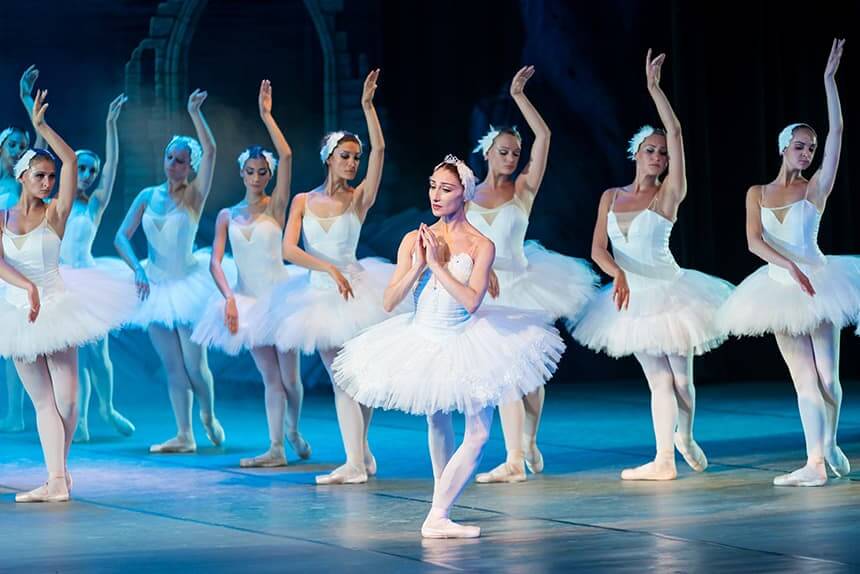
Examples of classical ballet are Swan Lake, The Nutcracker, and Sleeping Beauty.

Different styles of classical ballet vary somewhat geographically. Different ballet schools and teaching traditions developed in, for example, France, Russia, Denmark and Italy. While, today, some of these differences are no longer as marked, each school still has its own characteristics, traditional techniques and ballet “stars”.

Romantic Ballet

Romantic ballet emerged during the Romantic era, when European, and later American, culture began to reflect on the self-worth of man and his place in nature.

Romantic type of ballet dances.

Photo by Pixabay on Pexels

Romantic ballet is characterized by:

  • Focus on the drama and emotionality of the stories being told
  • The appearance of original music
  • The increased role of music, which helped create the dramaturgy and gave figurative musical characteristics to the characters
  • Opposing the real world to the world of exoticism and fantasy (hence the spread of the mystical women image)
  • Keeping the strictness form and traditions of classical choreography
  • The airiness of movement
  • Pointe shoes and short white tutus appear
  • The cult of the ballerina as a central part of the performance and star ballet dancers appear
  • Active development and use of theatrical special effects (in particular, gaslighting)

The brightest examples are Sylphide and Giselle.

Note!

You can also read the piece about Ballet History here.


Neoclassical ballet

Neoclassical ballet became widespread precisely in the United States, where it was possible to depart from the classical rules and create a completely unique dance.

Image of neoclassical ballet
Image Public domain, via Wikimedia Commons

Apollo Musaget is generally considered to be the first neoclassical ballet, and the legendary choreographer George Balanchine is the pioneer of the style. Another huge influence was Isadora Duncan and her free, easy and rule-free dance. After such daring oppositions to the classical form of dance, other popular bold, original and innovative dancers, choreographers, and directors emerged.

Neoclassical dance is characterized by:

  • Classical technique enriched with free movements and experimental techniques.
  • Deviations from strictly classical technique and movement patterns
  • A shift of focus from the plot to the dancer’s skill
  • Complex choreographic elements
  • Neoclassical performances often lack scenery and are characterised by a move away from sumptuous and colorful costumes in favor of simple and minimalist styles.
  • Significant reduction in the length of performances

The austere, clear, noble, and transparent form of neoclassical ballet is epitomised in Apollo Musaget and subsequently in other neoclassical ballets. The classical dance vocabulary, purged of decoration in terms of plot, design, emotion, and gestures, became the new ideal.

Modern ballet

Modern ballet differs from other types of ballet in its bolder costumes and free dance interpretation. Modern ballet does away with tutus and pointe shoes; they are typically replaced by loose, elongated garments to create an airy, sophisticated look. Many dancers go on stage barefoot.

Photo of modern ballet dancing on stage, colourful and fast
Photo by Ahmad Odeh on Unsplash

Modern ballet is characterised by:

  • The use of gymnastic and acrobatics elements
  • The blurring of genre boundaries
  • New, original interpretations of classical ballets
  • Rejection of the main “pillars” of classical ballet such as the use of strict arm and leg positions and “turn out”.
  • A freedom of feelings and ideas and a departure from conservatism
  • The movements are based on the natural plasticity of the body
  • Experimentality and symbolism
  • Scenic effects

Inspiration for modern ballet can be taken from a huge range of sources including national dances and new trends in other dance styles. Many directors try to make the audience look at classical dance from a different angle and new readings of classics are welcomed.

Ballet Teaching Methods

The rigorous physical preparation of the dancer’s body is foundational to all styles of ballet. Ballet dancers’ training is based on scientific research and a historically established system of rules. The main methods of ballet training are Vaganova, Cecchetti, the Royal Academy of Dance, the French School, Balanchine, and Bournonville. Principles like set arm and leg positions and the use of turn are used in all styles and it can be tricky for untrained observers to distinguish between the styles. There are, however, significant differences between these teaching methodologies.

The Vaganova Method

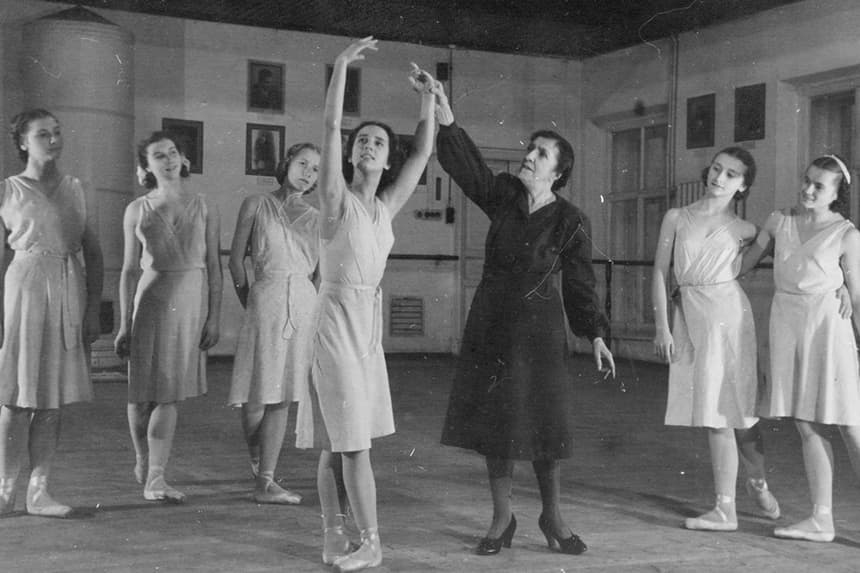
This widespread and prestigious method was developed in Russia by Agrippina Vaganova in the early twentieth century. Vaganova was able to take the best from the French, Italian, and Russian schools as well as the teachings of the iconic choreographer Marius Petipa. The style has gained a reputation for the strictness of the training and the ethereal grace and elegance of its graduates.

Agripina Vaganova with her students, training according to the Vaganova method.

The main principle of Vaganova’s pedagogical activity was the search for clean movement without unnecessary embellishment or carelessness and the desire to achieve great expressiveness of movements. Among the principles Vaganova brought into the process of training ballet dancers, it is worth mentioning the following:

  • Back positioning that allows the body to loosen up and become more expressive.
  • The positioning of the head and the direction of the gaze, which follows the movements of the arms and the body.
  • The dual role of arm movements: to create a spiritualized image and to support the dancer’s technique.

The teachers and judges at classical dance competitions still pay close attention to compliance with the principles and requirements of Vaganova technique.

The Cecchetti Method

Cecchetti’s pedagogical practice occupied a special place in ballet in the late 19th and early 20th centuries. Cecchetti, having learned a great deal from Russian ballet masters, synthesized the best qualities of the two different dance schools in his teachings.

Enrico Cecchetti method.

The pedagogical method he developed specifically for Russian pupils was distinguished by its clear systematization: he worked out a certain series of combinations for both adagio and allegro for each day of the week.

Cecchetti’s teaching principles had certain advantages. His method teaches solid skills for dynamic turns, steady poses, and clear tempos. Movements of arms, trunk, and legs acquire confidence and expression. Cecchetti’s class was rigorous, physically demanding, and developed breathing and leg strength (especially the feet).

French School

Bournonville’s technique is still part of Danish ballet practice. It appeared in European theatres as early as the nineteenth century, but August Bournonville’s ballets only became widely known outside of Denmark after World War II.

August Burnonville’s choreography is instantly recognizable. The illusion of weightless lightness is the main thing that the choreographer has brought to classical dance. The method requires the dancer to perform the most difficult movements as if they were so easy, in contrast to the French and Russian traditions, which highlight technically difficult steps.

Bournonville method

Bournonville’s technique is still part of Danish ballet practice. It appeared in European theatres as early as the nineteenth century, but August Bournonville’s ballets only became widely known outside of Denmark after World War II.

August Burnonville’s choreography is instantly recognizable. The illusion of weightless lightness is the main thing that the choreographer has brought to classical dance. The method requires the dancer to perform the most difficult movements as if they were so easy, in contrast to the French and Russian traditions, which highlight technically difficult steps.

The Royal Academy of Dance method

The English methodology of teaching classical dance evolved to spread this art form throughout England. The main feature of the methodology is the idea that by learning simple steps accurately and cleanly enough, it will be easier for the dancer to learn more complex and technical things later on. Accordingly, this school assumes slow and very careful teaching of simple steps, gradually increasing the level of complexity.

Balanchine method

The Balanchine method is used at the School of American Ballet (a school associated with ballet in New York City) and focuses on very fast movements combined with more open use of the upper body.

Balanchine’s method is characterized by intense speed, deep layers, and a strong emphasis on lines. The method has many hand positions and excellent and dramatic choreography. Balanchine-method hand positions (often referred to as “Balanchine hands”) tend to be more open, less curved, and often “broken” at the wrist. The arabesque positions tend to be uneven, with an open hip facing the audience to achieve the illusion of a higher arabesque line.

Kroon, Ron / Anefo, CC BY-SA 3.0 NL by Wikimedia Commons

Today, all of these techniques exist interdependently or in various combinations in ballet schools around the world. As a result of constant training, ballet dancers acquire an aesthetically beautiful positioning, strong muscles, flexible ligaments, and a confident command of the body.


Related articles:

Arabian dance in the nutcracker

The “Arabian” Dance in The Nutcracker

Christmas is around the corner, and if you are a Ballet enthusiast like me, you probably know that The Nutcracker recital has come to almost every city around the world. If you need to become ...
Ballet feet exercise. Ballerinas feet warming up stretching

Ballet foot exercises

10 Ballet Foot Exercises: Warm-up, Boost Your Technique and Foot Strength Foot exercises are an essential part of a ballet dancer’s training as they provide important strength and technique benefits. Developing strong and flexible feet ...
Ballerinas Feet. 3 ballet dancers stretching

Ballerina Feet: Ballet & Foot Health

If you’ve ever seen ballet or you’re a ballet dancer yourself, you’ll know how graceful dancers’ movements can be. But, of course, becoming a professional ballet dancer takes a LOT of hard work and dedication ...
Images of dancers on stage - moving to the best choreography, inspired by talented choreographers

The 9 Greatest Choreographers of the 20th century

This article see the DanceBible team pick some of the 20th century's (and all times!) greatest Choreographers, taking a historical slant via some very great and distinct contributions, which together help to describe the formation ...
Best bags for dancers. A girl carrying a bag on her shoulder whilst walking along.

Best dance bags

Best Dance Bags 2023 - Ultimate guide and review When you go to dance class or competitions, you probably take a lot of gear with you? Of course, dancers need a lot of space in ...
Classical Ballet. Ballerinas on stage with raised arms

Types of ballet

Ballet is a relatively young art form compared to other forms of classical dance, but its popularity exploded in the nineteenth, twentieth and twenty-first centuries and it remains one of the most loved forms of ...


Cover image  by vladislav83 on pixabay

This article was originally written by Emma but has been updated and contributed to by dance teacher Almiria Wilhelm.

Ballet Movies

Ballet movies is part of our series of reviews on movies about dancing
We have re-watched 14 ballet movies (‘films’ for some our our audience) and 1 series (what a hardship!), which tell stories of dance life. The list includes Hollywood-style feature movies, dramas, and documentaries about ballet. We’ve shortlist our favorites, to help you focus in on which ones to try first.

Enjoy watching!

A Ballerina’s Tale (2015)

A Ballerina's Tale 2015.

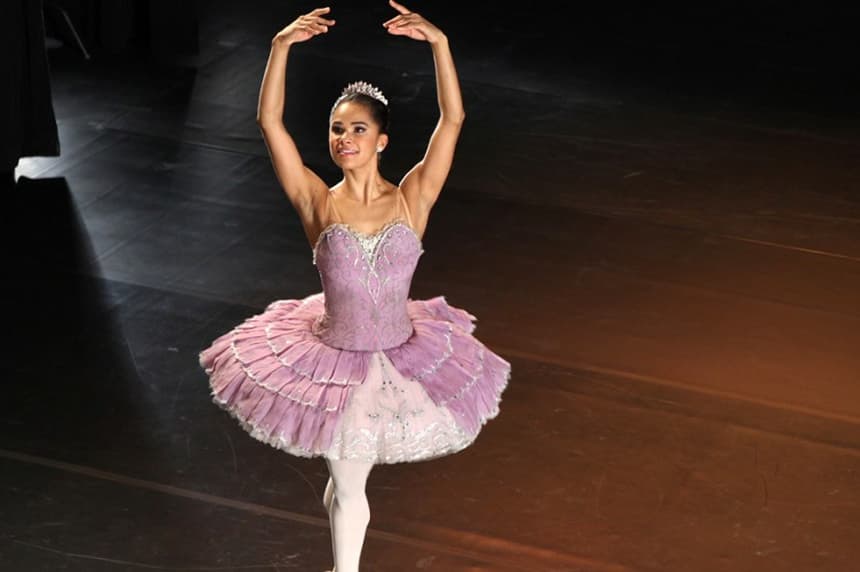
This is one of the most popular ballerina movies. Misty Copeland’s been dancing since she was a kid. However, the teachers of the ballet school thought that at the age of 13 there was no point in starting ballet lessons. Despite the fact that an art-passionate teenager at the age of 15 won a prestigious contest, many openly hinted that the girl can not have a successful career – she has the wrong physique.

In a troupe of 80 people, she considered herself a stranger, and the directors were thinking, not knowing how to work with such a girl. The only way out was to give her a solo part.

The Red Shoes (1948)

The Red Shoes.

If you want to enjoy watching ballet movies, this is a must see. “The Red shoes” is a model drama about art as a monster that destroys its children. The film is saturated with long dancing numbers and the participation of Leonid Myasin for authenticity. It still remains an exemplary movie to which all ballet directors are trying to look up to.

Billy Elliot (2000)

Billy Elliott.

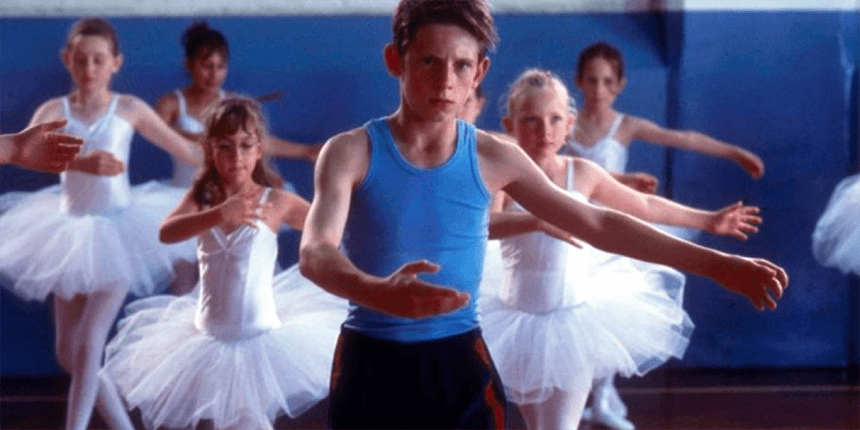
“Billy Elliot” is a ballet movie about a boy who wants to be a famous dancer. His father, a miner, because of gender prejudices does not consider dancing a man’s pastime and categorically against his son’s passion.

In a serious, in a funny way, “Billy Elliot” does not want to tell another boring story of following his dream. But it tells about growing up and normal for every teenager’s desire to find the right place in life.

First Position (2011)

First Position. Ballet documentary

A ballet documentary film about many years of training in ballet classes just for a few minutes on stage. Recently watching documentary movies about ballet is more interesting than fiction. Intrigue is still high, and the truth of real life can be much more dramatic than any fictional story.

Good dynamics, interesting protagonists, to the extent of drama and facts. The ballet movie is a well crafted documentary, well worth a watch.

Ballet 422 (2014)

Ballet 422 (2014). Ballet moviesAnother documentary tells the story of the debut of the young choreographer Justin Peck. The film tells the ups and downs of the creative process. In 72 minutes, viewers see how one man’s idea became a reality.

Darling (2017)

Darling.

It is danish ballet movie about the relationship between the two ballet dancers. Darling is a world-famous ballerina, Frans is her husband and partner in ballet. Together they plan to stage the Royal Giselle Theatre, where Darling will have the main part. During the first rehearsal, Darling falls in pain – she can no longer dance. The film tells the story of how the ballerina copes with the acceptance of injury, and it is before one of the most important events in the life of any ballet dancer.

The film shows the reverse side of the ballet dancer’s life very truthfully. Moreover, the film reveals the crisis of transition from stage activities to teaching – that is, the moment when ballerina can no longer perform on stage.

The Turning Point (1977)

The Turning Point.

This film is worth watching at least because it received 11 Oscar nominations and was never awarded, thus becoming one of the most famous losers in film history. Despite this, it is very deeply immersive: secondary roles in it were played by dancers of the American Ballet Theatre. The choreography was created by the famous director George Balanchine.

The Company (2003)

The Company 2003.

A new creative season has begun. The promising commonwealth of young dancers gathers again under the wing of Alberto Antonelli, the ingenious director of the troupe, famous for his ruthless exactingness demand for artists. How much tension will the artists have to go through to create an unforgettable spectacle on stage one day?

“The Company” was filmed with the participation of the Chicago Joffrey Ballet. When watching it there is a feeling of almost documentary curiosity, although The Company is a feature movie. This film is not so much about the people in the ballet as about the ballet. Therefore, it is obligatory for all fans of ballet art to watch it.

Center Stage (2000)

Center Stage (2000).

The main characters are young and confident, incredibly talented and ambitious dancers. They are ready to do anything to achieve success and recognition. Dance is the meaning of their lives, and they spare no effort climbing the Olympus of fame. But in ordinary life, they are ordinary people, with their problems, sorrows and joys, problems and shortcomings. But how do you become a star and still be human?

The White Crow (2019)

The White Crow (2019). Best ballet movies and films

A biographical drama about the legendary dancer Rudolf Nureyev and his difficult fate. The ballet movie is filled with the political context of the Soviet era, but it does not become less “dancing”.

Polina (2016)

Polina.In 2017, the American wide box office released the film “Polina”, telling about a Russian ballerina who moved to Paris in the hope of becoming famous. She does not want to engage in classical ballet in conservative and joyless Russia, but in contemporary dance in advanced Europe.

The main character of the film has devoted her life to ballet. She goes through grueling training, and through love difficulties, not without intrigue. The viewers see the story of the evolution of talent, tenacity, and real ballerina, who goes through many difficulties.

Dancer (2017)

Dancer.

The film “Dancer” directed by Stephen Kantor tells about the life and work of the famous ballet dancer Sergei Polunin, who became widely known after the release of the clip Hozier – Take Me To Church directed by David LaChapelle.

The film is about the biography of the performer. Polunin was accepted into the Royal Ballet Company of London at the age of 17. Two years later he became the youngest premier in the company’s history. However, the film tells not a classic success story, but tells about the emptiness that a person meets on top – and how to start life again, but by its own rules.

Center Stage: On Point (2016)

It is musical drama about the modernization of classical ballet and the fight against stereotypes in the dance art. The story is about a girl whose talent is darkened by her older sister, a brilliant ballerina. The film shows the young girl’s struggle for deserved recognition of her talent and her own dance vision.

The film is not without love stories and typical plot turns. This is another story of a dancer, whose path is accompanied by defeats and victories. But from that should not be considered bad – in this film will be a lot of dance, music and extravaganza, which is sure to please the youth audience.

Black Swan (2010)

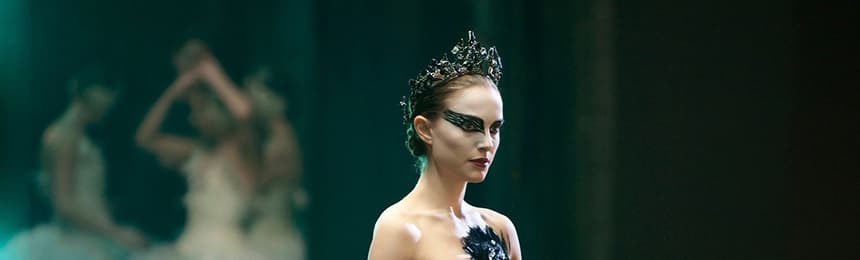
Black Swan.“Black Swan” is a modern story about ballet dancer Nina (played by Natalie Portman), whose life is changing as she gets the main role in Swan Lake. The film shows well the daily hard work of ballet dancers, tells about the strained relations between “ballet mom” and children-dancer. The life of the main character is inseparable from her professional activities because ballet and getting her starring role in the legendary ballet production – became the meaning of her life.

“Black Swan” should please not only fans of classical dance, but also those who love drama stories about self-reflection, which sometimes leads to schizophrenic tendencies.

But it should be noted that in this tape could not maintain a balance between acting and ballet. There are very visible cuts, understudies, misconstructed classes, the inability of the protagonists to dance professionally. Yes, Natalie Portman is good, but she is definitely not a ballerina and the montage could not disguise it.

Pina (2011)

Pina.

The film is not quite about classical ballet, but rather about modern dance – Art Nouveau. But we can’t ignore mentioning it in this list. Wim Wenders’ documentary is about the legendary German dancer and choreographer Pina Bausch, who passed away in the summer of 2009. While watching the film you understand where this or that “chips” and the movements of the contemporary dance appeared in due time.

Series «Flesh and Bone»

Flesh and Bone. Ballet series

This ballet series, something similar to the “Black Swan”: also about paranoia, mistrustfulness, and manic aspiration for absolute perfection, which, as you know, does not happen. There is a lot of dancing – though not as much as one would like – but even more ballet and melodramatic clichés, from which one even enjoys: and the choreographer, without a shadow of shame seducing young dancers, and drugs, and categorical tyranny. In short, behind every performance of Swan Lake, there is always an unpleasant inside.

We are sure that the list can be completed for a very long time!

After that, you may well be interested in seeing some other movies about dancing


Arabian dance in the nutcracker

The “Arabian” Dance in The Nutcracker

Christmas is around the corner, and if you are a Ballet enthusiast like me, you probably know that The Nutcracker recital has come to almost every city around the world. If you need to become ...
Ballet feet exercise. Ballerinas feet warming up stretching

Ballet foot exercises

10 Ballet Foot Exercises: Warm-up, Boost Your Technique and Foot Strength Foot exercises are an essential part of a ballet dancer’s training as they provide important strength and technique benefits. Developing strong and flexible feet ...
Ballerinas Feet. 3 ballet dancers stretching

Ballerina Feet: Ballet & Foot Health

If you’ve ever seen ballet or you’re a ballet dancer yourself, you’ll know how graceful dancers’ movements can be. But, of course, becoming a professional ballet dancer takes a LOT of hard work and dedication ...
Images of dancers on stage - moving to the best choreography, inspired by talented choreographers

The 9 Greatest Choreographers of the 20th century

This article see the DanceBible team pick some of the 20th century's (and all times!) greatest Choreographers, taking a historical slant via some very great and distinct contributions, which together help to describe the formation ...
Best bags for dancers. A girl carrying a bag on her shoulder whilst walking along.

Best dance bags

Best Dance Bags 2023 - Ultimate guide and review When you go to dance class or competitions, you probably take a lot of gear with you? Of course, dancers need a lot of space in ...
Classical Ballet. Ballerinas on stage with raised arms

Types of ballet

Ballet is a relatively young art form compared to other forms of classical dance, but its popularity exploded in the nineteenth, twentieth and twenty-first centuries and it remains one of the most loved forms of ...


Photo by Kal Visuals on Unsplash

Learn Ballet History

Ballet is a relatively young art form, with the earliest recorded mention of ballet dating back to the 15th century, or about 400 years ago. This article delves into ballet history and how it developed.

Agripina Vaganova with her students, training according to the Vaganova method.

The origins of the term ‘ballet’ are uncertain, with some sources suggesting it derives from the Latin word ‘balle’ (meaning dancing) and others suggesting it comes from the French ‘balleto.’ However, it is clear that ballet originated in a specific place. In the following article, we will explore the history of the development and popularization of this elegant art form.

Origin – 16th century ballet history

It is known that ballet originated during the Renaissance in Italy. The first mention of the word “ballet” is attributed to the court dance teacher Domenico da Piacenza. It was he who first proposed to combine several dances into one, perform them with a solemn finale and call them ballet.

The progenitor of classical dance is those forms of dance that were performed by hired dance masters for the nobles and princes at their celebrations. It was at such events that the original choreographic forms, the splendor of the spectacle, and the elements of drama in dance performances were born. Who would have thought that the usual entertainment of sovereigns would over time turn into art that millions of people around the world enjoy today?

A history of ballet. Ballet history

However, as a genre of art, the ballet took shape a little later. As we said earlier, ballet originated in Italy, but the first ballet production of The Queen’s Comedy Ballet was presented not in Italy, but in France in 1581. It was staged at the court of Catherine Medici of Italy, wife of the French King Charles VIII.

It was she who brought fashion for curious court ballets to France. The production was directed by the famous Italian choreographer and violinist Baltazarini di Beljoyozo from Italy. Since then, the ballet has moved to a professional stage where it occupied a certain place in opera and dramatic productions.

Mid 17th – 18th centuries

During this period of ballet history, this classical dance form continued to evolve about a century later, with the coronation of Louis XIV in France on June 7, 1654. Louis XIV was not only a fan of ballet, but also participated in productions himself, performing in the “Cassandra Ballet” at the age of 12 in 1651.

He earned the nickname “Sun King” for his role as the Rising Sun in “The Royal Ballet of the Night”. In 1661, Louis XIV established the Royal Academy of Dance to preserve dance traditions, with 13 of the best dance masters appointed to the Academy. Pierre Boschant, a royal dance teacher, was appointed director and later defined the five main positions of classical dance.

Louis XIV made the ballet stand out during his reign as a separate form of performance, different from balls. It was then that the division of dancers into amateurs and professionals appeared.

Ballet history fact!

Before 1681 only men danced in ballet. The first ballerina was the legendary dancer La Fontaine.

Then costumes and music were more important during performances than the dance technics. Girls danced in high heels wearing heavy dresses and masks. The costume of a man, although it was a little lighter (hence the greater grace and ease of movement), was still far from the clothes in which you could dance easily and freely.

The first to free the dancers from the shackles of these inconvenient costumes was a real reformer in the world of ballet art – the French ballet master Jean Georges Nover. He banned masks and gave the actors the opportunity to wear light suits that did not stiffen movement. Each innovation made dance more meaningful, and dance technique – more complicated.

Towards the end of the 17th century, court ballet achieved some success: it was fully funded by the authorities, which used it to exalt their own greatness. Gradually, the ballet completely separated from the opera and turned into an independent art.

One of the successful followers of Noverre became Jean Doberval, who in 1789 staged the ballet “Futile Precaution”. A simple story about the unhappy love of a young peasant and a village girl was presented on stage. The absence of stories about the adventures of the gods, majestic masks and corsets made the production natural, and the dance free.

Dance class in opera 1872. Edgar Degas (1834-1917).

Romanticism – late 18th – early 19th centuries

The strongest influence on ballet history was the direction of romanticism, which erupted in the late 18th century. In a romantic ballet, the female dancer first began to wear pointe shoes. Maria Taglioni was the first to do so, completely changing the previous ideas about ballet. In the ballet “Sylphide” she represented a fragile creature from the other world. The success was overwhelming.

Romanticism brought into the ballet the image of an incorporeal spirit – a ballerina who hardly touches the earth. In the same period, the roles of dancers are changing. Men turned into moving statues, which existed only to support the ballerina. Then the rising stars of female ballet completely and successfully overshadowed men.

Ballet history fact!

By the way, this situation was slightly corrected by the rise of the Nijinsky star from the Russian Ballet in the early 20th century. By this time, traditional for us ballet costumes, choreography, stage sets, props had already developed, in a word, everything had become almost what it is now. Eventually, it was a Russian ballet that started the revolution in ballet art.

Over time, the peak of the popularity of romantic ballet had already passed, and Paris, as the center of classical dance, began to fade away.

Russian ballet and its influence on world classical dance

The popularity of classical dance in Europe had an impact on ballet in Russia.

Ballet History Timeline.

The first ballet school in Russia was opened in 1738 (now the Vaganova Academy of Russian Ballet). At the same time, Peter I made dancing the main part of court etiquette, so the court youth was obliged to learn dancing. Thus, for example, the dance became a compulsory lesson in the Schlyakhet Cadet Corps in St. Petersburg. Since then, cadets have started to participate in ballet dances.

The dance instructor in the corps was Jean-Baptiste Lande. He understood that the nobility would not devote their lives to the art of dance. Therefore, in September 1737, Lande filed a petition in which he justified the need for a new special school where girls and boys of simple origin would be trained in choreography. Soon, such permission was given. From that moment on the training and development of dancers, for whom the ballet was a real profession, began.

At the beginning of the 19th-century Russian ballet art reached creative maturity thanks to the work of French ballet master Charles-Frederic-Louis Didlot. Didlot strengthens the role of the corps de ballet, the connection between dance and pantomime, asserts the priority of female dance. Russian dancers have brought expressiveness and sublimity to the dance.

The music of the legendary composer P. Tchaikovsky was the impetus for a new stage in the ballet history of Russia. Swan Lake, staged to Tchaikovsky’s music in 1877, gave rise to the fact that music for ballet began to be taken seriously. It was in the composer’s work that the romantic ballet became established. Tchaikovsky paid special attention to music, transforming it from an accompanying element into a powerful instrument that helps the dance to subtly capture and reveal emotions and feelings. Before that, music was considered just an accompaniment to dance.

Dancers from Swan Lake coming onto stage

Andrew Bossi Long CC 2.0via Wikimedia Commons

20th century

The beginning of the 20th century is characterized by an innovative search, the desire to overcome stereotypes and conventions of the academic ballet of the 19th century. One of the main innovators of this period in Russia is Sergey Diaghilev. In 1908, the annual performances of Russian ballet dancers in Paris began, organized by Diaghilev. The names of dancers from Russia became known throughout the world. But the first in this row is the name of the incomparable Anna Pavlova. Also, under his leadership in 1911, the ballet company was first organized. You can find out more about some of ballet types & styles in our related articles.

Anna Pavlova.
Diaghilev’s seasons – especially the first ones to include the ballets Firebird, Petrushka and Sacred Spring – played a significant role in popularizing Russian culture in Europe and helped establish a fashion for everything Russian. Thus, the passion of Europeans for traditional Russian costume gave rise to the new fashion. It was then, under the influence of Russian artists’ skill, that the western ballet took a second breath.

In 1929 Diaghilev died. Over time, his troupe broke up. One of its members – George Balanchine – was developing ballet in the USA and founded the New York City Ballé company. He became one of the most influential choreographers of the 20th century. In his dances, Balanchine strove for classical completeness of form, for impeccable purity of style. In many of his works, there is virtually no plot of any kind. The choreographer himself believed that the plot in the ballet is absolutely irrelevant, the main thing being the music and the movement itself. Today Balanchine’s ballets are performed in all countries of the world. He had a decisive influence on the development of twentieth-century choreography, not breaking with tradition, but boldly renewing it.

Another protege of Diaghilev, Serge Lifar, led the Paris Opera Ballet Company and for a long time was the most influential figure in French ballet.

The second half of the 20th century

In the 1950s, the dramatic ballet was in crisis. Strengthening the entertainment and pomp of performances, choreographers made futile attempts to preserve the ballet genre. Until the end of the 1950s, there was a breakthrough.

Choreographers and dancers of a new generation revived the forgotten genres – one-act ballet, ballet symphony, choreographic miniature. And since the 1970s, ballet troupes have emerged that were independent of opera and ballet theaters. Their number is constantly growing, among them, there are studios of free dance and modern dance. But today the academic ballet and the school of classical dance are still relevant.

FAQ:

Who were the 8 main figures who influenced the history of ballet?

Catherine Medici; Louis XIV; Jean Georges Nover; Jean Doberval; Jean-Baptiste Lande; P. Tchaikovsky; Sergey Diaghilev; George Balanchine.

What is the history of ballet?

16th century – the origin of ballet, the first ballet production. Mid 17th century – the rise of ballet dancers into amateurs and professionals. The end of 17th century – ballet is favourite form of art and accesses funding. 18th century – abandoning lavish costumes, the dance becomes freer and more professional. The start of Russian ballet. 18th - early 19th centuries – the era of romanticism in ballet, the female dancer first began to wear pointe shoes. 1877 – to the music of Tchaikovsky's Swan Lake ballet was staged. 20th century - Sergei Diaghilev's ballets are becoming popular throughout the world. 1950s - the dramatic ballet was in crisis. 1970s - the rebirth of ballet as we know it today begin.

What monarch reigned during the rise of professionalism in ballet history?

Professionalism in ballet emerged in the 18th and 19th centuries. During this time, several monarchs reigned in various countries where ballet was popular, including: King Louis XIV of France, who was the patron of the Paris Opera Ballet and played a significant role in the development of ballet as a professional art form. Queen Victoria of the United Kingdom, who was a patron of the Royal Ballet and supported the development of classical ballet in England. Tsar Nicholas I of Russia, who was a patron of the Imperial Ballet in St. Petersburg and played a significant role in the development of Russian ballet. King Ludwig II of Bavaria, who was a patron of the Munich Opera Ballet and supported the development of ballet in Germany.

Related articles:

Arabian dance in the nutcracker

The “Arabian” Dance in The Nutcracker

Christmas is around the corner, and if you are a Ballet enthusiast like me, you probably know that The Nutcracker recital has come to almost every city around the world. If you need to become ...
Ballet feet exercise. Ballerinas feet warming up stretching

Ballet foot exercises

10 Ballet Foot Exercises: Warm-up, Boost Your Technique and Foot Strength Foot exercises are an essential part of a ballet dancer’s training as they provide important strength and technique benefits. Developing strong and flexible feet ...
Ballerinas Feet. 3 ballet dancers stretching

Ballerina Feet: Ballet & Foot Health

If you’ve ever seen ballet or you’re a ballet dancer yourself, you’ll know how graceful dancers’ movements can be. But, of course, becoming a professional ballet dancer takes a LOT of hard work and dedication ...
Images of dancers on stage - moving to the best choreography, inspired by talented choreographers

The 9 Greatest Choreographers of the 20th century

This article see the DanceBible team pick some of the 20th century's (and all times!) greatest Choreographers, taking a historical slant via some very great and distinct contributions, which together help to describe the formation ...
Best bags for dancers. A girl carrying a bag on her shoulder whilst walking along.

Best dance bags

Best Dance Bags 2023 - Ultimate guide and review When you go to dance class or competitions, you probably take a lot of gear with you? Of course, dancers need a lot of space in ...
Classical Ballet. Ballerinas on stage with raised arms

Types of ballet

Ballet is a relatively young art form compared to other forms of classical dance, but its popularity exploded in the nineteenth, twentieth and twenty-first centuries and it remains one of the most loved forms of ...


Ballet Moves for Beginners

Are you dreaming about a career as a ballerina or just want to try classical dance for yourself? These simple (ha-ha) ballet moves for beginners will help you understand what ballet is and is it fits you.

Are you ready? There are 9 ballet movements that tone the muscles of the whole body. Let’s go.

Students learning to ballet dance - beginners moves
Photo by Cottonbro Studios on Pexels

PLIÉ

Plié in the first position is one of the basic elements of ballet. Stand in the first position and start bending your knees slowly until your knees are over your thumbs. Hold on to this position for a second and then return smoothly and quickly upwards. Complete the movement in the first position.

Plié should be performed in all 5 main ballet positions. There are two types of pliés: demi and grand.

GRAND PLIÉ

The Grand Plié also performs from the first position, but unlike the Plié, you sit much lower, tearing your heels off the floor.

RELEVE

Releve is a basic movement that almost all newcomers learn. To perform a simple releve, take the first position and hold the ballet barre with one hand. Tension the caviar muscles and pull up to be on your socks. Transfer all the weight to the part of the foot that is under your fingers. This position is called the demi-pointe. Then gently fall down.

Try to do single-leg releve as well. This exercise is good for strengthening the back surface of the hip and calf.

Over time, you try to connect the plié and the releve. First, make a plié and then climb up in the releve using the strength of your feet on climbing.

BATTEMENT TENDU

Battement tendu is an exercise in which the working leg is either pulled aside and then returned, or bent and unbent. There are several different types of battement with which you can practice the ability to correctly move your leg back to the original position, bend and stretch the leg, pull it out and lift it to any height in any direction and at any speed.

JETE

In this exercise, the working leg moves in three directions: forward, to the side, back and again to the side. But the sock is detached from the floor every time. The leg is raised to the position in which it will make from the other about 45 degrees. After making the whole chain of movements, repeat the jete from the other leg.

ROND

Push your right foot forward without tearing your sock off the floor. Smoothly, drawing a semicircle, move it to the side and then back. Return to the original position, repeat 6 times with each foot.

FONDU

Lower into the demi-plie by bending the supporting left leg and leading the sock to the right of the ankle stone. Unbend the supporting leg and pull the right one forward. Return to its original position. Repeat the movement by pulling the right foot to the side, but then lower into the demi plié, leading the right foot behind the shin with the left foot. Straighten the supporting leg by pulling the right foot back. Move the side again and return to the original position. Perform the exercise 4 times from each leg.

SAUTE

Saute is a jump with no position change. It is convenient for learning the mechanics of jumping with novice students. Its study is started separately, with pauses before each jump. Saute consists of three main points: half-sitting (preparation for the jump), the jump itself and landing (half-sitting). The jump is made by jumping with the pushing of heels from the floor.

During the jump, the legs in the air are stretched in the knees to the limit, toes are stretched too, and the body is straight, no tension, the legs in the air retain the given position. When landing after the jump, the socks touch the floor first, then the whole foot is lowered and a half-squat is made evenly on both feet. Keep the body straight.

ADAGIO

Get in the fifth position. Push your right foot forward as in a battement tendu, but then raise it, straight, to the parallel with the floor. Go back to the fifth position and also through the battement tendu lift the foot to the parallel with the floor to the side. Then make the same move back, again to the side and return to the original position. Repeat with the other leg.

So, after these ballet moves for beginners, are you ready to wake up the ballerina inside of you?


Related articles:

Arabian dance in the nutcracker

The “Arabian” Dance in The Nutcracker

Christmas is around the corner, and if you are a Ballet enthusiast like me, you probably know that The Nutcracker recital has come to almost every city around the world. If you need to become ...
Ballet feet exercise. Ballerinas feet warming up stretching

Ballet foot exercises

10 Ballet Foot Exercises: Warm-up, Boost Your Technique and Foot Strength Foot exercises are an essential part of a ballet dancer’s training as they provide important strength and technique benefits. Developing strong and flexible feet ...
Ballerinas Feet. 3 ballet dancers stretching

Ballerina Feet: Ballet & Foot Health

If you’ve ever seen ballet or you’re a ballet dancer yourself, you’ll know how graceful dancers’ movements can be. But, of course, becoming a professional ballet dancer takes a LOT of hard work and dedication ...
Images of dancers on stage - moving to the best choreography, inspired by talented choreographers

The 9 Greatest Choreographers of the 20th century

This article see the DanceBible team pick some of the 20th century's (and all times!) greatest Choreographers, taking a historical slant via some very great and distinct contributions, which together help to describe the formation ...


Also interesting to read: