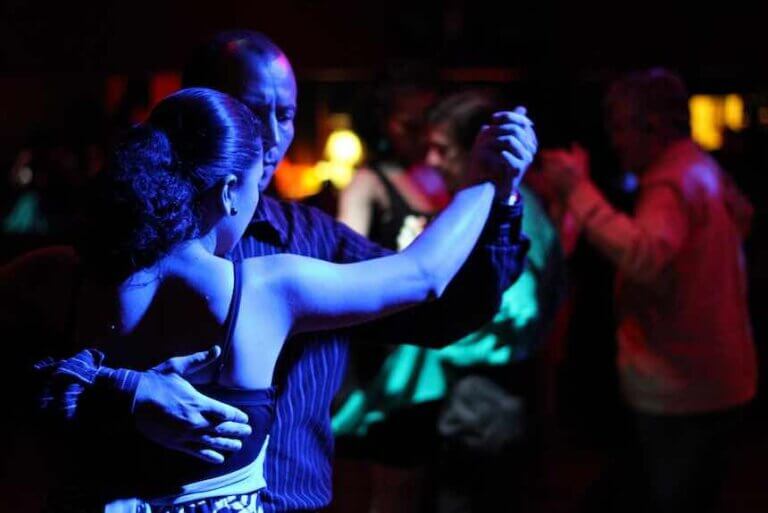
12 Benefits of Dancing

Dancing is one of the most popular types of physical activities, which among other things gives a good mood and brings pleasure. That’s why dancing is an ideal activity for those who are bored just to do sports. Below we will talk about other benefits of dancing for your health, psychological state, and social life.

1. Health: Greatest benefits of dancing

Dancing, like any other physical activity, has a positive effect on health. Dance movements improve blood circulation, rejuvenate the body. It directly affects the state of internal organs. Regular training reduces the risk of cardiovascular disease and colds. Dancing helps to raise the so-called “good” cholesterol (HDL) level and reduces the number of “bad” cholesterol (LDL).

Besides dancing helps to strengthen bones and as a result, prevents osteoporosis.

2. Dance benefits flexibility

Stretching to Lose Weight.
Development of flexibility and amplitude of movements is one of the ways of development for any dancer, regardless of the style of dancing. Most dancing lessons begin with a warm-up, which includes several stretching exercises. We can talk a lot about the benefits of flexibility and stretching, but here are its main advantages: improving body mobility, preventing injuries to feet, joints and muscles, improving blood circulation, the improvement of coordination of movements.

3. Strength is a dancing benefit

Persons who dance train all muscle groups. The body of the dancer and his muscles grow evenly and proportionally, which in turn affects the figure. Dancers’ muscles do not become as voluminous and embossed as, for example, weightlifters, but they have great strength and endurance. Just look at the so strong ballet dancers!

4. Keeping fit through dance

Keeping fit because of dancing.Photo by Pixabay on Pexels
During the dance, calories are burned. The more intensive and faster the dance moves, the more calories are burned. Therefore, if you tend to be full, the dance will help you spend time pleasantly while remaining in a good fit. In addition, many studies have proven that dancing helps control fat consumption.

5. Endurance training

Endurance is the ability of muscles to work harder for longer periods of time without fatigue. Dancing is a long time aerobic exercise, which also trains endurance.

6. Good memory

Of course, dances improve memory, as dancers have to memorize many different choreographies and do it quickly. Attending a lot of masterclasses, staging dances for performances, training new movements, and their techniques – all this requires constant concentration of attention and memory development.

7. Fighting the bad mood

It has been proved that movements to music contribute to the production of serotonin (the hormone of happiness), reduce stress levels, get rid of emotional tension.

8. Creative skills and thinking development

By dancing, you develop not only the body but also creative thinking. Moreover, improvisation is one of the most important parts of dancing classes. It also helps you to think outside the box and go beyond standard thinking. Improvisation also helps to go beyond the comfort zone, which also positively influences the level and ways of thinking and creative activity.

9. Beautiful gait and smooth posture

Great posture.
Choreography is impossible without grace in movements, which is grafted in the first lessons and over time becomes part of life. That is why dancers most often have a very smooth posture and a beautiful gait.

10. Good balance and coordination of movements

Performing some dance moves requires a high degree of coordination of movements and balance.

11. Communication and new contacts

You meet many new interesting and creative people in training. This is especially useful for children who are actively acquiring communication skills and are in the socialization phase.

12. Enhanced self-esteem

It is believed that dancing helps a person to reveal themselves, to express their feelings, to become more graceful and plastic. As a result, a person becomes more confident in himself, and this confidence is transferred not only to dance activities but also to everyday life.

Choreography and its benefits.

So, if you are looking for some physical activity that will help you to be more healthy and feel better, you should try dancing. The benefits of pole dancing, ballroom, classical dance, or street dances are numerous.


Other related dance tips articles:

Teaching dance tips - creating a supporting learning environment

10 Tips for New Dance Teachers

To help you with dance teaching in those early steps of your career, this article outlines some tips for new dance teachers. A few handy pointers which I've learned along the way ...
couple dancing the milonga in an evening

Milonga Dance: The uptempo relative of the Argentine Tango

Milonga dance celebrates Argentine Culture. A ballroom dance sharing many characteristics with the better known Argentine tango and considered to be the forerunner to Tango. A fluidity gives dancers the opportunity to express the vibrant ...
Ballet feet exercise. Ballerinas feet warming up stretching

Ballet foot exercises

10 Ballet Foot Exercises: Warm-up, Boost Your Technique and Foot Strength Foot exercises are an essential part of a ballet dancer’s training as they provide important strength and technique benefits. Developing strong and flexible feet ...
Image of lady with her hairstyle prepared for dancing in a flamenco competition

Dance Hairstyles: For Competitions and Classes

Dance hairstyles are part of the show! This article will give you inspiration and for new styles and pointers in doing them. The dance floor is very demanding. Including our hairstyles. This demand applies both ...
Image of a lady stretching on an athletics track

Hyperbolic Stretching

Hyperbolic Stretching Hyperbolic stretching is a new type of stretching from Alex Larsson. It's been getting a lot of coverage lately on various websites, but it's also been met with skeptics. Let's review the facts ...
A photo of a couple at night, swing dancing, being cheered by a crowd circled around them

12 Types of Swing Dance

What is swing dance? Swing dancing is a type of partner dance performed mostly to swing music. The focus is on musicality, improvisation, and personal expression. There are many ways to classify swing dances. Most ...

You may also be interested in the benefits of pole dancing

Burning Calories Dancing

Dancing is a good cardio load. This activity corresponds to a fat-burning cardio zone (60-80% of your maximum heart rate). Burning calories dancing is a great way to lose a couple of extra pounds.
Burning Calories Dancing. A lady dancer stepping out of bed onto the scales.
Photo by alan KO on Unsplash

The amount of calories burned depends on your age, weight and metabolic level.

That is, how many calories an average person spends an hour doing this or that dance.

All data below are based on estimates for a girl weighing approximately 155 pounds. But once again, let us remind you that everything depends not only on weight but also height, age, metabolic level, intensity of training.

Ballet – from 450 to 500 kcal/hour

Ballet is in first place in terms of calorie consumption. With various classic pas, you can burn about 500 calories or even more.

If you are not a professional dancer, try the relatively young direction of classical dance – body ballet. In such classes, you will be taught a basic ballet pas, put even posture, show how to work near the ballet barre.

Hip Hop — from 400 to 500 kcal/hour

Hip-hop and generally street dances such as dancehall, breakdancing, krump are usually very rhythmic and fast, which means it’s a great cardio load. The main elements and techniques of hip-hop are “rocking” body, jumping, falling, spinning and light acrobatic movements. This dance includes a wide range of movements of the whole body, which puts it quite high on the calorie scale. Depending on the intensity of your workout, you can spend up to 500 calories per hour.

Zumba — from 400 to 500 kcal/hour

Zumba is a dance fitness program that combines fitness exercises and movements from Latin American dances.

If your main goal in dancing is to lose weight, then Zumba is the perfect fit for you. It’s both fun and effective, and group dancing is not boring thanks to the fiery Latin rhythms of music. You can even try practicing zumba at home. But don’t forget to buy comfortable sneakers for zumba classes!

Latina – from 300 to 400 kcal/hour

Depending on whether you are a sports ballroom dancer or a social Latino dancer, there will be different calorie consumption and efficiency. But on average you can burn up to 400 calories per hour of active samba or salsa training.

Pole Dance – to 400 kcal/hour

Pole Dance combines cardio load, stretching exercises and at the same time power training. The main load is on the abs, back, and arms. Not as many calories can be burned for weight loss during a pole dance training as during a more rhythmic dance. However, you should take into account that sport pole dance is a serious power load, which develops your muscles, thus helping to increase muscle mass and, accordingly, increase the consumption of calories.

Contemporary — to 400 kcal/hour

Contemporary is a dance direction, consisting of many different techniques and styles. It is based on classical dance and art nouveau – modern dance. Despite the seeming lightness and airiness of movements, dance contemporary burns a lot of calories, gives enough load on the muscles and body.

The heavier you are, the more you spend compared to a lighter colleague. According to Harvard Medical School, if you weigh about 133 pounds, you’ll burn about 5.5 kcal per minute while dancing at a moderate pace. A person weighing 155 pounds kilograms will spend 7 kcal per minute or 420 kcal per hour.

Create a calorie shortage

Physical activity alone may not be enough to feel the full effect of dance training. In order to lose weight while dancing, it is advisable to contact a nutritionist, who will perform the necessary calculations and make a suitable menu taking into account all needs.

Advantages of Dancing for Slimming

Besides the fact that dancing produces plasticity and helps us lose weight, it has a lot of other advantages. Among them are the following:

  • The whole body works during training. By dancing, you develop all muscle fibers evenly, so rest assured that your body will look as proportionate as possible.
  • Dancing improves coordination – it helps a lot in everyday life.
  • Dance training makes you more flexible. Many dream of being able to do splits or a bridge. Dancing is a great opportunity to learn it all.
  • Choreography increases self-confidence.
  • Aerobic loads are a prevention of osteoporosis, a positive effect on the cardiovascular and respiratory systems.
  • Dancing develops a sense of balance and a sense of self in space.
  • Dancing also works well as art therapy. Sometimes it is difficult for a person to express his emotions and feelings in words, to say it out loud, to tell someone else. So the narrative goes through movements and music.

FAQ

How many calories do you burn when you dance?

It depends on what type of dance do you choose. But on average you can burn between 300 and 700 kilocalories per hour of dancing practice.

Which type of dance burns the most calories?

Hip hop and ballet burn the most calories in an hour of training. The Zumba Fitness Dance is also effective for weight loss.

How long do you have to dance to burn 1000 calories?

A person who weighs 155 pounds needs about two hours of high-intensity training to burn 1,000 calories while dancing.

Is dancing good for weight loss?

Dancing is good for weight loss.


Some other dance tips you might enjoy:

Teaching dance tips - creating a supporting learning environment

10 Tips for New Dance Teachers

To help you with dance teaching in those early steps of your career, this article outlines some tips for new dance teachers. A few handy pointers which I've learned along the way ...
couple dancing the milonga in an evening

Milonga Dance: The uptempo relative of the Argentine Tango

Milonga dance celebrates Argentine Culture. A ballroom dance sharing many characteristics with the better known Argentine tango and considered to be the forerunner to Tango. A fluidity gives dancers the opportunity to express the vibrant ...
Ballet feet exercise. Ballerinas feet warming up stretching

Ballet foot exercises

10 Ballet Foot Exercises: Warm-up, Boost Your Technique and Foot Strength Foot exercises are an essential part of a ballet dancer’s training as they provide important strength and technique benefits. Developing strong and flexible feet ...
Image of lady with her hairstyle prepared for dancing in a flamenco competition

Dance Hairstyles: For Competitions and Classes

Dance hairstyles are part of the show! This article will give you inspiration and for new styles and pointers in doing them. The dance floor is very demanding. Including our hairstyles. This demand applies both ...
Image of a lady stretching on an athletics track

Hyperbolic Stretching

Hyperbolic Stretching Hyperbolic stretching is a new type of stretching from Alex Larsson. It's been getting a lot of coverage lately on various websites, but it's also been met with skeptics. Let's review the facts ...
A photo of a couple at night, swing dancing, being cheered by a crowd circled around them

12 Types of Swing Dance

What is swing dance? Swing dancing is a type of partner dance performed mostly to swing music. The focus is on musicality, improvisation, and personal expression. There are many ways to classify swing dances. Most ...


Sources and External Resources