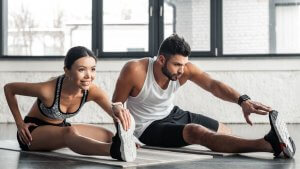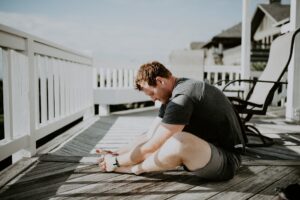
Milonga Dance: The uptempo relative of the Argentine Tango

Milonga dance celebrates Argentine Culture. A ballroom dance sharing many characteristics with the better known Argentine tango and considered to be the forerunner to Tango. A fluidity gives dancers the opportunity to express the vibrant energy and flirtatious spirit often associated with the milonga music. This is a known for its playfulness and joy – as well as its complicated, intricate steps and movements.

Are you looking to find out more about the techniques and music of Milonga, its similarities and differences with Argentine Tango? Well read on!
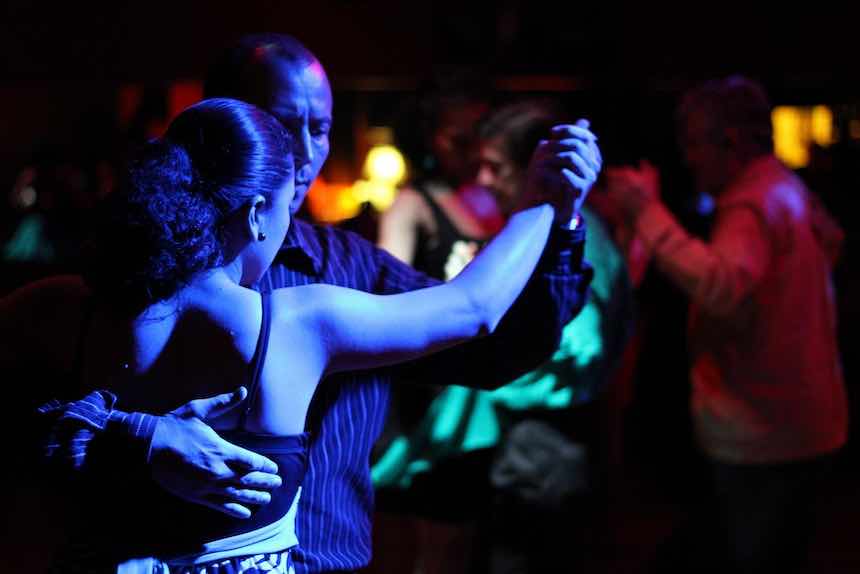
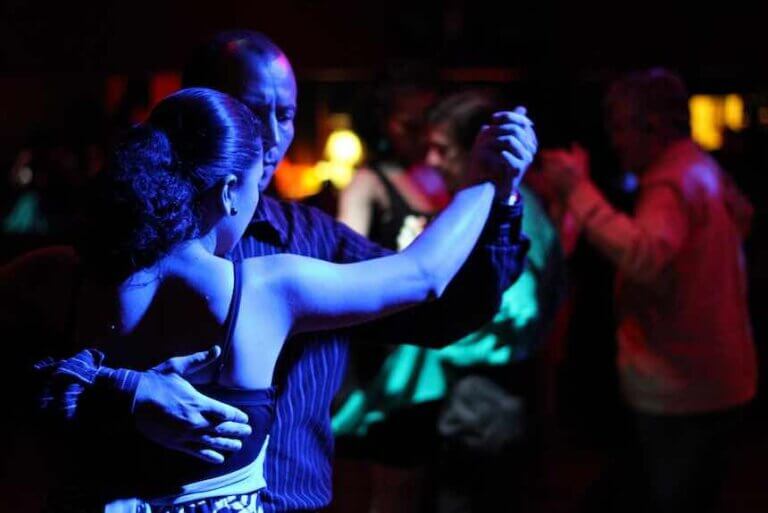
couple dancing the milonga in an evening
Image by Luis Fernando from Pixabay

History and origins of Milonga dance

The origin of the milonga dance is closely tied to the Afro-Argentine community. We’ll cover more about this in the ‘language’ section below – as it is an African word.

This period seems to have been less covered but we across this quote from Professor or Art History at Yale, Robert Farris Thompson, who noted “Tango started black, and milonga, the dance preceding it, even more so”.

In terms of its more widely covered origins, we trace back to The Río de la Plata, separating the cities of Montevideo and Buenos Aires – port cities, leading to ‘the pampas’ cattle ranches, as well as mining areas of the Andes. Because of this geography, international influence and nature of work, in the1870’s to 1900’s, the area had an influx of gauchos (cowboys), sailors, soldiers, stablemen – the lower classes of society.

Milonga was mainly danced by who mixed various global folk dances and dance at brothels and parlours, beginning as a walking dance and incorporating more sexualized movements, often ahead of the other activities taking place at these locations.

Hence milonga was frowned upon by the upper classes of Argentine society, to the point that you actually needed a permit to run dance around the city!

However, by the late 1870s, composers and singers began creating milonga songs, which contributed to its popularity and widespread adoption throughout Argentina.

By the early 1900s, milonga and tango became socially acceptable, even reaching craze status in fashionable European circles by 1915. It is believed that this started, in part, through wealthy families sending their sons on a coming of age, ‘grand tour’ to Europe.

There  were events and gatherings, at which these travellers would share their dance the tango, vals (waltz), and milonga, began to attract a wider audience. These events, initially spreading through then beyond Paris to gain more popularity across Europe and in the mainstream.

During this period, there were also a number of European contributions to the Milonga. These include:

  • The waltz, adding to to Milonga’s rotating movements and elegant flow.
  • The polka helping shape Milonga’s rhythm and high energy.
  • The mazurka, adding further sentimentality and drama

As milonga gained popularity, it started to merge with other dance styles like the Cuban habanera and flamenco, ultimately evolving to develop the Argentine tango that is known today.

Milonga is still celebrated, danced in classes, clubs and dancehalls around the world.

How to dance milonga

Getting the rhythm

First we need to get a grasp for the basic Milonga rhythm. It uses an upbeat 2/4 rhythm, with quick, syncopated steps. Listening to Milonga music and tapping your foot or hand to the beat is one way to get familiar with the rhythm ahead of taking any steps.

Next, focus on mastering the basic Milonga step patterns.

These include

  • the salida (the basic walking step)

In this video, Ana Padron from Tangoforall.com says “think of a Salida as the period (or ‘full-stop’) at the end of a sentence. You can also see the steps described here

  • the back ocho – steps that form a figure eight on the floor


  • the forward ocho


Milonga often incorporates fun, theatrical elements like small lifts, jumps and kicks. On mastering the basic steps, dancers can start exploring these more advanced moves. Remember to keep your movements careful and controlled to avoid disrupting your partner or other dancers.

Partnership

The lead and follow dancers working in harmony is what creates a smooth, connected dance experience to the rhythm. Good communication between partners, and signalling movements using the leader’s chest, arms, weight shifts and body movements to signal show clear intention to the follower. Followers need to be attentive and responsive to these subtle cues.

Posture

A Milonga posture is upright. You ensure that your chest is slightly forward, and weight over the balls of your feet, with knees are slightly bent. The embrace in Milonga is often very close – similar to Argentine Tango.

Dance styles and techniques

The two primary dance styles within milonga are Milonga Lisa and Milonga con Traspie.

Milonga Lisa

Milonga Lisa, sees the dancer make steps on every beat, displaying smooth and continuous movements. It’s good for beginners to familiarize themselves with milonga dance, using simple moves

Milonga con Traspie

A more advance dance. Milonga con Traspie is more syncopated and intricate. Rhythmic changes, include shifting weight from one foot to the other and back again in double time, or three steps in two beats. This gives the dance energy, as do the additional techniques:

  • Quebradas are breaks in the dance pattern where the couple momentarily pause or uses a different rhythm before resuming their dance.
  • Cortes, are brief interruptions in the movement, here dancers can showcase creativity and skills in improvisation.
Milonga dancers in competition
Photo by PreIllunination Seth on Unsplash

Similarities and differences between Milonga and Tango

Similarities between milonga and tango

Milonga and tango are both Argentine dances. They share a deep cultural and historical bond as they both originated from the The Río de la Plata area

Differences between milonga and tango

Music & tempo: Milonga is danced at a much faster tempo than tango, following a 2/4 rhythm. Tango is slower and more deliberate allows dancers to interpret the music through pauses, slow and quick movements and includes a variety of melody.

Movements: Milonga dance has faster, sharper and more flowing movements, with a more relaxed posture.

Embrace: Milonga dancing maintains a tighter embrace than tango, to support the faster, more intricate footwork required.

Milonga Music

Milonga music typically includes various instruments that are essential to its unique sound:

  • Bandoneon: An often used, type of concertina. It’s similar to an accordion.
  • Piano: providing harmony and syncopation.Often used in Milonga.
  • Violin: adding and emotion to the music, playing both melodic and rhythmic parts
  • Double Bass: a foundation for the music, adding depth and anchoring the melodic instrument
  • Guitars showcase the dance’s connection to traditional Argentine and Uruguayan folk music

Musical Influences

The origins of milonga music can be traced back to a combination of musical genres and influences. This includes:

  • Habanera, a Cuban dance rhythm that found its way to Buenos Aires in the late 19th century
  • The vals (waltz) contributed to the development of the milonga style with its flowing and graceful melodic elements.

Famous Composers & Contributors to Milonga Music

Great musicians and composers have been central to the development of Milonga music and the dance style more broadly. Some of the most well-known contributors include:

  • Ástor Piazzolla: A revolutionary Argentine composer.
  • Carlos Gardel: Known as the “King of Tango,” but also very influential on the development of milonga music
  • Aníbal Troilo: A significant composer, bandleader and bandoneon player bandleader during mid-20th century.
  • Villoldo: known as the father of tango

Some others who made considerable contributions to the music include: Rodolfo Biagi, Edgardo Donato, Gabino Ezeiza, Juan D’Arienzo, Angel Vargas, and Roberto Firpo.

Some of the individuals notable in the transition from Milonga to Tango include: Francisco Canaro, Lucio Demare, Pedro Laurenz, and Domingo Federico. Carlos Di Sarli is famed for mastering both styles.


Milonga etiquette for the dance floor

Off to your first Milonga, fear not, here’s some tips to get started.

  • Go with or arrange to meet a friend or partner. It will be much more fun to have someone to dance with. Once you become more familiar, you will be more likely to have opportunities to meet with other dancers.
  • Instead of asking a stranger to dance and the potential for embarrassment this creates, in Milonga, use eye contact (“mirada” as in ‘mirror’) is made with a potential partner. If this is held, a slight nod of the head “cabaco” is made and, if returned, the leader will walk the follower to the dance floor.
  • Dress to impress, think more fancy restaurant than club. Some events are more casual but as a rule you’re dressing up.
  • Firstly, understanding the flow of the dance floor is essential, so you can enter the dance floor safely. Dancers follow the “ Ronda”, an imaginary line of dance by moving counter-clockwise around the room, allowing everyone to enjoy the space without causing disruptions. Ensure any approaching leader has seen you before moving into and maintaining space on the dance floor.
  • During a Milonga, the music is organized in tandas, which typically consist of three to four tangos from the same genre or orchestra. It is considered proper to dance with the same partner for the entire tanda.
  • At the end of each tanda, a short musical break called a ‘cortina’ provides an opportunity for dancers to change partners, rest or socialize.
  • Leaders should be aware of their partner’s comfort, avoiding excessive force or uncomfortable body positions.
  • If its getting hot and sweaty, bringing a change of outfits, like shirts for men and extra (but not overpowering) perfumes, mints and deodorants can be a good idea – after all, you’re up very close in a Milonga embrace!
  • Thank your partner after each dance.

Famous Milonga Dancers

Want to see great examples of Milonga in action? Checkout these amazing dancers:

  • Miguel Zotto and Daiana Guspero are prominent figures in the world of milonga dance.
  • Angel Coria and Claudia Sortino are another example of celebrated milonga dancers. They are known for infusing their routines with humor and joy.
  • Dani Garcia and Luna Palacios have significantly contributed to the milonga dance scene.

Milonga Meaning

As a word itself, Milonga has African origins, meaning ‘argument’ / ‘issue’ in Kimbundu or ‘lines of dancers’ in Ki-Kongo. Milonga is also a term with multiple meanings in the context of Argentine culture and dance.

Musical genre:

As a musical genre: “Milonga is an excited habanera.” Often the music accompanying the dance, with a related history.

Milonga dance:

As we’ve spent the last few minutes describing, dancers perform the milonga with smooth and gliding movements, intricate footwork and rhythm.

Milonga event:

Milonga is also a word describing a social event, where people dance. The styles danced also include the Argentine tango and vals. Attendees, known as milongueros, enjoy a night of dancing and socializing. Often the events are a relaxed and social affair with a sense of community.


Related articles:

Spanish dancers performing

10 Classical Spanish Dances

Spanish Dances article by Tanya, a dancer who lives in Spain. The warm, cheerful, and picturesque streets of Spain contain many wonders for anyone who wants to visit them. There is a very rich and ...
Conga line dancing

Conga Line: How to Conga at parties in 3 steps

Conga lines have long been a favorite for parties and social gatherings, helping break the ice and getting that party vibe going. If you’ve never experienced a Conga Line, it’s good fun. In this article  ...
couple dancing the milonga in an evening

Milonga Dance: The uptempo relative of the Argentine Tango

Milonga dance celebrates Argentine Culture. A ballroom dance sharing many characteristics with the better known Argentine tango and considered to be the forerunner to Tango. A fluidity gives dancers the opportunity to express the vibrant ...
Ballet feet exercise. Ballerinas feet warming up stretching

Ballet foot exercises

10 Ballet Foot Exercises: Warm-up, Boost Your Technique and Foot Strength Foot exercises are an essential part of a ballet dancer’s training as they provide important strength and technique benefits. Developing strong and flexible feet ...
Male and Female doing a Tango dance before a crowd. Photo by Preillumination SeTh on Unsplash

Tango Dance

Tango Dance is a passionate and expressive form of dance that originated in Argentina in the late 19th century. It is characterized by its close embrace, intricate footwork, and dramatic flair. Tango Dance is known ...
Crowd gathered gor a parade with samba dancers in full costume

Samba Dance

The Samba is a Brazilian dance that has become popular all over the world. It is characterized by its lively and energetic steps and is often performed to music with a strong beat. The origins ...

Why not check out our article on Conga lines too.

Ballet foot exercises

10 Ballet Foot Exercises: Warm-up, Boost Your Technique and Foot Strength

Foot exercises are an essential part of a ballet dancer’s training as they provide important strength and technique benefits. Developing strong and flexible feet is a big part of the groundwork you lay as a dancer. Given the exceptionally demanding nature of ballet, appropriate foot exercises help prevent injuries, maintain correct technique, and contribute to achieving the desired aesthetic lines on stage.

After all, dancers’ feet are so central to everyday life as well as to our art that we want to keep them in great shape. In a previous article, we covered some of the injuries that affect ballet dancers’ feet and legs including sprains, strains, and stress fractures. In this article, we’ll cover warm-ups and exercises that you may wish to consider adding to your routine. Remember, if you are experiencing pain, make sure to seek medical advice and let your teacher know – it’s always better to catch potential problems early.

Ballet feet exercise. Ballerinas feet warming up stretching
Photo by Astrid Schaffner on Upsplash

Warm-Up Ballet Foot Exercises

Most dance classes will start by warming up your feet (and the rest of your body). It’s a great way to help prevent injuries. Repeating these exercises as part of a “cool down” at the end of dance class/training can also be very beneficial.

Ankle Circles

Let’s start with a simple warm-up for the ankles. Either sitting or standing, move your ankles in a circular fashion, one ankle at a time, clockwise for 5-10 circles, then change direction to counter-clockwise. Repeat on the other side.

Tennis Ball Circles

Take a tennis ball and roll it under your toes and the balls of your feet in circles as demonstrated in this video:

You can also use products such as foot rollers in a similar way and some dancers report that they have given them relief from various foot conditions. If you need a foot roller, take a look at this one.

Toe Points and Foot Flexes

This classic exercise really helps  warm up and stretch the muscles in your feet, right to the ends of your toes. This can be done either sitting down or standing up.

First, press your toes toward the floor, pointing your feet, and hold the position for 5-10 seconds.

Then switch to flexing your entire foot up toward your body and hold this position for another 5-10 seconds.

Foot Rolls

Next, warm up your arches by lifting your heels off the ground and rolling onto the balls of your feet, one foot at a time, and holding it for 2-3 seconds, as shown in this video. Complete around 5 sets of these.

Strength Training Exercises for Ballet Feet

Now that your feet are warmed up, we move on to ballet foot exercises to strengthen the muscles around the feet and ankles, assisting with both stability and flexibility.

Towel Scrunches

Towel scrunches

Try this standing up. Use your toes to grip and pull the towel closer to you, “scrunching” it up each time and repeating until the towel is pulled all the way toward you. A variation of this is picking up and moving a small ball or similar object with your toes.

Alternatively, in this video, professional ballerina Nikki White shows us the 5 steps to towel scrunches in a sitting position, as well as “reverse towels scrunches” and the “grab and pull”. Ignore the cover image – the video should play fine.

The Ball exercise:

This is a popular strengthening exercise and goes beyond foot strength, helping to develop calf strength and flexibility. First place a ball (or a similar round object) between your ankles. Use controlled sets of lifting and lowering the heels.

TheraBand Resistance

TheraBand exercises are a form of resistance training for the foot, with the bands available in different levels of resistance. With the Theraband wrapped around the foot, there is a wide selection of movements and exercises available. This video shows a great one to start with:

Don’t yet have a theraband? No problem! Check out here.

Domed Foot Presses

Domed foot presses are a great way to activate and strengthen the muscles of the foot. The exercise can be performed effectively by following the steps below:

Place the foot flat on a solid surface. Lift the arch of the foot as high off the floor as possible without bending the toes.

Maintaining healthy feet as a ballet dancer

Nobody wants an injury, so look after your feet – and the rest of your body. We’ve covered a lot in this guide. Here are a few recaps and wider considerations:

1.     Warm Up and Stretch

Never skip warming up your feet as part of your overall warm-up program. We’ve covered a few suitable exercises today including ankle circles, tennis ball circles, toe points and flexes and foot rolls. Equally, remember to perform a “cool down” at the end of your class or training.

2.     Strengthen Foot and Ankle Muscles

We’ve looked at a variety of ways to help build strength including towel scrunches, domed foot presses, the ball exercise and TheraBand resistance training.

3.     Proper technique

A common thread through all these tried and tested techniques featured above (and in dancing generally) is using the right technique. Performing exercises with poor form can have serious consequences, so really pay attention to following the techniques and alignments demonstrated in the videos.

4.     Suitable Footwear

In our guide to the best pointe shoes, we cover some important considerations such as getting the right fit and level of support depending on your specific foot type and ballet experience. Wearing comfy, supportive shoes (i.e. not high heels) outside of dance class, like trainers or Birkenstocks, is a rule many dancers live by.

5.     Gradual Progression

As with any sport, but especially one as physically demanding as ballet, avoid injury by building gradually up to more strength, flexibility and advanced movements. Going too hard, too fast, is counter-productive and likely to cause injury.

6.     Listen to Your Body

Your intuition about those early warning signs your body gives you is important. Listen to this and get help when you’re unsure. Early intervention can prevent more severe injuries from developing.

7.     Get expert help

If you experience any pain or discomfort during or after dancing or exercising, tell your family, dance teacher, doctor, or professional specialising in dance injury. They’re there to help and want the best for you.

That’s it. We hope you’ve found these ballet foot exercises and techniques useful. We wish you happy, healthy dancing!


Other related articles about Ballet:

Disclaimer: We hope you find his guide helpful but please remember that all information, guidance, or advice provided on this site is for informational and educational purposes only and used at your own risk.

Coaching of each move in dance class is often the best way to learn. Improper execution of exercises can cause health problems. Consult your healthcare provider if you are having problems with your feet or are looking to make changes to your exercise regime.

Students learning to ballet dance - beginners moves

Ballet Moves for Beginners

Are you dreaming about a career as a ballerina or just want to try classical dance for yourself? These simple (ha-ha) ballet moves for beginners will help you understand what ballet is and is it ...
Ballet feet exercise. Ballerinas feet warming up stretching

Ballet foot exercises

10 Ballet Foot Exercises: Warm-up, Boost Your Technique and Foot Strength Foot exercises are an essential part of a ballet dancer’s training as they provide important strength and technique benefits. Developing strong and flexible feet ...

Cover photo by Astrid Schaffner on Unsplash.

This article was originally written by our editor Emma, checked and contributed to by Almiria Wilhelm.

Hyperbolic Stretching

Hyperbolic Stretching

Hyperbolic stretching is a new type of stretching from Alex Larsson. It’s been getting a lot of coverage lately on various websites, but it’s also been met with skeptics. Let’s review the facts and help you understand both sides better.

What Exactly Is Hyperbolic Stretching?

What exactly is hyperbolic Stretching?

According to the official website, hyperbolic stretching is a new type of stretching that focuses on the tendons and ligaments to improve flexibility.

The basis behind Hyperbolic stretching “is based upon the discovery that, contrary to what was previously thought, tendons and ligaments are not rigid tissues but actually very elastic.”

Main Points of Hyperbolic Stretching Technique

  • 4 pieces of training a week
  • Duration – 1-month minimum
  • The time you need – around 8 minutes a day
  • Available for any age
  • There are two separate programs for men and women. According to the program, and some old research, it is believed that there are differences between stretching and its effectiveness for women and men. Therefore, the programs have been chosen with these features in mind.
  • 60-day money-back guarantee
  • The program includes 21 exercise videos.

How Much Does It Cost?


How Much Does It Cost?

You’ll get lifetime access to video workouts for only $27. No additional fees or commissions.

Hyperbolic Stretching Review

Hyperbolic Stretching Review.

The program consists of six different content blocks.

  1. Complete side splits video series. This part of the course explains how to stretch for the most difficult splits. The videos will help you relax and open your hips to maximize your performance.
  2. Complete front splits video series. This is where you work on stretching the hamstrings and hip flexors.
  3. Dynamic flexibility and stretching. Dynamic stretching is useful for athletes and dancers because it helps increase the range of motion and speed of movement of the legs.
  4. Complete upper body stretching. The flexibility of the shoulders, chest, arm muscles, and upper back is just as important as the flexibility of the lower body. This video segment will tell you how to do it more effectively.
  5. Pike mastery & front bending. The important part of quality stretching is to work on the lower back and the back of the thighs. The girdle, glutes, and hamstrings require a special approach. But as a result of stretching them, you will be able to fully bend over your legs and reach positions that you could not achieve before.
  6. Easy bridge & back bending. This video unit will help strengthen your shoulder and abdominal muscles so you can easily do the bridge.

How Does Hyperbolic Stretching Work?

According to hyperbolic’s official website, the method of stretching is designed to improve flexibility by slowly-but-surely elongating muscle/tendon tissues, increasing their elasticity before trying to lengthen them. This prevents injuries and helps muscles get back into shape faster.

It does this through a three-step process:

  1. Slow Tissue Preload: This step involves a slow tensing of the muscle before extending it to its full length. Through a series of controlled repetitions, you slowly work up to lengthening your muscles so they can be stretched comfortably.Hyperbolic stretching uses this technique in conjunction with what is called “polarized stretching.” This means that during the elongation, you minimize the muscle’s cross-sectional area by pulling the muscle and cutaneous ligaments apart.
  2. Active Extension: In this step, you use a controlled force to slowly increase your extended length until you reach (and hold) your maximum natural range of motion. This dissipates any tension developed during stretching that was not released through slow tissue preload.This is the main reason why hyperbolic stretch advocates recommend doing this type of stretching at least four times a week for 8 minutes each time.
  3. Muscle Relaxation: Once your muscles are totally elongated, they’re maintained at their maximum length by contracting your antagonist’s muscles. Since the effects of relaxation occur much faster than other stretching methods, this step is very important for hyperbolic stretching. The best way to do this would be through proprioceptive neuromuscular facilitation (PNF) stretch because it allows you to contract and relax specific muscle groups in order to further extend your range of motion.Hyperbolic stretching also uses a technique called “active pause elongation,” a slower version of the active extension that may well be the most important aspect of this type of stretching. This enables your muscle to focus on its elastic capabilities as you gradually increase your flexibility.The creator, Alex Larsson, believes that if done right, there’s no limit to how flexible you can become.

Interested? Take a look here at the official site.

Who Is Alex Larsson?

Who Is Alex Larsson?

He is professional flexibility and core strength expert as well as a specialist in hyperbolic stretching.

He began experimenting with his technique after he had a complete neuro-muscular shutdown in his lower back, hips, and thighs. His mobility was so restricted that he couldn’t even stand up from his chair. He realized that most stretching programs were ineffective in achieving long-term flexibility and decided to do something about it after researching tendon elasticity and the physiology of lengthening muscles during a stretch. He spent years researching the science of stretching, exercise, and physical fitness in order to recover from this event.

What Are The Benefits of Hyperbolic Stretching?

According to the hyperbolicstretching.com, there are several benefits to using their technique:

  • Maximum Range of Motion: The goal of every stretch should be full range of motion (ROM) in all directions. Hyperbolic stretching is believed to maximize your body’s natural ROM because it encompasses the entire tendon and not just the muscle itself.
  • Injury Prevention: Since the idea is to elongate tissues over time, you can minimize injuries before they even happen because you are conditioning yourself for upcoming activities that may involve strenuous movement or awkward postures.
  • Correct Posture: This method works best if it’s done immediately after a workout routine, which is why it’s considered a recovery method. It helps to restore your normal posture by lengthening the connective tissue throughout your entire body, especially in the lower back and neck regions.
  • Less Stress On Joints: This type of stretching is very helpful because you are not overloading any one joint while trying to stretch muscles that are connected to that joint.
  • It’s A More Efficient Way of Stretching: Many people don’t realize that stretching during a workout can actually reduce your performance and may cause you to feel sore the next day as well as weak muscles. Hyperbolic stretching, on the other hand, reduces these effects because it increases flexibility with less effort.
  • Enhance the dancing skills and dynamic elasticity – a key for a professional dancer. Therefore, effective stretching that is affordable and takes a little time becomes a great option for dancers who are practicing anyway.
  • It improves the blood circulation throughout your entire body, which is beneficial in so many ways including better sleep quality and reduced soreness after workouts.
  • Beyond that, it’s a well-known fact that stretching before an intense workout is beneficial to your performance so you can consider using this type of stretching as part of your warmup routine if you want to reduce the risk of injury and increase ROM.
  • The main reason why people love to use the hyperbolic stretching technique is that there are many ways to customize it, depending on your ability level. You can also change the positioning of your body so that you’ll feel less tension in certain areas.
  • Back relief and decompression. Hyperbolic stretching is a great way to stretch and release your body’s pressure points. Stretching is vitally important for your body, but most people only stretch the largest muscle groups without ever considering all of their connective tissue. Hyperbolic stretching covers this by attacking muscles fibers with everything from lengthening to relaxation. The technique has even been shown to be helpful for people who suffer from chronic back pain or compressed discs in their spine!

Who Should do Hyperbolic Stretching?

This technique is ideal for people of all ages, especially those who are more active or have some sort of injury because it will allow them to recover faster. People who use this type of stretching are usually athletes, dancers, yoga enthusiasts, crossfitters, martial artists, and anyone else who wants an efficient way to improve flexibility.

Most people who try this type of stretching for the first time do it as a part of a physical therapy process because, unlike comparative exercises, hyperbolic stretching is believed to increase your ROM by an average of 12% compared to other methods.

The only limitation is that you’ll have to be patient in order to experience its full benefits because it takes a while to complete the exercises. However, you can test out this technique by doing a few of the stretches in your free time and seeing if you notice any changes in your flexibility levels.

You will need to be disciplined and do the stretches consistently if you want to experience the best results.

How Do You Use Hyperbolic Stretching?

It’s pretty easy to use this technique; all you have to do is stretch in the following manner, paying attention to proper form and breathing patterns.

You can use this method as your primary method of stretching. However, if you expect to lose weight or burn calories with these workouts, you should add hyperbolic stretching as a supplement to strength or other core workouts.

Athletes, dancers, and yogis use hyperbolic stretching as an adjunct to their core skills.

The Bottom Line

If you’re an athlete or anyone else who wants to increase flexibility while reducing the risk of injury, hyperbolic stretching is a good option for you because it’s known to reduce soreness and joint pain. The different positions that you’ll be in during these stretches will allow you to target problem areas that other exercises don’t address. If you love yoga, this is a great alternative because you can combine the breathing techniques from both practices for even more effective results.

It might take a while for you to achieve your desired results, but it’s totally worth it because this type of stretching is a proven method of increasing flexibility and range of motion. If you’re not a fan of long workouts, that’s OK because you can do hyperbolic stretching for around 8 minutes at least 4 times a week during a month and you’ll see the great results anyway.

Related articles:

couple dancing the milonga in an evening

Milonga Dance: The uptempo relative of the Argentine Tango

Milonga dance celebrates Argentine Culture. A ballroom dance sharing many characteristics with the better known Argentine tango and considered to be the forerunner to Tango. A fluidity gives dancers the opportunity to express the vibrant ...
Ballet feet exercise. Ballerinas feet warming up stretching

Ballet foot exercises

10 Ballet Foot Exercises: Warm-up, Boost Your Technique and Foot Strength Foot exercises are an essential part of a ballet dancer’s training as they provide important strength and technique benefits. Developing strong and flexible feet ...
Image of a lady stretching on an athletics track

Hyperbolic Stretching

Hyperbolic Stretching Hyperbolic stretching is a new type of stretching from Alex Larsson. It's been getting a lot of coverage lately on various websites, but it's also been met with skeptics. Let's review the facts ...
Exercises for stretching the back. Image of dancer on a rooftop

Exercises for Stretching the Back

Let's look at exercises for stretching the back. Flexibility for a dancer is just as important as strength. It helps to avoid injuries, to move with more amplitude, and to feel your body and its ...
Plow exercise for your back. Image of dancer stretching

Stretching Routine for Dancers

A stretching routine for dancers helps to prevent injuries and prepare the body for the load. We will tell you in detail about the various benefits of stretching for dancers. And then we offer some ...
Stretching to Lose Weight.

How does stretching help you lose weight?

There's no point in questioning the benefits of stretching to the body. A flexible body is a sign of his youth. But as for stretching to lose weight, how effective will that be? For many, ...

Exercises for Stretching the Back

Let’s look at exercises for stretching the back. Flexibility for a dancer is just as important as strength. It helps to avoid injuries, to move with more amplitude, and to feel your body and its possibilities better. But in addition to the cherished splits, the concept of flexibility also means developed and soft back muscles. Most exercises for stretching the back are not easy. But if you do it regularly and effectively, you will be incredibly satisfied and surprised at the result! The flexible back gives ease of movement, relieves pain, and helps in everyday life.

Well, after we tried to convince you of the usefulness of exercises for back stretching, let’s start directly to the training.

Exercises for stretching the back. Image of dancer on a rooftop
Photo by Photo by Jana Muller on Upsplash

Training Rules

Always follow these rules to ensure that the result does not take too long:

  • Exercise daily.
  • Before stretching, do an intense workout.
  • Perform all stretching exercises smoothly, relax your muscles as much as possible.
  • Exercise in comfortable clothes.
  • Start stretching with a small amplitude so that there are no injuries.
  • Watch your breathing: breath evenly and deeply.

Warm-up before stretching

It’s important to warm up before doing exercises to stretch your back to help prevent injury and improve flexibility. If you’re planning a separate stretching session, start with some joint-warming exercises to get your body moving. So first do some exercises:

  1. Join-warming: include twist joints, tilt, and swivel the body.
  2. 5-7 minutes cardio: This can include activities like jogging, jumping jacks, “rock-climbing,” or jumping rope.

Once you’ve warmed up, you can then begin stretching.

Exercises for stretching the back

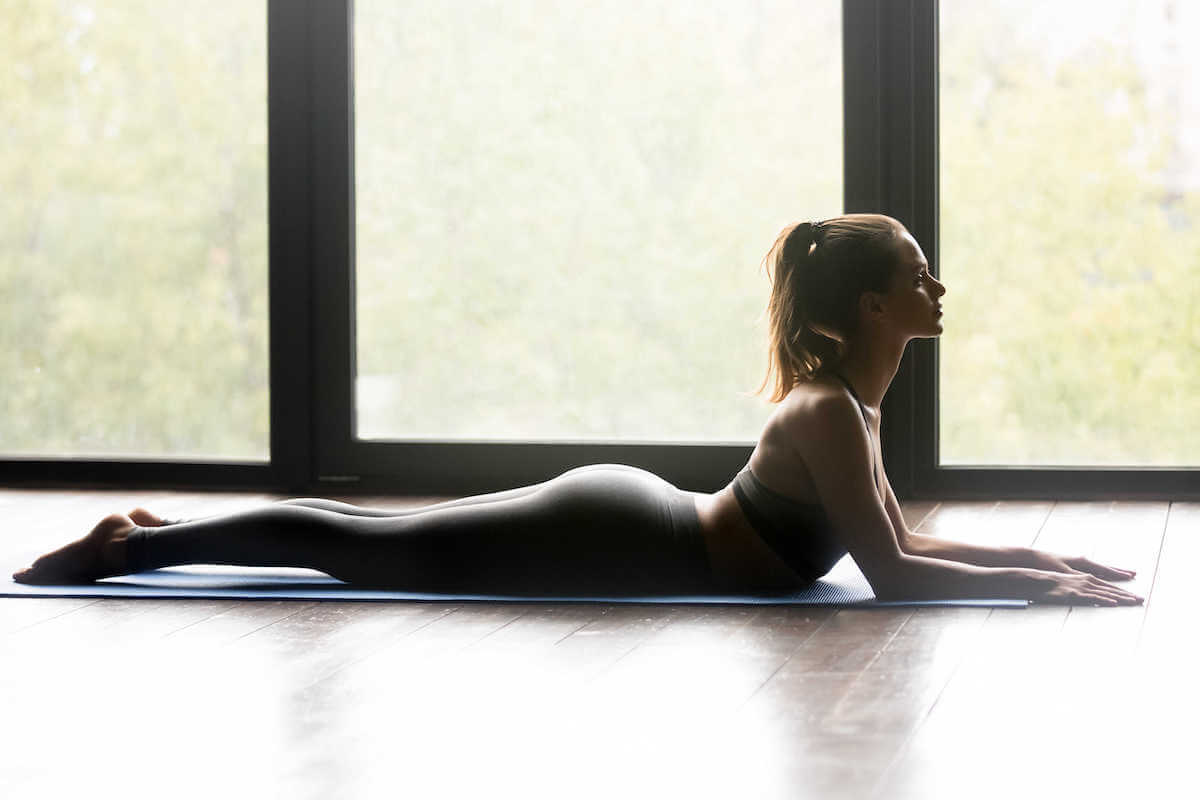
1. Sphinx posture

It is a basic and one of the most popular asanas in yoga, it is also called Ardha Bhujangasana.

Photo of young lady doing the Spinx position to stretch her back as a dancer
Photo by fizkes on Shutterstock

Technique. It’s done by lying on your stomach. Extend your arms in front of you parallel to each other. Shoulders down and open neck. First, place your head on the floor and relax your back, buttocks, and legs.

With a breath tighten your abs, raise your torso and pull your arms up, bending at the elbows. Find a comfortable position in which the lumbar spine will feel comfortable. The abdomen should be pressed tightly to the floor and the chest should be torn from the mat to the limit of the lower ribs. The top of your head reaches up.

Your main task is to divert tension into the area of the shoulder blades and at the same time relax the lower back and relax the neck. Pull the shoulders down from the neck, pushing your hands off the floor. Feel the tension in the middle part of the back, focus on the inner sensations.

2. Cobra position

This and previous postures effectively develop flexibility and eliminate pain in the lower back. The cobra is a more advanced version of the sphinx posture. The technique is almost the same as in the previous exercise, but you need to put your palms, not your elbows, on the floor, and then straighten your elbows by raising the body up.

Cobra back stretch for dance and exercise
Photo by Ketut Subiyanto on Pexels

If you need to complicate the exercise, remaining in the position of the cobra, bend your knees, and at the same time bend in the back, moving your head back. Pull the toes to the back of the head, deflecting the back as much as possible.

3. Superman

This exercise is not only for flexibility but also for the strength of back muscles. You need to lie down on your stomach and then raise your arms and legs simultaneously. In this position are at least 10 accounts, slowly lower your legs and arms to the floor. After rest, you can repeat one more cycle. Do not throw your head, look directly in front of you, focusing on the muscles and breathing. With this exercise, you will strengthen your back muscles!


4. Forward Bend

Sit on the floor. Align your knees in front of you. Lean forward gradually until you put your face on your knees and touch your toes with your hands.

The same can be done with wide-leg positions. Sitting on the floor, spread your legs wide, lean forward, and you can also try tilting the sides in turn to each leg.

Photo by Marta Wave via Pexels


5. Kneeling tilts

Kneel down so that you have a right angle between your tibia and thighs. Then gently stretch back without any sudden movements or jerks. If you have difficulty, first try to guide your hands through the bottom by touching the heels. As the exercise becomes more difficult, try to bend, leading your hands through the top, which is without support.

Kneeing tilt stretch, 3 people, 2 men and a lady doing this in the studio. In the photo you can see the form of the starting position
Photo by Mikhail Nilov via Pexels


6. Bow position

Lie on your abdomen, resting on your palms or forearms. Keep your hands behind your back and bend your knees at the same time. The heels should point upwards. Wrap your arms around your ankles and bend as much as possible in your back without throwing your head back. Pull the legs towards the back of the head with your socks so that the result is a pose that looks like a stretched bow.

Dancer stretching back in the bow position
Photo by Elina Fairytale on Pexels
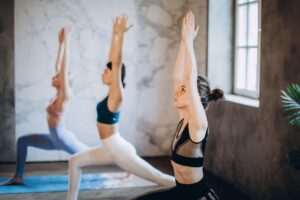
7. Gymnastic bridge

Of course, almost the main back stretching exercise is the bridge. It is excellent for both beginners and advanced, and also helps to relax the shoulder muscles.

Gymnastics bridge stretch - in this image demonstrated by a girl in her front room
Photo by Gustavo Fring on Pexels

Lie on your back and place your palms on both sides of your head, turning them inside out. Bend your legs and raise your pelvis up, straightening your arms. Try to stretch your legs at the knees, and hands at the elbows so that the arch in the back resembles a real semicircular bridge. Standing in the bridge position, try to carry your weight on your hands, slightly leveling your legs in your knees.

Complication: exit to the bridge from standing position. To learn this, try near the wall first. Stand close to the wall, lean back, and find the wall with your hands. “Walk” the wall with your hands downwards until you reach the floor. In the same way, return to the standing position. When you feel that you have enough strength to do the exercise without help, try to move away from the wall carefully.

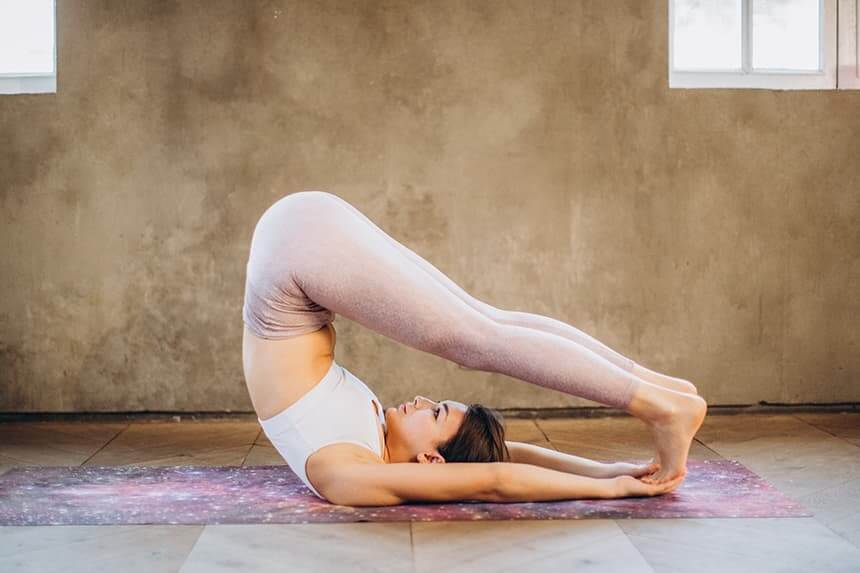
8. Exercise Plow

Exercise is performed while lying on your back, arms and legs are extended along the body. Slowly raise your legs up, perpendicular to the floor. When the legs are upright, pull the toes towards you. Then slowly lower your legs behind your head, and grab your toes with your fingers. Keep your knees level. In this position, you need to stay at least for a minute. Then you can return to the starting position, avoiding sudden movements, and take a few deep breaths.

Plow exercise for your back.Photo by Elina Fairytale on Pexels 

The exercise has a complicated continuation. Try bending your knees and laying them near your ears. Not everyone can do it, but all in good time! Perform our complex regularly and you’ll precisely achieve this level of stretching!

9. Cat & Camel

Stand on all fours (table position) with your hands exactly under the shoulder joints and your hips under the pelvic bones. Then arch your back up toward the ceiling and tighten (or brace) your abdominals, drop your chest toward the floor and lift your head slightly, imitating the cat. When arching rise up your chin, and when bending – lower your head down. Work at maximum amplitude but at a slow pace to avoid pain.

10. Twisting from a table pose

While staying in the table position, move the weight on one hand and place the second hand on the floor perpendicular to the body. So, you put the body weight on the scapula and hand, gently lift the second hand up, turning the head and body after it. Look up in the palm of your hand or forward. Perform extremely gently and slowly, without jerking so as not to damage the shoulder. This exercise develops flexibility of the upper back, strengthens arms and shoulders, improves balance and coordination.

Twisting from a table pose. Back stretching for dancers
Photo by Fizkes on istockphoto

After training recovery

After training, you should do exercises to relax back muscles, such as rolls. Sit on the floor, bend your knees, hug your legs with your hands. In this position, your back should be as if hunched. Gently begin to roll onto your back and back to a sitting position. If you have pain in the spine, lay a rug or a soft towel under your back. Do 10 of these rollings.

At the very end of the stretch, be sure to make an embryo pose. Stand on all fours and put the pelvis on its heels, stretching your arms out in front of you. The head touches the floor, the back is straight. In this position, relax all the muscles of the back, shoulders, arms. Lie down in the fetal position for at least a minute. Then stretch your arms along the torso without pulling them forward. You can turn your head to relax your neck. This position maximizes stress relief from the spine and gently stretches it.

Embrion pose.

That’s it! Congratulations! You have performed a full range of exercises for back stretching. Performing these exercises regularly, over time you will feel exactly how much easier this or that exercise is given to you. Also, your back will hurt less and it will be easier for you to perform different tilts in everyday life.

We wish you a flexible back and a healthy body!


Other articles related to stretching:

couple dancing the milonga in an evening

Milonga Dance: The uptempo relative of the Argentine Tango

Milonga dance celebrates Argentine Culture. A ballroom dance sharing many characteristics with the better known Argentine tango and considered to be the forerunner to Tango. A fluidity gives dancers the opportunity to express the vibrant ...
Ballet feet exercise. Ballerinas feet warming up stretching

Ballet foot exercises

10 Ballet Foot Exercises: Warm-up, Boost Your Technique and Foot Strength Foot exercises are an essential part of a ballet dancer’s training as they provide important strength and technique benefits. Developing strong and flexible feet ...
Image of a lady stretching on an athletics track

Hyperbolic Stretching

Hyperbolic Stretching Hyperbolic stretching is a new type of stretching from Alex Larsson. It's been getting a lot of coverage lately on various websites, but it's also been met with skeptics. Let's review the facts ...
Exercises for stretching the back. Image of dancer on a rooftop

Exercises for Stretching the Back

Let's look at exercises for stretching the back. Flexibility for a dancer is just as important as strength. It helps to avoid injuries, to move with more amplitude, and to feel your body and its ...
Plow exercise for your back. Image of dancer stretching

Stretching Routine for Dancers

A stretching routine for dancers helps to prevent injuries and prepare the body for the load. We will tell you in detail about the various benefits of stretching for dancers. And then we offer some ...
Stretching to Lose Weight.

How does stretching help you lose weight?

There's no point in questioning the benefits of stretching to the body. A flexible body is a sign of his youth. But as for stretching to lose weight, how effective will that be? For many, ...

Stretching Routine for Dancers

A stretching routine for dancers helps to prevent injuries and prepare the body for the load. We will tell you in detail about the various benefits of stretching for dancers. And then we offer some effective videos of a stretching routine for dancers.
Plow exercise for your back. Image of dancer stretching
Photo by Elina Fairytale on Pexels
Important!

When stretching, pay attention to all muscle groups in your body. Neglecting one muscle can lead to clamp formation and general asymmetry.

Why do dancers need stretching?

  • Stretching is the ability of joints to make movements of the maximum possible amplitude, for this it is necessary to improve the elasticity of muscles and ligaments. The higher the elasticity of muscles and tissues, the greater the amplitude of the movements performed, and vice versa: if the muscles are enslaved, the amplitude will be less.
  • Stretching also plays a huge role in the prevention of various kinds of injuries, reducing the risk of damage to ligaments and muscles. Stretching the back is a good example
  • When a dancer pays attention to stretching, the muscles are easier to bear the load and also recover more quickly.
  • Additional possibilities in choreography: the ability to perform more complex dance elements.
  • The body of the dancer becomes more mobile.
  • The ability to relax the body, cleverly manage it.
  • Learning choreography becomes faster and easier because a flexible body acquires a motor skill.
  • Improve the ability to do moves like the splits.

Grace and plasticity, flexibility, and mobility – all these qualities can be developed by performing the simplest stretching exercises. Let’s get started with the workout!

Important!

Remember to warm-up well before stretching!

Full body stretching routines


Stretching routines for splits


Stretching routines for back


Types of stretching:

  • static;
  • slowly;
  • pair;
  • dynamic;
  • ballistic.

Static Stretching involves very slow and smooth exercises, where you need to take a certain pose and hold it for 10-30 seconds. Stretched muscles can be strained periodically or continuously. Actually, this is the classic stretching, from which this type of fitness originates, it is also the most effective for stretching and strengthening muscles.

Slow stretching is good for warming up, it runs at a very slow pace and provides stretching to maximum length.

Pair stretching is performed with a partner who acts as a counter to your stretching.

Dynamic Stretching is slow (by no means sharp) spring movements, at the end of the exercise you have to hold on to the extreme point of stretching for a few seconds.

Ballistic stretching, or, more simply, swing, is an active type of load. With ballistic stretching, it is necessary to do swings with arms and legs, as well as bend and unbend the body with great speed and amplitude. In this type of stretching lengthening of certain muscle groups is short-lived and lasts exactly as long as the swing or bend.

So, Dear dancers, do not neglect stretching to dance better, more amplitude, more plastic!

Related stretching articles:

couple dancing the milonga in an evening

Milonga Dance: The uptempo relative of the Argentine Tango

Milonga dance celebrates Argentine Culture. A ballroom dance sharing many characteristics with the better known Argentine tango and considered to be the forerunner to Tango. A fluidity gives dancers the opportunity to express the vibrant ...
Ballet feet exercise. Ballerinas feet warming up stretching

Ballet foot exercises

10 Ballet Foot Exercises: Warm-up, Boost Your Technique and Foot Strength Foot exercises are an essential part of a ballet dancer’s training as they provide important strength and technique benefits. Developing strong and flexible feet ...
Image of a lady stretching on an athletics track

Hyperbolic Stretching

Hyperbolic Stretching Hyperbolic stretching is a new type of stretching from Alex Larsson. It's been getting a lot of coverage lately on various websites, but it's also been met with skeptics. Let's review the facts ...
Exercises for stretching the back. Image of dancer on a rooftop

Exercises for Stretching the Back

Let's look at exercises for stretching the back. Flexibility for a dancer is just as important as strength. It helps to avoid injuries, to move with more amplitude, and to feel your body and its ...
Plow exercise for your back. Image of dancer stretching

Stretching Routine for Dancers

A stretching routine for dancers helps to prevent injuries and prepare the body for the load. We will tell you in detail about the various benefits of stretching for dancers. And then we offer some ...
Stretching to Lose Weight.

How does stretching help you lose weight?

There's no point in questioning the benefits of stretching to the body. A flexible body is a sign of his youth. But as for stretching to lose weight, how effective will that be? For many, ...

How does stretching help you lose weight?

There’s no point in questioning the benefits of stretching to the body. A flexible body is a sign of his youth. But as for stretching to lose weight, how effective will that be?

For many, Stretching is not only a way to brag about doing the splits, but also a way to keep yourself in shape and even to lose weight. Stretching exercises do indeed nourish the muscles with oxygen, as a result of which the blood circulation is activated, more useful substances enter the body tissues and metabolism is improved. As a result, you can even lose some pound weight.

Since not every stretching workout is energy-intensive enough to lose enough calories, let’s work out how and in what cases it is effective for weight loss.

Stretching to Lose Weight.
Image by Ryan McGuire from Pixabay
Important!

Stretching is a set of exercises aimed at stretching the muscles and ligaments and as a result of improving the flexibility of the whole body.

How many calories are spent on a stretching training session?

An hour of stretching routines for dancers consumes an average of 150-200 calories, which of course is much less than an hour of dancing or strength training.

So from a calorie perspective, there are many types of activities that you could be doing to burn more calories during an hour of training. For example, some of the top ones (based on an 11 stone individual as reported by the Sun) by calories per hour are:

  • Boxing (800)
  • Squash (748)
  • Rowing (740)
  • Running (700)
  • Swimming (680)
  • Team sports (614)
  • Cycling (604)

Stretching has a number of positive side effects that indirectly affect muscle calorie consumption and body quality in general. Among them:

  • increasing the amplitude of movement of the stretched muscle, which means it starts to use more energy when functioning;
  • keeping our muscles more limber and looser which ultimately means you might perform better when you do your formal training;
  • muscles become more prominent;
  • decreasing stress hormones;
  • muscle tone is improved.

These are the main reasons why stretching is recommended for all athletes who train in weightlifting.

So what about weight loss? – it’s fair to ask.

Stretching training alone is not good enough for a significant weight loss. But you can combine different types of activities to get a good weight loss or choose alternative workouts that include stretching exercises.

A combination of gym and stretching exercises

– works doubly well for weight loss. If you are engaged in strength training and your goal is to lose weight, try to add some days of stretching to your training schedule, or at least stretch your muscles out after weightlifting.

Dynamic stretching

This is when you do a repeated controlled motion to stretch that muscle group. Some pros of dynamic stretching are that it warms up your body temperature, increases your heart rate and your blood flow, so it’s really good for warming up your muscles.

This type of activity also helps with the speed of your nerve impulses. It helps increase your range of motion before activity. It’s really important to remember not to be too vigorous with your dynamic stretches especially if you are a beginner or if you’re covering from injury. For dynamic stretching, the control is key.

So all of these factors mean that dynamic stretching is something like cardio training and in that way, it helps you to lose your weight and look good.

Here are some useful and effective dynamic workouts we’ve found on YouTube for you:


Energetic warming up exercises

Before any physical activity, including stretching, a warm-up is required. Your body must be prepared in order not to “tear” and not to injure the muscles. Often group training sessions on the stretching are built in such a way that warming-up is the most tempo-intensive and energy-intensive part.

That is, due to the intensity of the warm-up increases and, in general, calorie consumption throughout the workout, which means it is easier to create a calorie deficit and as a result lose weight.

Important!

To lose weight, you need to follow simple rules of proper nutrition. Because the main thing that helps us lose weight is a calorie shortage.

Efficiency for Beginners

If you are new to the sport and have never trained before, stretching is likely to be an effective way to lose weight for you, and in the first few months, you will be able to lose from 4 to 9 pounds. This is due to an increase in calorie intake because it’s could be enough to do such kind of activity to lose weight for a body unused to sports.

Examples of Stretching Exercises

You can use any of the exercises available on youtube and on Instagram. We have picked out some of our favorite ones:

  • Routine for the Inflexible and beginners:
  • Middle splits stretching:
  • Side Splits:
  • Back flexibility stretches:
Important!

Stretching is a quite injury activity. If you train on your own, please be careful: be sure to warm up the body, do exercises without sharp jerks and without using physical strength, breathe deeply, and do not try to achieve quick results. Flexibility requires patience and regularity in training.

Alternative workouts

You can find many other ways to lose weight that are focused on stretching the muscles but not only on that. There are different kinds of yoga, body ballet, pole dance, bar class. All of these exercises will help you with stretching muscles and losing weight. And these ways are not only very effective but also very interesting and include learning many other skills.

Alternative stretching workouts to lose weight.

Conclusions

To sum up, stretching is not a primary weight-loss activity. It’s something that helps your overall health and will help all the other things that you’re doing with your diet and your exercise. So that’s not to say that certain kinds of exercises that are very stretching focused aren’t phenom for weight loss. That’s examples like yoga or pilates or bar class – those things can really help weight loss but that’s not static stretching, these are dynamic motions that you happen to be stretching but your quads are also burning, you’re activating your core and you’re burning more calories than during static stretching class.

But! It needs to say, that stretching helps you to lose weight indirectly because It gets your body stronger.

Also, stretching can help to lose weight effectively if you are a beginner and you’ve never done any sports activities


Other articles relating to stretching:

couple dancing the milonga in an evening

Milonga Dance: The uptempo relative of the Argentine Tango

Milonga dance celebrates Argentine Culture. A ballroom dance sharing many characteristics with the better known Argentine tango and considered to be the forerunner to Tango. A fluidity gives dancers the opportunity to express the vibrant ...
Ballet feet exercise. Ballerinas feet warming up stretching

Ballet foot exercises

10 Ballet Foot Exercises: Warm-up, Boost Your Technique and Foot Strength Foot exercises are an essential part of a ballet dancer’s training as they provide important strength and technique benefits. Developing strong and flexible feet ...
Image of a lady stretching on an athletics track

Hyperbolic Stretching

Hyperbolic Stretching Hyperbolic stretching is a new type of stretching from Alex Larsson. It's been getting a lot of coverage lately on various websites, but it's also been met with skeptics. Let's review the facts ...


Cover image by Ryan McGuire on Pixabay


How to do the splits? Step-by-Step Instructions Without Hurting Yourself

The myth that stretching is painful, scares away many people from any attempt to do splits. In fact, strong pain is an obstacle to relaxing your muscles and ligaments, which means it is an obstacle to stretching progress. But also, severe pain is a risk of sprains and other injuries. When working on a stretch, stretching to a medium level of discomfort and no more is sufficient. In this article we’ll explore how to do the splits and some tips to get you stated.

The next misconception – good flexibility can only be achieved in childhood. Of course, in childhood, muscles and ligaments are more flexible. But this does not mean that in adulthood, you can not do splits. All in your hands, you just might need a little more time.

Every day stretching.

The main thing in stretching training is regularity. You should not stretch daily. The optimal variant is 3-4 stretching trainings per week lasting 20-40 minutes.

Theory

Before you start training directly, you must understand that neither muscles, ligaments nor tendons are physically stretched. We can increase the distance between our attachment points only by changing the muscles’ tonus. Our task is to change the tone of the muscle fiber, not to make it longer. If we understand this, it becomes clear that there is no point in physically stretching the muscle trying to physically push it. We need to influence the brain, whose task is to protect the body from injury. Therefore it is necessary to do all exercises for heating and stretching without strong painful sensations. Do all the exercises on breathing.

Myotatic reflex in stretching.

The task of ligaments is to fix and limit certain movements in the joints. That is, they do not stretch at all, just like the tendons.

To make a stretch as effective as possible without the risk of injury, we suggest doing the following:

  • Breathe deep while doing the exercise. This will give the brain an extra signal and it will switch to breathing a little, thus relaxing the muscle that we are pulling.
  • Tighten the antagonist muscle. For example, when you stretch the right longitudinal split, try pulling the sock of your right leg on yourself (the tension under the knee will increase), then strain the front thigh of your right leg (the knee is even more level), and then breathe deeply. In this position, you will feel the tension in the body switches from the stretched muscle to other parts of the body.
  • If you don’t have enough strength to stretch, you can ask for help. But! You don’t have to ask to be laid down or pulled with great effort. It’s enough for your assistant to just guide you by his hands. For example, when you do the right split, it is enough for your assistant to direct the hips with his hands to a level position. Then the tension in the area of the front thigh of the hind leg will increase.

Practice

In this article, we will offer you several exercises that you can alternate on different training days, or do the whole complex on each training session.

Before stretching – be sure to warm up. You need to prepare your muscles for such a load. You can try warming up like this.

Preparatory exercises for longitudinal split

To do the right or left split, you need to warm up the back of the hip and the hamstrings.

Sit on the floor, stretch your legs forward, tilt into a fold. IMPORTANT: do not round your back, stretch with a flat back. When we stretch with a rounded back, the back is not the back of the hip or the hamstrings.

Forward bend stretch - image of young lady doing this in front room, head touching her knees
Photo by Marta Wave via Pexels

The more actively the feet are stretched on themselves, the more the hamstrings are stretched. Do the exercise for about a minute statically. Then do 10 active tilts with even back, touching the feet with your hands.

Then we bend one leg on the passe. Pull the bent knee to the floor. We stretch out the hand of the same name with the bent leg upwards and go diagonally to the flat leg. That is, we stretch a little in a twist.

What exactly is hyperbolic Stretching? An athletic young man and lady stretching in the gym
Photo by VitalikRadko on Lightfield Studios

Do the same thing on the other leg.

Doing the stretching exercises you can stretch in a static position or a little “wobble”. But! Swinging should be as soft as possible and accompanied by correct breathing: do a small effort to exhale and relax on inhalation.

In addition to the patellar ligaments, we should stretch the front thigh surface. This is the most clogged area of the legs, because even when walking these muscles strain. A variety of forward impacts on both legs are well suited for this purpose:

Lunging stretch by women in a dance studio
Photo by Elina Fairytale on Unsplash
  • put the right foot forward with the foot turned outward, keep the angle of the front knee at least 90 degrees;
  • we put the foot of the back (left) leg on a rise;
  • watch your posture – it must be flat, the blades must be together;
  • watch out for hips and shoulders – do not turn your hip to the side, and shoulders – be sure to keep it straight;
  • if it’s easy for you in this position, put your hands on the lower back and press the left thigh down slightly with your hands, you’ll feel exactly how the front surface of the left leg is stretched;
  • after – try to bend them back leg in the knee and pull it up with the same hand, you should feel it stretching in the front thigh area of the back leg.

After the preparatory exercises, try to sit on the longitudinal right twine. Remember to breathe deeply and relax.

Repeat the same on the second leg.

Preparation exercises for transverse split

Butterfly

Butterfly stretch - man doing the stretches outside
Photo by Scott Broom on Unsplash

Sit down evenly, conveniently place pelvic bones on the mat, bend the legs in the knees and spread the knees to the sides with a straight back. Foot are kept together. Sitting in this position (and always with a flat back) try with effort to open the knees to the side to the floor. Do such 10 pushes with the knees. Then put our hands back behind the lower back and do 10 more such knees movements. Try to do everything smoothly and without sharp movements.

Frog

As a preparatory movement you can make two variations of the frog: lying on the back and on the stomach.

The frog on the back will be suitable for those who have an assistant. Lie on the back, press the lower back to the floor and do not lift it while doing the exercise. Then bend your legs in your knees, putting your feet together. Spread your knees apart. A person who helps you can push your knees and thighs slightly to the side. Then move your feet a little further, i.e. make a corner in your hips a little more, and stretch in this position again. This is a static exercise, smooth, no need to do any jiggling or jerking.

If you stretch alone, try the frog on your stomach. We sit as if on a cross twine, but with bent knees, shoulders and chest serve a little forward, hands in front, if it turns out – hands on the forearms.

In this position, you can also make small smooth rolls back and forth. Then try to roll your hips back a little, screw your coccyx in and be in this position for another 10 counts.

Then smoothly align one leg and do rolling to back and forth. Change the legs and roll again.

After these preparatory exercises, try to sit on a transverse split and stretch it more.


Common mistakes when stretching splits

Mistake №1. When you stretch a longitudinal split, keep your hips level. Very often the hip of the hind leg turns to the side and does not let us stretch the twine to the end. Pay close attention to this during all the exercises for stretching longitudinal twine.

Mistake №2. Performance of preparatory exercises with a round back. Do not forget to straighten your back all the time. Smooth posture will ensure the most effective tension exactly where you need it. A round back does not allow you to exercise effectively enough.

Mistake №3. No warm-up of the muscles. Warm up your body before stretching practice. Do joint gymnastics, squats, plank. Unheated stretching is very traumatic!

Mistake №4 – to stretch out without strength training. Bark and leg muscles, which are in good tone, will be a great bonus for your stretching. Periodically make different curls on the press, plié squats, plank. Tonus in your muscles will help you achieve better stretching results.

FAQ

Can everybody do a transverse split?

There is an opinion that some people cannot do a transverse split because of the structure of the hip joint. Indeed, we are all different, and physiologically as well. It happens that it is much harder for some people to do the transverse split, but it does not mean that you can not do the split in principle. It’s just that you’ll need more time for that. For this, you will need to work actively on developing and opening the hip joint.

How do you do the splits in one day?

The main rule of stretching – do not try to do a split in one day. Stretching should be moderate and uniform, without jerks and strong painful feelings. Otherwise, you risk getting injured in ligaments. And it hurts and you will have to recover from this injury for a long time.

How to do the splits in a month?

How quickly you can do the splits depends on your level of training, genetics, intensity, and quality of training. In general, doing a split in a month is real. But we recommend not to chase for speed. It is better to reach the goal slower, but confidently and without injury. So you can not just do the split, but to be in it painlessly for a few minutes.

How do guys do the splits?

In stretching, it is more appropriate to consider the physiological specificity of the body rather than based on gender. As a general rule, stretching exercises are equally difficult for girls and boys. It’s just that guys often have more clogged muscles and it leads to difficulties with stretching.


Here’s some more articles about stretching:

couple dancing the milonga in an evening

Milonga Dance: The uptempo relative of the Argentine Tango

Milonga dance celebrates Argentine Culture. A ballroom dance sharing many characteristics with the better known Argentine tango and considered to be the forerunner to Tango. A fluidity gives dancers the opportunity to express the vibrant ...
Ballet feet exercise. Ballerinas feet warming up stretching

Ballet foot exercises

10 Ballet Foot Exercises: Warm-up, Boost Your Technique and Foot Strength Foot exercises are an essential part of a ballet dancer’s training as they provide important strength and technique benefits. Developing strong and flexible feet ...
Image of a lady stretching on an athletics track

Hyperbolic Stretching

Hyperbolic Stretching Hyperbolic stretching is a new type of stretching from Alex Larsson. It's been getting a lot of coverage lately on various websites, but it's also been met with skeptics. Let's review the facts ...


Cover photo: Photo by The Lazy Artist Gallery on Pexels