How does stretching help you lose weight?

There’s no point in questioning the benefits of stretching to the body. A flexible body is a sign of his youth. But as for stretching to lose weight, how effective will that be?

For many, Stretching is not only a way to brag about doing the splits, but also a way to keep yourself in shape and even to lose weight. Stretching exercises do indeed nourish the muscles with oxygen, as a result of which the blood circulation is activated, more useful substances enter the body tissues and metabolism is improved. As a result, you can even lose some pound weight.

Since not every stretching workout is energy-intensive enough to lose enough calories, let’s work out how and in what cases it is effective for weight loss.

Stretching to Lose Weight.
Image by Ryan McGuire from Pixabay
Important!

Stretching is a set of exercises aimed at stretching the muscles and ligaments and as a result of improving the flexibility of the whole body.

How many calories are spent on a stretching training session?

An hour of stretching routines for dancers consumes an average of 150-200 calories, which of course is much less than an hour of dancing or strength training.

So from a calorie perspective, there are many types of activities that you could be doing to burn more calories during an hour of training. For example, some of the top ones (based on an 11 stone individual as reported by the Sun) by calories per hour are:

  • Boxing (800)
  • Squash (748)
  • Rowing (740)
  • Running (700)
  • Swimming (680)
  • Team sports (614)
  • Cycling (604)

Stretching has a number of positive side effects that indirectly affect muscle calorie consumption and body quality in general. Among them:

  • increasing the amplitude of movement of the stretched muscle, which means it starts to use more energy when functioning;
  • keeping our muscles more limber and looser which ultimately means you might perform better when you do your formal training;
  • muscles become more prominent;
  • decreasing stress hormones;
  • muscle tone is improved.

These are the main reasons why stretching is recommended for all athletes who train in weightlifting.

So what about weight loss? – it’s fair to ask.

Stretching training alone is not good enough for a significant weight loss. But you can combine different types of activities to get a good weight loss or choose alternative workouts that include stretching exercises.

A combination of gym and stretching exercises

– works doubly well for weight loss. If you are engaged in strength training and your goal is to lose weight, try to add some days of stretching to your training schedule, or at least stretch your muscles out after weightlifting.

Dynamic stretching

This is when you do a repeated controlled motion to stretch that muscle group. Some pros of dynamic stretching are that it warms up your body temperature, increases your heart rate and your blood flow, so it’s really good for warming up your muscles.

This type of activity also helps with the speed of your nerve impulses. It helps increase your range of motion before activity. It’s really important to remember not to be too vigorous with your dynamic stretches especially if you are a beginner or if you’re covering from injury. For dynamic stretching, the control is key.

So all of these factors mean that dynamic stretching is something like cardio training and in that way, it helps you to lose your weight and look good.

Here are some useful and effective dynamic workouts we’ve found on YouTube for you:


Energetic warming up exercises

Before any physical activity, including stretching, a warm-up is required. Your body must be prepared in order not to “tear” and not to injure the muscles. Often group training sessions on the stretching are built in such a way that warming-up is the most tempo-intensive and energy-intensive part.

That is, due to the intensity of the warm-up increases and, in general, calorie consumption throughout the workout, which means it is easier to create a calorie deficit and as a result lose weight.

Important!

To lose weight, you need to follow simple rules of proper nutrition. Because the main thing that helps us lose weight is a calorie shortage.

Efficiency for Beginners

If you are new to the sport and have never trained before, stretching is likely to be an effective way to lose weight for you, and in the first few months, you will be able to lose from 4 to 9 pounds. This is due to an increase in calorie intake because it’s could be enough to do such kind of activity to lose weight for a body unused to sports.

Examples of Stretching Exercises

You can use any of the exercises available on youtube and on Instagram. We have picked out some of our favorite ones:

  • Routine for the Inflexible and beginners:
  • Middle splits stretching:
  • Side Splits:
  • Back flexibility stretches:
Important!

Stretching is a quite injury activity. If you train on your own, please be careful: be sure to warm up the body, do exercises without sharp jerks and without using physical strength, breathe deeply, and do not try to achieve quick results. Flexibility requires patience and regularity in training.

Alternative workouts

You can find many other ways to lose weight that are focused on stretching the muscles but not only on that. There are different kinds of yoga, body ballet, pole dance, bar class. All of these exercises will help you with stretching muscles and losing weight. And these ways are not only very effective but also very interesting and include learning many other skills.

Alternative stretching workouts to lose weight.

Conclusions

To sum up, stretching is not a primary weight-loss activity. It’s something that helps your overall health and will help all the other things that you’re doing with your diet and your exercise. So that’s not to say that certain kinds of exercises that are very stretching focused aren’t phenom for weight loss. That’s examples like yoga or pilates or bar class – those things can really help weight loss but that’s not static stretching, these are dynamic motions that you happen to be stretching but your quads are also burning, you’re activating your core and you’re burning more calories than during static stretching class.

But! It needs to say, that stretching helps you to lose weight indirectly because It gets your body stronger.

Also, stretching can help to lose weight effectively if you are a beginner and you’ve never done any sports activities


Other articles relating to stretching:

couple dancing the milonga in an evening

Milonga Dance: The uptempo relative of the Argentine Tango

Milonga dance celebrates Argentine Culture. A ballroom dance sharing many characteristics with the better known Argentine tango and considered to be the forerunner to Tango. A fluidity gives dancers the opportunity to express the vibrant ...
Ballet feet exercise. Ballerinas feet warming up stretching

Ballet foot exercises

10 Ballet Foot Exercises: Warm-up, Boost Your Technique and Foot Strength Foot exercises are an essential part of a ballet dancer’s training as they provide important strength and technique benefits. Developing strong and flexible feet ...
Image of a lady stretching on an athletics track

Hyperbolic Stretching

Hyperbolic Stretching Hyperbolic stretching is a new type of stretching from Alex Larsson. It's been getting a lot of coverage lately on various websites, but it's also been met with skeptics. Let's review the facts ...


Cover image by Ryan McGuire on Pixabay


How to do the splits? Step-by-Step Instructions Without Hurting Yourself

The myth that stretching is painful, scares away many people from any attempt to do splits. In fact, strong pain is an obstacle to relaxing your muscles and ligaments, which means it is an obstacle to stretching progress. But also, severe pain is a risk of sprains and other injuries. When working on a stretch, stretching to a medium level of discomfort and no more is sufficient. In this article we’ll explore how to do the splits and some tips to get you stated.

The next misconception – good flexibility can only be achieved in childhood. Of course, in childhood, muscles and ligaments are more flexible. But this does not mean that in adulthood, you can not do splits. All in your hands, you just might need a little more time.

Every day stretching.

The main thing in stretching training is regularity. You should not stretch daily. The optimal variant is 3-4 stretching trainings per week lasting 20-40 minutes.

Theory

Before you start training directly, you must understand that neither muscles, ligaments nor tendons are physically stretched. We can increase the distance between our attachment points only by changing the muscles’ tonus. Our task is to change the tone of the muscle fiber, not to make it longer. If we understand this, it becomes clear that there is no point in physically stretching the muscle trying to physically push it. We need to influence the brain, whose task is to protect the body from injury. Therefore it is necessary to do all exercises for heating and stretching without strong painful sensations. Do all the exercises on breathing.

Myotatic reflex in stretching.

The task of ligaments is to fix and limit certain movements in the joints. That is, they do not stretch at all, just like the tendons.

To make a stretch as effective as possible without the risk of injury, we suggest doing the following:

  • Breathe deep while doing the exercise. This will give the brain an extra signal and it will switch to breathing a little, thus relaxing the muscle that we are pulling.
  • Tighten the antagonist muscle. For example, when you stretch the right longitudinal split, try pulling the sock of your right leg on yourself (the tension under the knee will increase), then strain the front thigh of your right leg (the knee is even more level), and then breathe deeply. In this position, you will feel the tension in the body switches from the stretched muscle to other parts of the body.
  • If you don’t have enough strength to stretch, you can ask for help. But! You don’t have to ask to be laid down or pulled with great effort. It’s enough for your assistant to just guide you by his hands. For example, when you do the right split, it is enough for your assistant to direct the hips with his hands to a level position. Then the tension in the area of the front thigh of the hind leg will increase.

Practice

In this article, we will offer you several exercises that you can alternate on different training days, or do the whole complex on each training session.

Before stretching – be sure to warm up. You need to prepare your muscles for such a load. You can try warming up like this.

Preparatory exercises for longitudinal split

To do the right or left split, you need to warm up the back of the hip and the hamstrings.

Sit on the floor, stretch your legs forward, tilt into a fold. IMPORTANT: do not round your back, stretch with a flat back. When we stretch with a rounded back, the back is not the back of the hip or the hamstrings.

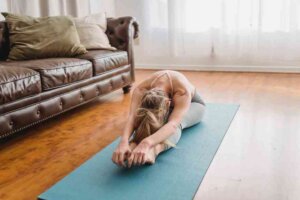
Forward bend stretch - image of young lady doing this in front room, head touching her knees
Photo by Marta Wave via Pexels

The more actively the feet are stretched on themselves, the more the hamstrings are stretched. Do the exercise for about a minute statically. Then do 10 active tilts with even back, touching the feet with your hands.

Then we bend one leg on the passe. Pull the bent knee to the floor. We stretch out the hand of the same name with the bent leg upwards and go diagonally to the flat leg. That is, we stretch a little in a twist.

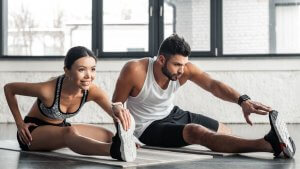
What exactly is hyperbolic Stretching? An athletic young man and lady stretching in the gym
Photo by VitalikRadko on Lightfield Studios

Do the same thing on the other leg.

Doing the stretching exercises you can stretch in a static position or a little “wobble”. But! Swinging should be as soft as possible and accompanied by correct breathing: do a small effort to exhale and relax on inhalation.

In addition to the patellar ligaments, we should stretch the front thigh surface. This is the most clogged area of the legs, because even when walking these muscles strain. A variety of forward impacts on both legs are well suited for this purpose:

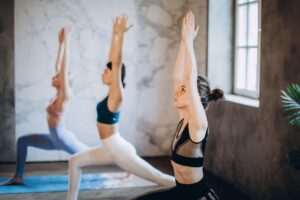
Lunging stretch by women in a dance studio
Photo by Elina Fairytale on Unsplash
  • put the right foot forward with the foot turned outward, keep the angle of the front knee at least 90 degrees;
  • we put the foot of the back (left) leg on a rise;
  • watch your posture – it must be flat, the blades must be together;
  • watch out for hips and shoulders – do not turn your hip to the side, and shoulders – be sure to keep it straight;
  • if it’s easy for you in this position, put your hands on the lower back and press the left thigh down slightly with your hands, you’ll feel exactly how the front surface of the left leg is stretched;
  • after – try to bend them back leg in the knee and pull it up with the same hand, you should feel it stretching in the front thigh area of the back leg.

After the preparatory exercises, try to sit on the longitudinal right twine. Remember to breathe deeply and relax.

Repeat the same on the second leg.

Preparation exercises for transverse split

Butterfly

Butterfly stretch - man doing the stretches outside
Photo by Scott Broom on Unsplash

Sit down evenly, conveniently place pelvic bones on the mat, bend the legs in the knees and spread the knees to the sides with a straight back. Foot are kept together. Sitting in this position (and always with a flat back) try with effort to open the knees to the side to the floor. Do such 10 pushes with the knees. Then put our hands back behind the lower back and do 10 more such knees movements. Try to do everything smoothly and without sharp movements.

Frog

As a preparatory movement you can make two variations of the frog: lying on the back and on the stomach.

The frog on the back will be suitable for those who have an assistant. Lie on the back, press the lower back to the floor and do not lift it while doing the exercise. Then bend your legs in your knees, putting your feet together. Spread your knees apart. A person who helps you can push your knees and thighs slightly to the side. Then move your feet a little further, i.e. make a corner in your hips a little more, and stretch in this position again. This is a static exercise, smooth, no need to do any jiggling or jerking.

If you stretch alone, try the frog on your stomach. We sit as if on a cross twine, but with bent knees, shoulders and chest serve a little forward, hands in front, if it turns out – hands on the forearms.

In this position, you can also make small smooth rolls back and forth. Then try to roll your hips back a little, screw your coccyx in and be in this position for another 10 counts.

Then smoothly align one leg and do rolling to back and forth. Change the legs and roll again.

After these preparatory exercises, try to sit on a transverse split and stretch it more.


Common mistakes when stretching splits

Mistake №1. When you stretch a longitudinal split, keep your hips level. Very often the hip of the hind leg turns to the side and does not let us stretch the twine to the end. Pay close attention to this during all the exercises for stretching longitudinal twine.

Mistake №2. Performance of preparatory exercises with a round back. Do not forget to straighten your back all the time. Smooth posture will ensure the most effective tension exactly where you need it. A round back does not allow you to exercise effectively enough.

Mistake №3. No warm-up of the muscles. Warm up your body before stretching practice. Do joint gymnastics, squats, plank. Unheated stretching is very traumatic!

Mistake №4 – to stretch out without strength training. Bark and leg muscles, which are in good tone, will be a great bonus for your stretching. Periodically make different curls on the press, plié squats, plank. Tonus in your muscles will help you achieve better stretching results.

FAQ

Can everybody do a transverse split?

There is an opinion that some people cannot do a transverse split because of the structure of the hip joint. Indeed, we are all different, and physiologically as well. It happens that it is much harder for some people to do the transverse split, but it does not mean that you can not do the split in principle. It’s just that you’ll need more time for that. For this, you will need to work actively on developing and opening the hip joint.

How do you do the splits in one day?

The main rule of stretching – do not try to do a split in one day. Stretching should be moderate and uniform, without jerks and strong painful feelings. Otherwise, you risk getting injured in ligaments. And it hurts and you will have to recover from this injury for a long time.

How to do the splits in a month?

How quickly you can do the splits depends on your level of training, genetics, intensity, and quality of training. In general, doing a split in a month is real. But we recommend not to chase for speed. It is better to reach the goal slower, but confidently and without injury. So you can not just do the split, but to be in it painlessly for a few minutes.

How do guys do the splits?

In stretching, it is more appropriate to consider the physiological specificity of the body rather than based on gender. As a general rule, stretching exercises are equally difficult for girls and boys. It’s just that guys often have more clogged muscles and it leads to difficulties with stretching.


Here’s some more articles about stretching:

couple dancing the milonga in an evening

Milonga Dance: The uptempo relative of the Argentine Tango

Milonga dance celebrates Argentine Culture. A ballroom dance sharing many characteristics with the better known Argentine tango and considered to be the forerunner to Tango. A fluidity gives dancers the opportunity to express the vibrant ...
Ballet feet exercise. Ballerinas feet warming up stretching

Ballet foot exercises

10 Ballet Foot Exercises: Warm-up, Boost Your Technique and Foot Strength Foot exercises are an essential part of a ballet dancer’s training as they provide important strength and technique benefits. Developing strong and flexible feet ...
Image of a lady stretching on an athletics track

Hyperbolic Stretching

Hyperbolic Stretching Hyperbolic stretching is a new type of stretching from Alex Larsson. It's been getting a lot of coverage lately on various websites, but it's also been met with skeptics. Let's review the facts ...


Cover photo: Photo by The Lazy Artist Gallery on Pexels