

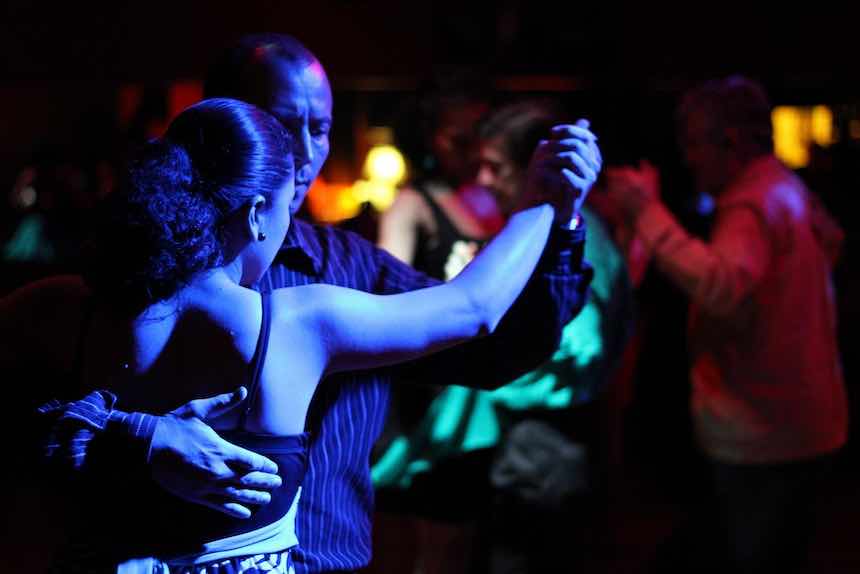
Milonga dance celebrates Argentine Culture. A ballroom dance sharing many characteristics with the better known Argentine tango and considered to be the forerunner to Tango. A fluidity gives dancers the opportunity to express the vibrant energy and flirtatious spirit often associated with the milonga music. This is a known for its playfulness and joy – as well as its complicated, intricate steps and movements.
Are you looking to find out more about the techniques and music of Milonga, its similarities and differences with Argentine Tango? Well read on!

History and origins of Milonga dance
The origin of the milonga dance is closely tied to the Afro-Argentine community. We’ll cover more about this in the ‘language’ section below – as it is an African word.
This period seems to have been less covered but we across this quote from Professor or Art History at Yale, Robert Farris Thompson, who noted “Tango started black, and milonga, the dance preceding it, even more so”.
In terms of its more widely covered origins, we trace back to The Río de la Plata, separating the cities of Montevideo and Buenos Aires – port cities, leading to ‘the pampas’ cattle ranches, as well as mining areas of the Andes. Because of this geography, international influence and nature of work, in the1870’s to 1900’s, the area had an influx of gauchos (cowboys), sailors, soldiers, stablemen – the lower classes of society.
Milonga was mainly danced by who mixed various global folk dances and dance at brothels and parlours, beginning as a walking dance and incorporating more sexualized movements, often ahead of the other activities taking place at these locations.
Hence milonga was frowned upon by the upper classes of Argentine society, to the point that you actually needed a permit to run dance around the city!
However, by the late 1870s, composers and singers began creating milonga songs, which contributed to its popularity and widespread adoption throughout Argentina.
By the early 1900s, milonga and tango became socially acceptable, even reaching craze status in fashionable European circles by 1915. It is believed that this started, in part, through wealthy families sending their sons on a coming of age, ‘grand tour’ to Europe.
There were events and gatherings, at which these travellers would share their dance the tango, vals (waltz), and milonga, began to attract a wider audience. These events, initially spreading through then beyond Paris to gain more popularity across Europe and in the mainstream.
During this period, there were also a number of European contributions to the Milonga. These include:
- The waltz, adding to to Milonga’s rotating movements and elegant flow.
- The polka helping shape Milonga’s rhythm and high energy.
- The mazurka, adding further sentimentality and drama
As milonga gained popularity, it started to merge with other dance styles like the Cuban habanera and flamenco, ultimately evolving to develop the Argentine tango that is known today.
Milonga is still celebrated, danced in classes, clubs and dancehalls around the world.
How to dance milonga
Getting the rhythm
First we need to get a grasp for the basic Milonga rhythm. It uses an upbeat 2/4 rhythm, with quick, syncopated steps. Listening to Milonga music and tapping your foot or hand to the beat is one way to get familiar with the rhythm ahead of taking any steps.
Next, focus on mastering the basic Milonga step patterns.
These include
- the salida (the basic walking step)
In this video, Ana Padron from Tangoforall.com says “think of a Salida as the period (or ‘full-stop’) at the end of a sentence. You can also see the steps described here
- the back ocho – steps that form a figure eight on the floor
- the forward ocho
Milonga often incorporates fun, theatrical elements like small lifts, jumps and kicks. On mastering the basic steps, dancers can start exploring these more advanced moves. Remember to keep your movements careful and controlled to avoid disrupting your partner or other dancers.
Partnership
The lead and follow dancers working in harmony is what creates a smooth, connected dance experience to the rhythm. Good communication between partners, and signalling movements using the leader’s chest, arms, weight shifts and body movements to signal show clear intention to the follower. Followers need to be attentive and responsive to these subtle cues.
Posture
A Milonga posture is upright. You ensure that your chest is slightly forward, and weight over the balls of your feet, with knees are slightly bent. The embrace in Milonga is often very close – similar to Argentine Tango.
Dance styles and techniques
The two primary dance styles within milonga are Milonga Lisa and Milonga con Traspie.
Milonga Lisa
Milonga Lisa, sees the dancer make steps on every beat, displaying smooth and continuous movements. It’s good for beginners to familiarize themselves with milonga dance, using simple moves
Milonga con Traspie
A more advance dance. Milonga con Traspie is more syncopated and intricate. Rhythmic changes, include shifting weight from one foot to the other and back again in double time, or three steps in two beats. This gives the dance energy, as do the additional techniques:
- Quebradas are breaks in the dance pattern where the couple momentarily pause or uses a different rhythm before resuming their dance.
- Cortes, are brief interruptions in the movement, here dancers can showcase creativity and skills in improvisation.


Similarities and differences between Milonga and Tango
Similarities between milonga and tango
Milonga and tango are both Argentine dances. They share a deep cultural and historical bond as they both originated from the The Río de la Plata area
Differences between milonga and tango
Music & tempo: Milonga is danced at a much faster tempo than tango, following a 2/4 rhythm. Tango is slower and more deliberate allows dancers to interpret the music through pauses, slow and quick movements and includes a variety of melody.
Movements: Milonga dance has faster, sharper and more flowing movements, with a more relaxed posture.
Embrace: Milonga dancing maintains a tighter embrace than tango, to support the faster, more intricate footwork required.
Milonga Music
Milonga music typically includes various instruments that are essential to its unique sound:
- Bandoneon: An often used, type of concertina. It’s similar to an accordion.
- Piano: providing harmony and syncopation.Often used in Milonga.
- Violin: adding and emotion to the music, playing both melodic and rhythmic parts
- Double Bass: a foundation for the music, adding depth and anchoring the melodic instrument
- Guitars showcase the dance’s connection to traditional Argentine and Uruguayan folk music
Musical Influences
The origins of milonga music can be traced back to a combination of musical genres and influences. This includes:
- Habanera, a Cuban dance rhythm that found its way to Buenos Aires in the late 19th century
- The vals (waltz) contributed to the development of the milonga style with its flowing and graceful melodic elements.
Famous Composers & Contributors to Milonga Music
Great musicians and composers have been central to the development of Milonga music and the dance style more broadly. Some of the most well-known contributors include:
- Ástor Piazzolla: A revolutionary Argentine composer.
- Carlos Gardel: Known as the “King of Tango,” but also very influential on the development of milonga music
- Aníbal Troilo: A significant composer, bandleader and bandoneon player bandleader during mid-20th century.
- Villoldo: known as the father of tango
Some others who made considerable contributions to the music include: Rodolfo Biagi, Edgardo Donato, Gabino Ezeiza, Juan D’Arienzo, Angel Vargas, and Roberto Firpo.
Some of the individuals notable in the transition from Milonga to Tango include: Francisco Canaro, Lucio Demare, Pedro Laurenz, and Domingo Federico. Carlos Di Sarli is famed for mastering both styles.
Milonga etiquette for the dance floor
Off to your first Milonga, fear not, here’s some tips to get started.
- Go with or arrange to meet a friend or partner. It will be much more fun to have someone to dance with. Once you become more familiar, you will be more likely to have opportunities to meet with other dancers.
- Instead of asking a stranger to dance and the potential for embarrassment this creates, in Milonga, use eye contact (“mirada” as in ‘mirror’) is made with a potential partner. If this is held, a slight nod of the head “cabaco” is made and, if returned, the leader will walk the follower to the dance floor.
- Dress to impress, think more fancy restaurant than club. Some events are more casual but as a rule you’re dressing up.
- Firstly, understanding the flow of the dance floor is essential, so you can enter the dance floor safely. Dancers follow the “ Ronda”, an imaginary line of dance by moving counter-clockwise around the room, allowing everyone to enjoy the space without causing disruptions. Ensure any approaching leader has seen you before moving into and maintaining space on the dance floor.
- During a Milonga, the music is organized in tandas, which typically consist of three to four tangos from the same genre or orchestra. It is considered proper to dance with the same partner for the entire tanda.
- At the end of each tanda, a short musical break called a ‘cortina’ provides an opportunity for dancers to change partners, rest or socialize.
- Leaders should be aware of their partner’s comfort, avoiding excessive force or uncomfortable body positions.
- If its getting hot and sweaty, bringing a change of outfits, like shirts for men and extra (but not overpowering) perfumes, mints and deodorants can be a good idea – after all, you’re up very close in a Milonga embrace!
- Thank your partner after each dance.
Famous Milonga Dancers
Want to see great examples of Milonga in action? Checkout these amazing dancers:
- Miguel Zotto and Daiana Guspero are prominent figures in the world of milonga dance.
- Angel Coria and Claudia Sortino are another example of celebrated milonga dancers. They are known for infusing their routines with humor and joy.
- Dani Garcia and Luna Palacios have significantly contributed to the milonga dance scene.
Milonga Meaning
As a word itself, Milonga has African origins, meaning ‘argument’ / ‘issue’ in Kimbundu or ‘lines of dancers’ in Ki-Kongo. Milonga is also a term with multiple meanings in the context of Argentine culture and dance.
Musical genre:
As a musical genre: “Milonga is an excited habanera.” Often the music accompanying the dance, with a related history.
Milonga dance:
As we’ve spent the last few minutes describing, dancers perform the milonga with smooth and gliding movements, intricate footwork and rhythm.
Milonga event:
Milonga is also a word describing a social event, where people dance. The styles danced also include the Argentine tango and vals. Attendees, known as milongueros, enjoy a night of dancing and socializing. Often the events are a relaxed and social affair with a sense of community.
Related articles:


10 Classical Spanish Dances
Conga Line: How to Conga at parties in 3 steps

Ballet foot exercises

Tango Dance

Samba Dance

Ballroom Etiquette: Basic Guidelines for Dancers
Why not check out our article on Conga lines too.
- About the Author
- Latest Posts


Professional Dancer, Dance coach. Favorite dance style – Pole Dance. Favorite Move – Sword Simakhina. A graduate of Saint Marys. Former Chief Editor and Owner of DanceBibles.com